

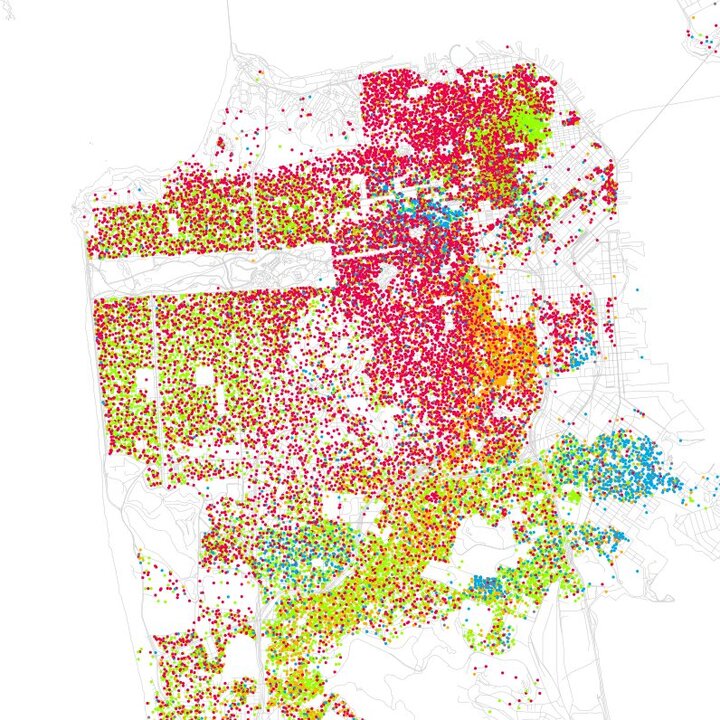
Michael The population in San Francisco is quite diverse. As I've mentioned before in Rundbrief 07/2005, 44% of the population here are white, 31% asian, 14% latino, and 8% black. The map in Figure 2 shows that members of an 'ethnicity' often concentrate in specific neighborhoods. It should come as no surprise that mainly asians settle in Chinatown and that predominantly whites live in affluent neighborhoods like ours in Noe Valley. The latinos (mainly South Americans) mostly live in the Mission district. In the southern part of the city, there are somewhat more affordable areas where, interestingly, a very balanced mix of skin colors can be found. The blue centers on the map with predominantly black populations are the neighborhoods of Tenderloin, Hunters Point, and Sunnydale, which are unfortunately partly known as social hotspots.
When you meet a person for the first time and have never seen a picture of them, most people inevitably have already formed a mental image: male or female, old or young? If the person doesn't have an exotic name, in Germany you wouldn't even think about their skin color, as it would almost certainly be white.
In the USA, most people tend to infer the origin of a person they have never seen before based on their first and last names. A "Tim O'Reilly" is almost certainly of Irish descent, a "John McLaughlin" is either Irish or Scottish. A "Joshua Rosenzweig" is of Jewish descent, a "Jessica Chang" is usually Chinese, a "Srivasan Venkataraman" is Indian. A "Manuel Rodriguez" typically comes from South America, a "Latisha Smith" is most likely an African American, and an "Eric Schmidt" could be a third-generation German immigrant.
This inevitably leads to interesting questions, for example, during the hiring process in a company: In the USA, resumes do not include a photo to prevent discrimination based on appearance. However, a candidate's origin often becomes apparent through the first or last name, raising the question of which first names parents from disadvantaged communities should choose for their children to boost their professional careers. Should they opt for a more traditionally white name like "Greg" or "Britney," or follow tradition with names like "Rigoberto" or "Guadalupe" in the latino community, or "Tyrone" or "Latisha" in the black community?
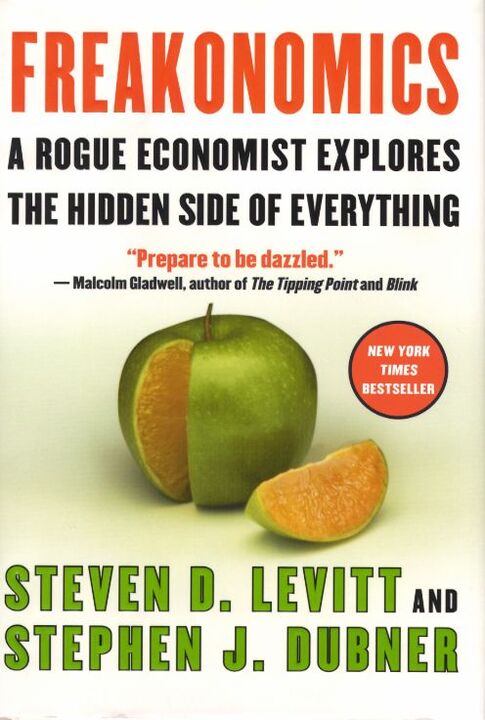
The authors of the bestseller "Freakonomics" (already discussed in Rundbrief 09/2005) report that for several years now, it has been found that first names alone cannot be directly linked to success or failure in life in a causal way. However, it has been proven that the Tyrones and Latishas of this world perform worse than the Gregs and Britneys. Why is that? According to Freakonomics, the reason lies more with the parents and the environment: someone who names their child Tyrone or Latisha often lives in a problematic social environment and is often less strict about checking homework compared to the parents of Greg and Britney.
As is often the case with stereotypes, it can happen that you are completely off the mark. The comedy series Seinfeld poked fun at this topic a long time ago. In one episode, Jerry Seinfeld is very excited because he has a date with a "Donna Chang," whom he only knows from the phone. He assumes she is Asian, but is later completely surprised when his new acquaintance turns out to be white.