
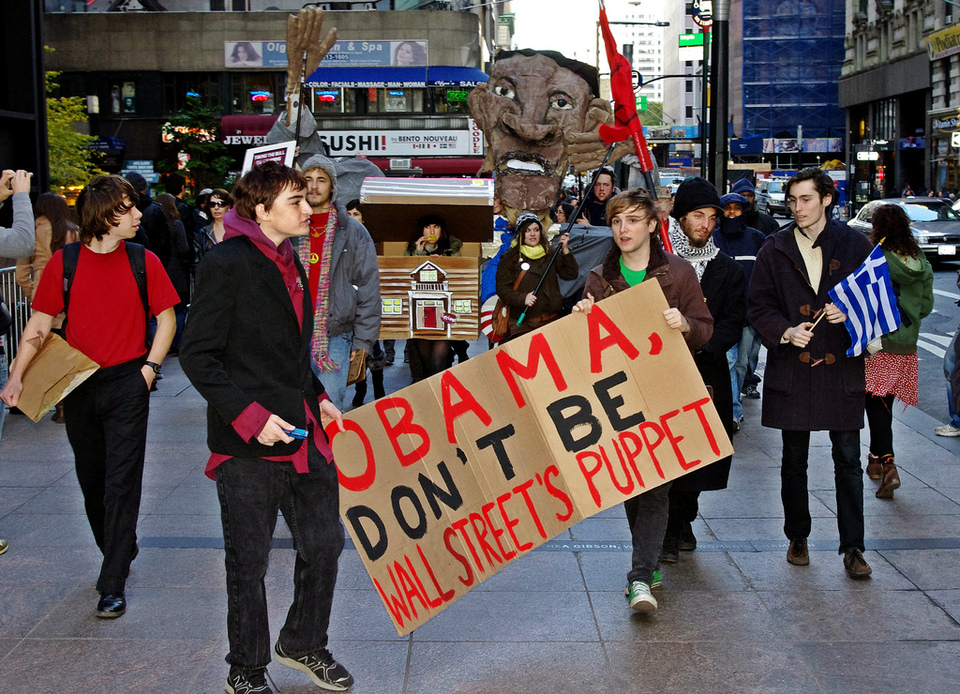
Angelika Surely you have already heard of the American protest movement "Occupy Wall Street," which began in New York and spread like wildfire to several American cities--eventually, its offshoots have even reached Germany. I've seen this coming for a long time, for people in the USA to finally taking to the streets, as the gap between rich and poor is particularly wide here.
Private wealth is particularly unequally distributed here, and social achievements such as jobs with legally regulated and paid vacation and sick days, as well as reasonable unemployment and health insurance, leave much to be desired compared to other Western countries. However, so far, everyone seemed to hold on to the dream that they too would eventually break away from the masses of the 99% and belong to the 1% of the super-rich. Interestingly, the protests were initiated by the right-leaning Tea Party movement. They criticized the financial bailouts following the housing and banking crisis, as well as Obama's push for universal healthcare. Many see the Tea Party movement as a protest from the right and the Occupy Wall Street action as the counter-movement from the left.
The glaring difference, however, is that the Tea Party supporters wanted to be involved in politics from the very beginning and now play a significant role in the American Congress. They even influence the upcoming presidential election, while the Occupy Wall Street group tends to keep its distance from political parties. In my opinion, this is a big mistake, as I fear that the entire movement might eventually dissipate. Overall, they make few concrete demands. The common denominator seems to be opposition to big banks, which is somewhat short-sighted, as the misery of the ongoing economic crisis is much more complex and cannot be solved by closing accounts at Bank of America or Wells Fargo Bank.
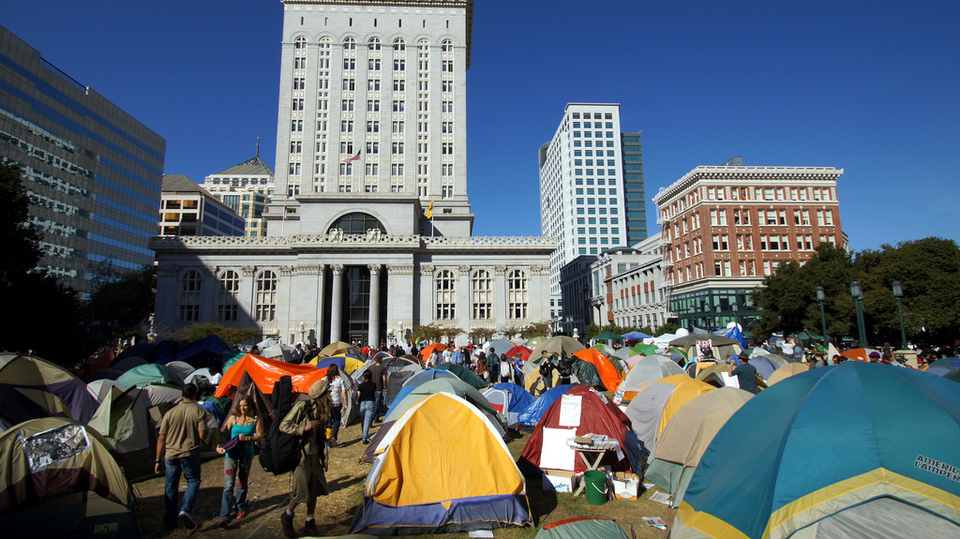
Interestingly, Oakland, the city on the other side of the Bay Bridge that always stands somewhat in the shadow of San Francisco, has surpassed San Francisco in terms of the protest movement. "Occupy Oakland" is receiving a lot of attention from the press, and not just since one of the movement's sympathizers died in a shooting, which was likely the result of a personal dispute. The protesters are still camping in tents in front of Oakland City Hall and managed to shut down the Port of Oakland during a large demonstration in early November, which catapulted them into all TV channels. However, the tents are supposed to disappear in the coming days, as Mayor Jean Quan is increasingly under pressure. After the square in front of City Hall was cleared by the police once before, she allowed the protesters to settle again in their tents on Frank Ogawa Plaza.
However, the medium-sized businesses and residents around town hall have had enough. They claim that no one dares to come to downtown Oakland anymore and their business has dramatically decreased. Quan hoped that the protesters would voluntarily leave. However, it was reported this morning that riot police had cleared the square.
In general, it remains exciting to see what will become of the movement in the various cities. To gain sustainable influence and bring about change, it seems that protesters would need to get involved in the political process. I have been saying for years that the USA urgently needs a more diverse party landscape, and much of the narrow-mindedness lies in the currently existing two-party system.