

Michael Inexperienced German tourists coming to the U. S. are often surprised when a T-shirt priced at $9.99 suddenly costs $10.84 at the checkout. The difference is due to the sales tax levied by the respective county. Similar to how Germany uses value-added tax (VAT), the state uses this trick to tax already taxed income again. And just like in Germany, the seller is merely an intermediary, passing the tax collected from the customer to the tax man without benefiting from it themselves. Unlike in America, it would be illegal in Germany to add VAT for end consumers only at the checkout; the price on the label already includes VAT. Americans find it normal for the checkout to add an odd amount.
You read it correctly before, the sales tax rate varies from county to county. If I buy a T-shirt for $9.99, it costs $10.84 at the Macy's store in Union Square in downtown San Francisco because the tax rate in San Francisco County is 8.5%. However, the Macy's at the Serramonte Shopping Mall in South San Francisco (20 km south) only charges $10.81 because South San Francisco is in San Mateo County which sets the sales tax at 8.25%. While this may seem irrelevant to you, a man like me has to count every penny.
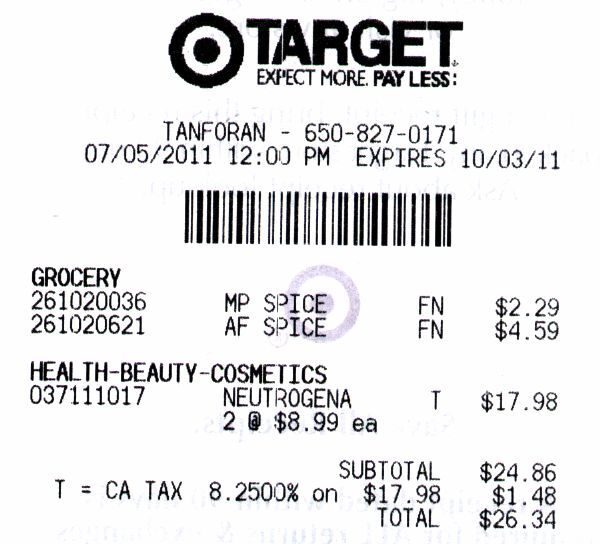
In Figure 2, you can see that I bought two spices and two bottles of sunscreen at the supermarket "Target." Spices are tax-free, whereas sunscreen is taxed at the usual rate of 8.25% in South San Francisco. And that's not all, if you look into the regulations on sales tax which define what items are subject to sales tax and which are not, the typical American bureaucracy madness comes to light, which people in Germany know nothing about.
In California, sales tax is typically not charged on groceries. However, if a supermarket or bakery sells hot food and the customer consumes it on a wooden bench in front of the store, the store must charge and remit taxes as if it were a restaurant. The cashier at our local "Whole Foods" once asked me if the leek on the conveyor belt was intended for immediate consumption. I vehemently denied it to avoid having to pay tax on the leek!
The different sales tax rates are calculated from the base rate for California (7.25%) and the rate added by the county. For example, San Francisco County charges an additional 1.25%, while South San Francisco in San Mateo County settles for 1%. According to state regulations, the maximum allowed sales tax rate for California is 9.75%. The county can therefore add a maximum of 2.5% to the state's base rate. Two counties in the Los Angeles area are going to the limit: Stores in Pico Rivera and South Gate would charge a straight $10.95 for the $9.99 T-shirt!
Each state sets individual percentages for the base rate and the maximum percentage. Alaska, Delaware, New Hampshire, Montana, and Oregon do not impose any sales tax at all and also prohibit their counties from doing so. Additionally, the tax is only applicable if the goods are 'consumed' in a taxable state. Also, a customer does not have to pay sales tax on an iPod purchased in the state and delivered to California if they immediately send it as a gift to their ungrateful nephews in Germany.
When it comes to the previously mentioned small amounts of sales tax when buying a T-shirt, hardly anyone cares, but if an LCD TV suddenly costs $1,097.50 instead of $1,000, the average consumer starts thinking and finds ways to bypass the $97.50 tax owed to the state of California. The easiest way: order online from Amazon. (Correction: However, that loophole has been closed since 2012).