11/28/2025   English German

Previous
edition
  Edition # 160  
San Francisco, 11-28-2025
Next
edition


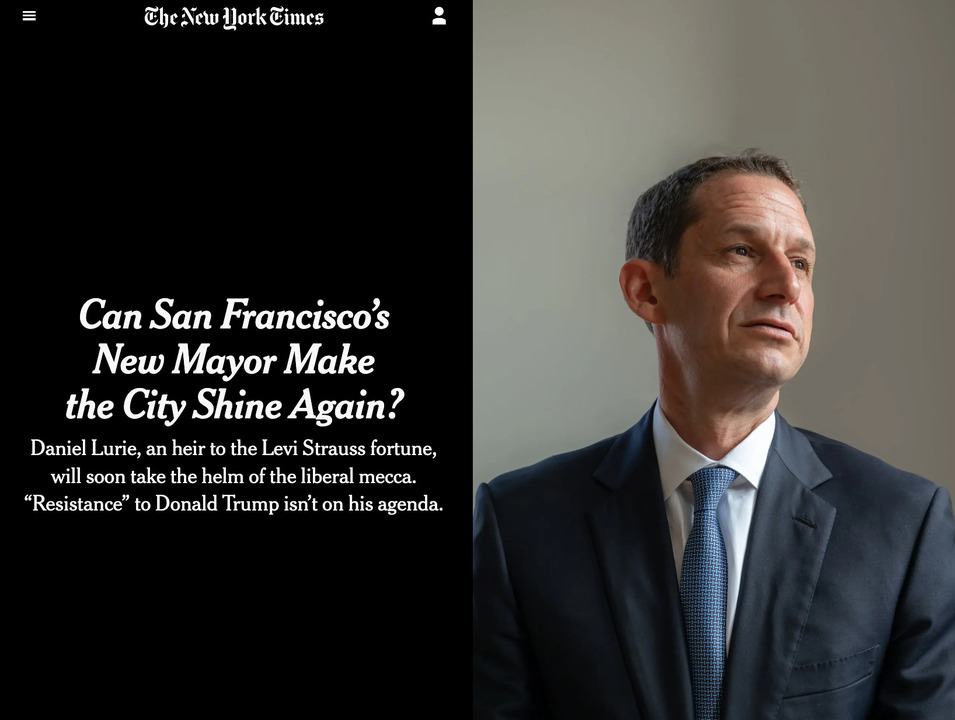
Figure [1]: Even the well-known newspaper, The New York Times, dedicated an article to Mayor Lurie.

Angelika I'm a big fan of our new mayor, Daniel Lurie. As attentive newsletter readers know, he surprisingly won the city election as an underdog in November (Rundbrief 10/2024) and has now been in office for almost a year. Nowadays, people hardly have any expectations of politicians, but I must say, the man is doing a really good job so far. With his calm, thoughtful, and pragmatic manner, he often finds a reasonable middle ground. According to the latest surveys, 71% of citizens agree with me and say they are satisfied with his work. An astonishingly high approval rating in a city where everyone loves to endlessly debate and many are convinced they know everything better.

Figure [2]: Drug addicts are still hanging around downtown, but there are fewer of them.

You can really tell that Lurie genuinely cares about San Francisco. What I find particularly pleasant is that he doesn't constantly put himself in the spotlight and doesn't engage in low-level exchanges with Trump on the platform X, like some other politicians do. On the contrary, he was even able to convince Trump not to send the National Guard to San Francisco because the city itself has initiated measures to improve public safety. The tent cities on the sidewalks have visibly decreased, and open drug use is declining because drug dealers are being arrested more consistently, and more pressure is being put on drug addicts to accept help such as withdrawal and therapy. The dirt is piling up a bit less in certain corners. I was really amazed recently when I entered the subway station at 24th Street; the forecourt was sparkling. And the typical urine smell that usually greets you there was completely absent.

Figure [3]: Powell Street at the cable car line was spotlessly cleaned.

Lurie has also set out to straighten out the bureaucratic madness so that things can be implemented more quickly, such as making more beds available for the homeless. Of course, many problems cannot be solved overnight. The number of fentanyl deaths remains alarmingly high (in October alone there were 27 deaths), and downtown is recovering very, very slowly from the effects of the pandemic. Still, there's too many empty shops, too many abandoned offices, too little life on the streets downtown. Here, too, Lurie is trying to counteract and help smaller businesses in particular by reducing bureaucracy and fees. It is said that Lurie is out and about in the city every day, engaging in conversations with residents, listening to their concerns and suggestions. I'm waiting for him to stop by us in Noe Valley, because I would also like to have a chat with him.

Figure [4]: Many homeless people have moved away from the city center.

San Francisco has always been a city that continually reinvents itself and must keep doing so. This began with the gold rush and continued after two major earthquakes in 1906 and 1989, through the AIDS crisis, the bursting of the dot-com bubble, and finally the pandemic. At the moment, it almost feels as if the city is experiencing a small renaissance. Self-driving taxis are zipping futuristically through the streets, new ideas are emerging, and many residents are once again looking at their city with optimism. And as we know, such optimism is a bit contagious.

Delivery Services and Grubhub Lurkers

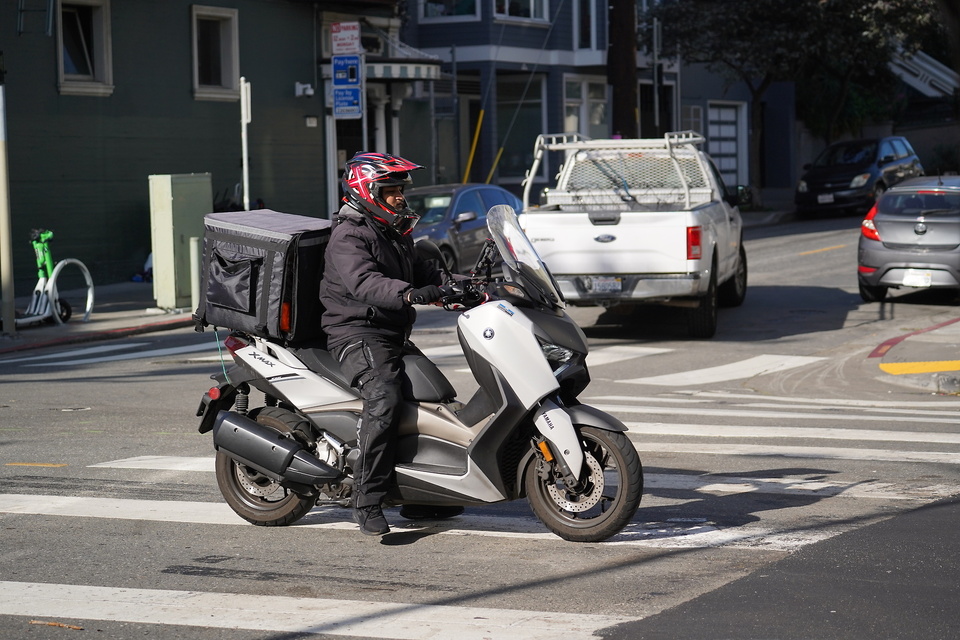
Figure [5]: Delivery service moped men are racing all over the city.

Michael I can tell that I'm really getting old by the fact that I just can't wrap my head around why someone would order food from a delivery service. For people from the Millennial or Gen-Z generation, it seems completely normal to have lukewarm food delivered to their unventilated rooms at exorbitant prices. A sandwich shop owner once told me that he sometimes sees people sitting in their rooms in houses across the street, ordering a sandwich from him via an app and having it delivered 20 meters across the street for a three-dollar fee.

Figure [6]: Doordash, Grubhub, Caviar are all different delivery services.

Figure [7]: A Grubhub lurker is hanging out in front of a restaurant.

At the end of the nineties, just as we had arrived in San Francisco with a bang, bike couriers were considered hot shit. Back then, they were less associated with delivery services, but the internet wasn't as fast as it is today, and companies often had to send important documents or data carriers from location A to location B. In cities with hopeless car traffic like New York City or San Francisco, bike couriers stepped in, daringly weaving through the standstill of rush hour traffic to transport items in grotesquely large flat bags across the city.

Figure [8]: Often, the Grubhub scooter guys hang out at trendy restaurants.

The image of the well-trained, tattooed long-haired person who disregarded conventions, fearlessly zipping through the streets of the megalopolis, riding up in the elevator in their outlaw attire along with their bicycle, to the executive floors and their suit wearers, had a coolness factor of over 10,000 and inspired many followers.

Figure [9]: Grubhub guy with typical puffy sleeves and always on the phone.

During the Covid era, delivery services became fashionable because sitting in a restaurant suddenly became very out of style. Since bicycle couriers were either too slow or couldn't transport ten cubic feet of food, daring riders of Vespa-like smelly mopeds or couriers on illegally souped-up electric bikes stepped in to fill the gap. This industry has long been established in major cities of the third world; in Bangalore or Delhi, moped men also weave through the streets to deliver warm meals or drinks to their masters.

Moped men can be recognized by their handlebar muff sleeves (illustration 9) and the grotesquely large (about ten cubic feet) warming boxes in which they transport the lukewarm mush around. Interestingly, this job is often done by either Latin Americans or Indians. They race through the dense traffic, dressed in arctic grade puffball jackets, and, like madmen, weaving recklessly through standstill traffic. Often, they don't pay attention to traffic but instead keep staring at their phone, which is attached to the moped's handlebar, sometimes even typing on it, probably to arrange the next delivery.

Figure [10]: Grubhub driver picks up an order from a restaurant.

I often observe the lukewarm mush couriers loitering on their delivery mopeds in front of trendy restaurants, where our hipsters apparently prefer to order their food. At this point, the couriers, still inactive, sit on the saddles of their propped-up mopeds, bored, tapping away on their phones and waiting for an order to come in through delivery services like Grubhub, Doordash or Caviar, so they can quickly accept the job on the app. Then they dash into the restaurant, receive the meal packed in boxes and plastic bags, and hop on their moped to speed away. Depending on the hipness of a restaurant and the time of day, it can happen that half a dozen couriers are sitting in their saddles in front, tapping away on their phones. Bizarre!

Figure [11]: Always on the phone, even while driving, very important.

As I said, for me personally, a delivery service would only be interesting in exceptional circumstances. For example, if I had a contagious disease and couldn't leave the house because of unsightly pustules on my face. In all other cases, I would prefer to pick up the meal myself, or cook something nice, or we would just go to a restaurant. But, hey, to each their own, not the same for everyone!

"Government Temporarily Closed"

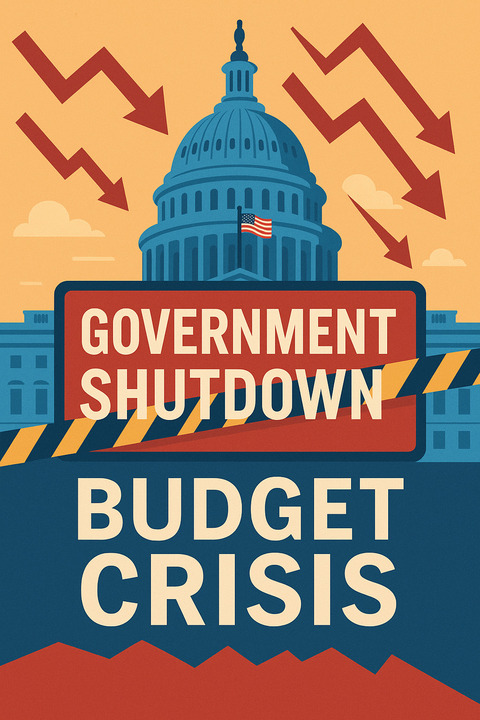
Figure [12]: The government cannot find a budget compromise and shuts down.

Angelika Since October 1st, I've sometimes felt like living in a banana republic. The ladies and gentlemen politicians in Washington couldn't agree on a new federal budget in September and therefore went home in a huff, while we citizens were left in the lurch. Without an approved budget, federal spending was frozen, and the US administration was operating on a low flame. Offices and agencies closed or offered only severely limited services.

Figure [13]: At the airports, many flights were canceled.

Many government employees were sent home without pay. Others, responsible for essential services or security--such as air traffic controllers--had to continue working, albeit without pay. Naturally, this greatly upset many, and sick leave reports increased sharply. Some even sought side jobs, such as package delivery drivers for Amazon. This is because many people in the USA have little savings, live paycheck to paycheck, but their expenses remain the same, regardless of whether the government shuts down or not.

Figure [14]: National parks had to close during the shutdown.

How did this so-called "Government Shutdown" come about? The U.S. budget must be passed by both the House of Representatives and the Senate. In the Senate, it requires 60 out of 100 votes. More precisely, it needs 60 votes to end the so-called filibuster in the Senate. The filibuster is a strategy used by the opposition to prevent or delay a vote through prolonged speeches. Although the Republicans currently hold a slim majority in the Senate, they only have 53 votes, meaning they needed votes from the Democrats to pass the budget. However, the Democrats refused to give their approval because they demanded that the budget include funds for federal subsidies for Obamacare insurance premiums. These subsidies are officially set to expire at the start of the new year, which would mean significantly higher premiums for many citizens who are insured through Obamacare.

Figure [15]: Members of Congress could not
agree on a budget.>

This brings me back to my series "What is difficult in the American political system and urgently needs to be changed?" In many other democracies, the old budget remains valid until a new one is passed to ensure stability. The legal basis for the entire drama in the USA is the so-called Antideficiency Act. This law, which dates back to the 19th century, prohibits federal agencies from spending money or paying employees if Congress has not passed a budget. However, it was not strictly enforced until 1980, and expenditures continued to be paid regardless. However, then-President Jimmy Carter's Attorney General put an end to this practice and decreed: Without a budget, the money flow is cut off. Since that time, "government shutdowns" have occurred repeatedly. However, they have become more frequent and last longer in recent times because, in times when no one can agree or make compromises, they are used as a political pressure tool.

In the population, it is understandably not well-received when their own government no longer works for the citizens, even though the members of Congress and Senators are paid with their tax dollars. Often, the party considered to be the driving force behind the "shutdown" is punished in later elections. By the way, members of Congress and Senators continue to receive their salaries, as stipulated in Article 1, Section 6 of the U.S. Constitution. It's no wonder that some people wonder why there aren't larger protests. Since 2019, government employees have at least been guaranteed back pay for their unpaid salaries once the shutdown is over.

Figure [16]: The park "Crissy Fields" in San Francisco is federally owned and was closed during the shutdown.

After 35 days of shutdown, the votes of eight Democrats helped to pass the provisional budget, although without the assurance of Obamacare subsidies. By the end, air travel was already severely affected, as many flights had to be canceled due to a lack of air traffic controllers. This caused unrest among many politicians, including Republicans. Thanksgiving was approaching at the end of November, as it does every year, and traditionally, it feels like every American flies home to see their family. It is the most sacred of American holidays, and no one wanted to risk incurring the full wrath of the citizens.

Figure [17]: Not even SNAP food stamps for the needy were issued.

Some government employees lined up at charitable organizations to help with food distribution, and when these images circulated in the press, the pressure increased. Then there was the back and forth regarding food stamps, called SNAP (Supplemental Nutrition Assistance Program), for people living at the subsistence level. Initially, the payments were halted, but they were reinstated under pressure. Now, the provisional budget is going to be in effect until the end of January 2026, and then another vote will be necessary.

King of the Asian Markets: "H Mart"

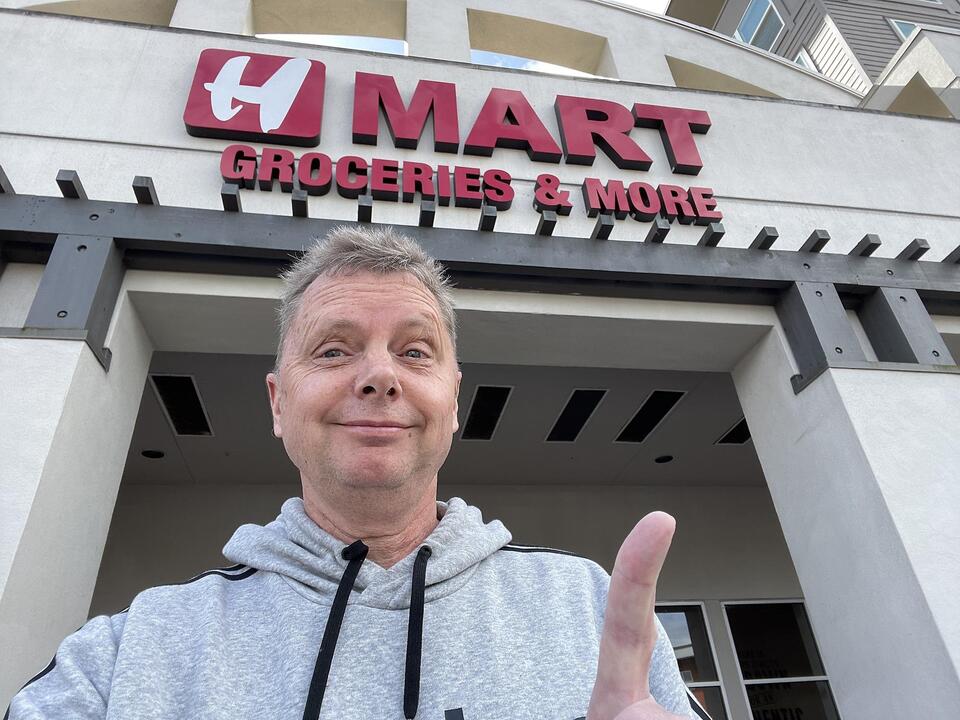
Figure [18]: The intrepid newsletter reporter in front of the H-Mart in San Francisco.

Michael If there has ever been a comparable hysteria about a new store in San Francisco as there was back in 2000 about the then-new Ikea in nearby Emeryville (Rundbrief 08/2000), then it was the hype around the branch of the Korean food giant "H Mart," which opened its doors in 2024 in the Ingleside neighborhood on Alemany Boulevard.

Figure [19]: Rich selection of Korean specialties.

There are already several excellent supermarkets for Asian groceries in our city, which is not exactly lacking in international gourmets, but the chain "H Mart" is like the Berlin-based department store KDW, only for Koreans, and it often holds childhood memories, as described in the book Crying In H Mart", which I have read and found to be okay, but I do not want to praise it highly in front of the audience on this popular forum.

Figure [20]: Even books have already been written about H Mart.

Now, H Mart is Korean, and accordingly, the store carries about 47 different types of kimchi (spicy Korean fermented cabbage) and other delicacies like bulgogi (thinly sliced beef in a spicy sauce) or chicken feet marinated in barbecue sauce.

Figure [21]: Specialty at H Mart: Marinated chicken feet.

But the range also includes fresh Japanese udon noodles or canned coconut milk or spicy curry pastes, which I like to use for my now-legendary red Thai curry. It also has a fish counter, or Japanese mushrooms, or other hard-to-find ingredients like lemongrass or Thai basil. Simply everything you need to cook Asian dishes at home, perfect!

Figure [22]: Blue-tinted chickens are considered a delicacy.

The selection of sushi also makes most stores that offer supermarket sushi look like 2nd class. Whether it's monkfish liver, unagi (cooked eel in teriyaki sauce), or uni (sea urchin), everything is very well made. I visit the store about once a month and have now become quite familiar with the aisles of more exotic ingredients. The store is spotless and offers extremely fresh goods at normal prices. Slightly more expensive than other Asian grocery stores, but also more on the ball, definitely worth the extra cost.

Low Rider Parade in the Mission District

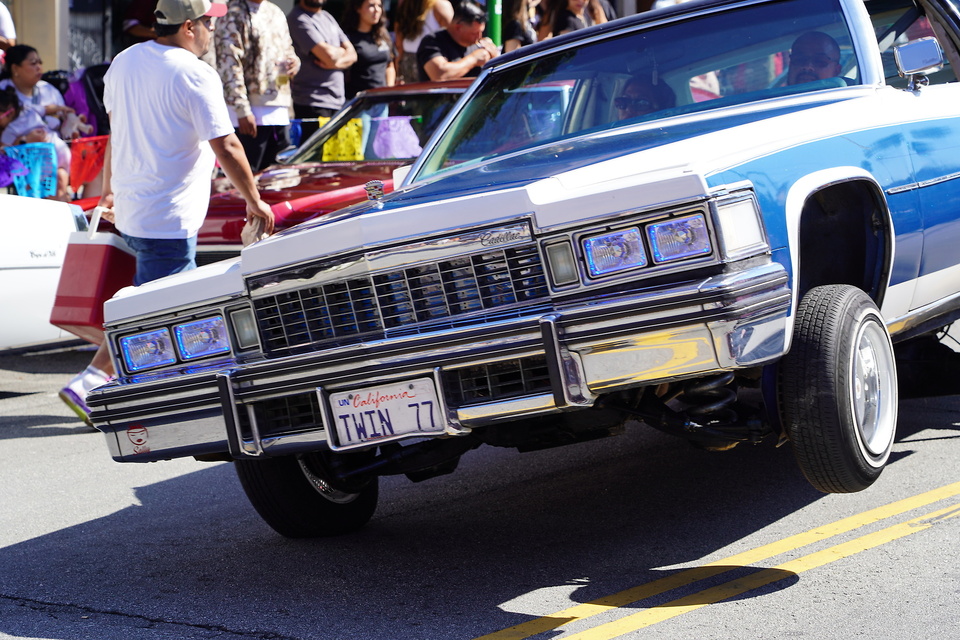
Figure [23]: Low riders jump sideways at the push of a button.

Michael One of the most exciting details of our nearly 30-year residence in the city of San Francisco is still the fact that I only have to walk or bike half a mile down the hill from our neighborhood, Noe Valley, and I find myself in the "Mission" district, or in other words, the chaos of Mexico City.

Figure [24]: Hooray, the parade is starting!

In 1997, when we moved here, it wasn't entirely safe, because there were occasional shootings between rival gangs. However, that didn't stop me back then from exploring the neighborhood with a friend even after nightfall, although with my knees shaking.

Figure [25]: The hydrolics engineering in these cars is quite spectacular.

Nowadays, there is no longer any danger, but the foreignness remains: the bustling commotion, the chatter in Spanish everywhere, the somewhat casual attitude towards law and order. People might sell stolen goods on the sidewalk or grill sausages without a permit from the city; things aren't as strict down there.

Figure [26]: Member of the vintage car club visibly enjoys the parade drive.

Latin American residents of the Mission neighborhood also maintain their own traditions, such as the holiday on May 5th (Cinco de Mayo) or the "Carnival" (not unlike the German Fasching), but also in September, the parade of the so-called "Low Riders," souped-up, often lowered vintage cars that can sometimes jump at the push of a button thanks to adventurous hydraulic constructions.

Figure [27]: All eyes are on the hydrolic suspension in this car.

The models of classic American brands, lovingly maintained by enthusiasts over 50 and cherished in car clubs, can be admired by the audience at the roadside during the so-called "Low Rider Parade" when their owners, with pride-swollen chests, slowly drive down "Mission Street."

Figure [28]: Tough guys, almost like in Breaking Bad.

The participants view their souped-up cars as works of art in the venerable Latino tradition. Many years ago, the city of San Francisco even temporarily banned the so-called "cruising" on Mission Street, but in protest, car enthusiasts formed the "San Francisco Lowrider Council" in 1981 to legalize and promote the showcasing of these artworks. And in 2024, our Governor Gavin Newsom even signed a decree stating that the state of California officially recognizes cruising by stating it should never be banned again.

Figure [29]: Even pickup trucks are lowered.

A German TÜV car inspection employee would naturally have a fit of hyperventilation at such modified vehicles, but Californians are entirely unfamiliar with the concept of such regular safety checks; only emissions are regularly checked here, and classic cars are even exempt from these. I attended the event as a roving photojournalist for this issue, and it went off peacefully, just like in previous years. It was even https://www.youtube.com/watch?v=l2qavq3mjbo. Unbelievable, times live in!

Buyer Found for Our Apartment Building

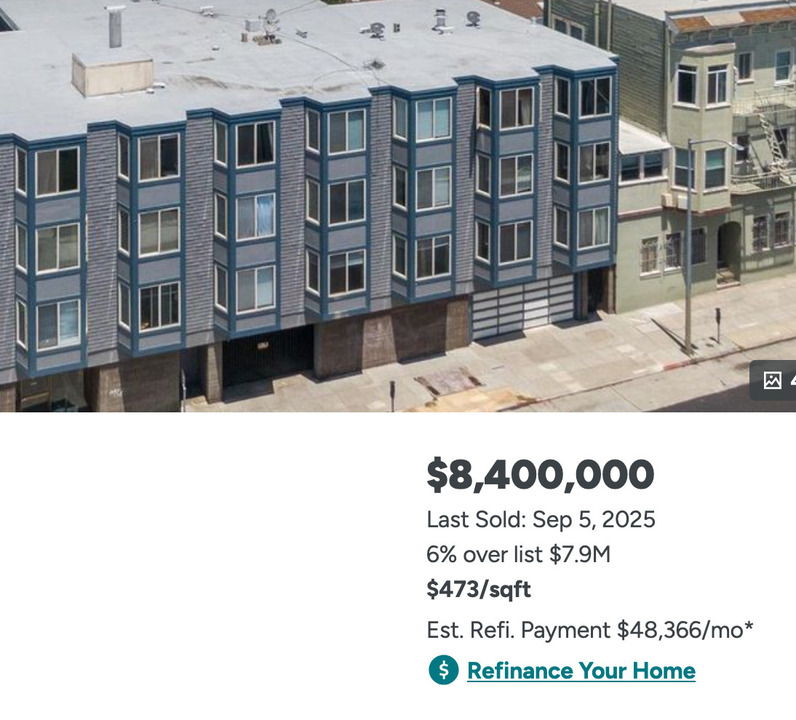
Figure [30]: Our apartment building was sold for 8.4 million dollars.

Angelika We were quite surprised at how quickly a buyer was finally found for our apartment building (Rundbrief 08/2025). In September, the deal went through, and everything was finalized. However, to this day, we have no idea who the buyer actually is. He has not made a single appearance. No introduction, no information, nothing. Instead, a property management company is now taking care of everything, from collecting rent to repairs and renovations of vacant apartments. It's quite convenient to finally have a reliable point of contact who knows what they're doing and has been handling things fairly promptly so far.

In recent weeks, various necessary improvements have been made as required by the city of San Francisco, which had been somewhat neglected until now. Smoke detectors are now installed in every room (except in the bathroom). Although we already had some before, there were significantly fewer. Now we have to be extremely careful that even harmless steam from cooking or blowing out a bunch of candles doesn't set off the alarm. Then, one day, diligent workers installed new connecting conduit with alarm boxes in our built-in closets, which are now connected to the central fire alarm system, just like the ones in communal areas like the stairwells. It is a requirement that the fire alarm in the stairwell must be audible in every room of the apartment.

Figure [31]: The old elevator sometimes gets stuck.

Our old elevator, on the other hand, still hasn't been modernized. With beautiful regularity, it gets stuck en route. By now, we know a few tricks to get it running again, like pulling the stop button and pushing it back in, or walking through the entire building to check on each floor if the elevator doors are closed.

Despite everything, I miss the personal contact with our old landlord Gus, who would always drop by from time to time and talk with us about everything under the sun.

Kennedy and Autism

Figure [32]: The CDC's website on the topic of autism

Angelika Anyone who knows me a little better knows that I have always worked with autistic children, both in Germany and in the USA. Right after graduating from high school, I did a year-long internship at the Heilpädagogische Bildungsstätte Altenoythe, where I encountered children with an autism diagnosis for the first time in my life. My later internship at the clinic for autistic children in Bremen (now called the Autism Therapy Center) also had a significant impact on me. At that time, the Bremen center was a leader in diagnosis and early intervention, and there I not only met a large number of children and adolescents with autism but also learned a lot about life in general. I still think about some of the children from back then today.

Although autism has been known for a long time and was already described in 1943 by Leo Kanner (early childhood autism) in the USA and by Hans Asperger (Asperger syndrome) in 1944 in Austria, much has changed over the decades. The number of people diagnosed with autism has increased significantly. Nowadays, people also refer to an autism spectrum disorder, meaning that autism exists on a continuum and manifests in a wide variety of forms.

Now everyone is arguing about how this recent increase in numbers comes about. I agree with the group of experts, also based on my own professional experience, who believe that it is mainly due to earlier, broader, and improved diagnostics and the fact that autism is now widely recognized, meaning that parents, doctors, and educators can identify it better. For example, the autism diagnosis in girls was often not considered because autism symptoms in girls often look a little different than in boys. So, autism is not necessarily more common today, but it is recognized more frequently. If there is anyone among our newsletter readers who is interested in its history, I can highly recommend the following book: "In a Different Key: The Story of Autism" by John Donvan and Caren Zucker. The book is very vividly and excitingly written. I am very surprised that it has not yet been translated into German.

The exact cause of how autism develops remains somewhat of a mystery despite intensive research, although it is now agreed that it is a complex developmental disorder with a strong genetic component. Simply put, one inherits the predisposition, but additional factors must come into play to trigger autism. There is not one gene or genetic mutation that causes autism, but rather likely a multitude of genes that, through a complex interplay with various other environmental factors (e.g., infections during pregnancy, complications at birth, older parents), that lead to autism.

Unfortunately, there have been and continue to be attempts to explain autism that are not based on facts. As recently as the 1970s, mothers were blamed for autism because they were supposedly cold to their children, and as a result, these children did not form bonds with them. Bruno Bettelheim, a well-known American psychologist, propagated this nonsense and caused a lot of harm. Then there was the persistent belief that the combination vaccine against measles, mumps, and rubella triggers autism. Andrew Wakefield, a British doctor, published a study on this in 1998 and advised parents against the vaccination. However, the study was later found to be fraudulent and has since been refuted by numerous studies.

Unfortunately, this has not yet reached our current Secretary of Health, Robert Kennedy. Initially, he announced that he would get to the bottom of autism within nine months, which, of course, did not happen. However, the well-known vaccine skeptic and opponent Kennedy couldn't resist and actually ordered the wording regarding vaccinations and autism on the official CDC website ("Center for Disease Control") to be subtly changed. Instead of continuing to explicitly assure that vaccinations do not cause autism, it now states that "Scientific studies have not ruled out the possibility that infant vaccines contribute to the development of autism". This just leaves me speechless. Not only is it unsettling to parents, but there is also the danger that autism research will be steered in the wrong direction again. Not to mention that we are already experiencing increased measles outbreaks in the USA because parents are no longer vaccinating their children. I had measles as a child because the vaccine wasn't available to us yet, and I can only say that measles is no picnic, and I would have gladly done without it.

The Most Controversial Bike Path In the World

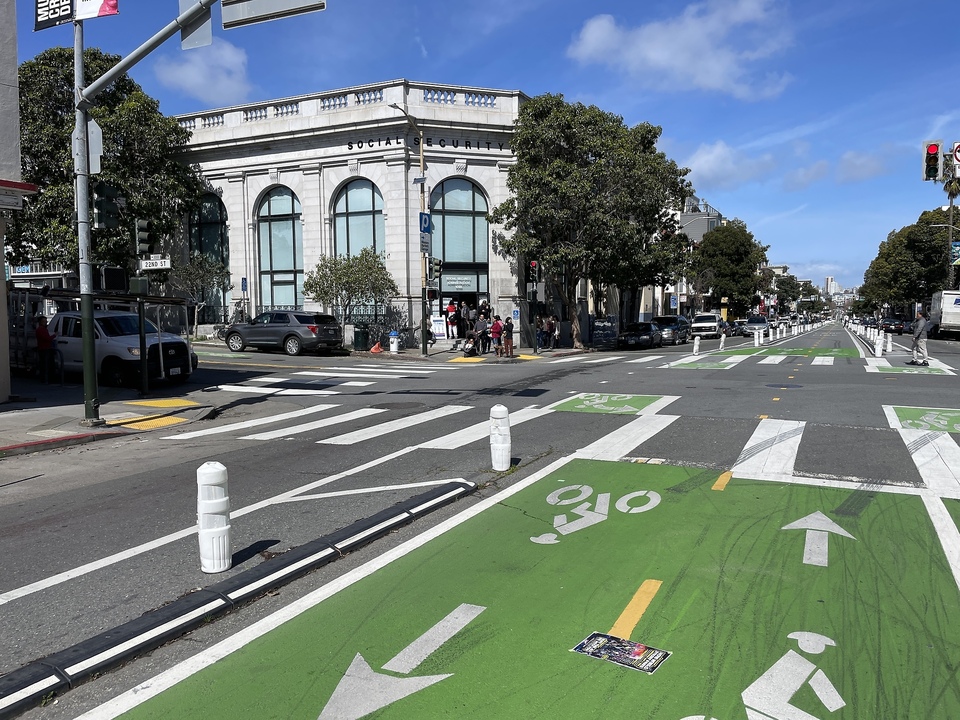
Figure [33]: Something different: A bike path in the middle of the street.

Michael After I was able to report some time ago about the most expensive toilet in America in our neighborhood Noe Valley (Rundbrief 10/2024), I continue in this issue with the most absurd bike path on planet earth. I need to first explain that "Valencia Street" runs through our neighboring district "Mission." Until a few years ago, it was a four-lane road with bike lanes marked on both sides.

Figure [34]: Michael enjoys the ride on the luxury bike path in the center of Valencia Street.

The city planners from the SFMTA (San Francisco Municipal Transportation Agency), in collaboration with local cycling groups, thought to themselves: "Today, we're going all out! We're eliminating two of the four car lanes, and all parking spaces, and will be building a fifteen feet-wide luxury bike lane in the middle of the street! That will teach those silly drivers a lesson they'll never forget, ha ha!" And since our tax coffers are brimming with funds for insane projects, a gigantic road construction site was quickly set up, and the project slowly began to take shape.

Figure [35]: The pub owner claims that he can now close up.

Figure [36]: The Mexican restaurant also thinks that customers are staying away from the establishment because of the center bike lane.

After the initial excitement about the new luxurious "Center Bike Lane," disillusionment soon set in. How does a cyclist make a right turn into a side street when there are still cars driving to the right of the bike lane? New confusing traffic light sequences were devised, and drivers were prohibited from making left turns along the entire route. Oh, and if only one lane per direction is open for cars, how does a fire truck on a call get past the cars stuck in traffic? No problem, the fire truck just drives on the bike lane in the center! Once, I was riding my bike there, and one of those typical giant San Francisco fire trucks (illustration 37) came towards me with flashing lights on the bike lane. I almost fell off my bike in shock.

Figure [37]: Typical fire truck in San Francisco

Figure [38]: Valencia Street: Masked rioters make noise.

And the bars and shops along Valencia Street also filed complaints. Allegedly, there were far fewer customers, probably because of the eliminated parking spaces. Personally, I appreciated the luxury bike lane in the middle, but when turning, I always had to be as cautious as a hawk to avoid being run over by a car. Additionally, some car and scooter drivers made left turns despite the ban, leading to some accidents with injured cyclists. And, of course, the bicycle highway attracted all sorts of riffraff, electrified aggressive cyclists, and even the so-called "dirt bikers" who are unfortunately common in the area, racing around illegally on off-road motorcycles without license plates.

Figure [39]: Construction workers couldn't care less; the city is paying for it anyway.

To cut a long story short, after a while, city officials decided to terminate the "pilot project," as they now called it, and again turned the street back into a permanent construction site to reinstall regular bike lanes on both sides of the road. However, since every 100 feet there now is a so-called parklet from some pub, covered wooden structures with tables and chairs for outdoor dining, cyclists now have to constantly zigzag, as the bike path winds in a completely crazy way around the little huts.

Figure [40]: The restored old bike path now zigzags along the edge of the roadway.

Figure [41]: The new bikepath even leads over ramps!

In the end, the old bike path now runs along the edge of the road again, albeit with huge cracks in the asphalt and massive potholes. For cars, the street still offers only one lane per direction, but a few parking spaces have returned, and generous striped no-go zones adorn the rest. The millions wasted on the pointless construction project won't come back, though, but at least the city has gained some experience. After all, it was all free money!

Greetings from Crazytown!

Angelika und Michael

RSS Feed
Mailing Liste
Impressum
Mike Schilli Monologues


Get announcements for new editions

New editions of this publication appear in somewhat random intervals. To receive a brief note when they're available in your mailbox (about once every two months on average), you can register your email on the 'usarundbrief' Google Groups list.

Your email address


All Editions:


Send us a comment
We'd like to hear from you, please send us feedback if you want to comment on the content or have suggestions for future topics.

Simply write your your message into the text box below. If you'd like a response from us, please also leave your email. If you want to stay anonymous, simply put 'anonymous' into the email field. This way we'll get the message, but we have no way to respond to you.

Your email address


Message

 
Contact the authors
Latest update: 03-Dec-2025