
Angelika Anyone who knows me a little better knows that I have always worked with autistic children, both in Germany and in the USA. Right after graduating from high school, I did a year-long internship at the Heilpädagogische Bildungsstätte Altenoythe, where I encountered children with an autism diagnosis for the first time in my life. My later internship at the clinic for autistic children in Bremen (now called the Autism Therapy Center) also had a significant impact on me. At that time, the Bremen center was a leader in diagnosis and early intervention, and there I not only met a large number of children and adolescents with autism but also learned a lot about life in general. I still think about some of the children from back then today.
Although autism has been known for a long time and was already described in 1943 by Leo Kanner (early childhood autism) in the USA and by Hans Asperger (Asperger syndrome) in 1944 in Austria, much has changed over the decades. The number of people diagnosed with autism has increased significantly. Nowadays, people also refer to an autism spectrum disorder, meaning that autism exists on a continuum and manifests in a wide variety of forms.
Now everyone is arguing about how this recent increase in numbers comes about. I agree with the group of experts, also based on my own professional experience, who believe that it is mainly due to earlier, broader, and improved diagnostics and the fact that autism is now widely recognized, meaning that parents, doctors, and educators can identify it better. For example, the autism diagnosis in girls was often not considered because autism symptoms in girls often look a little different than in boys. So, autism is not necessarily more common today, but it is recognized more frequently. If there is anyone among our newsletter readers who is interested in its history, I can highly recommend the following book: "In a Different Key: The Story of Autism" by John Donvan and Caren Zucker. The book is very vividly and excitingly written. I am very surprised that it has not yet been translated into German.
The exact cause of how autism develops remains somewhat of a mystery despite intensive research, although it is now agreed that it is a complex developmental disorder with a strong genetic component. Simply put, one inherits the predisposition, but additional factors must come into play to trigger autism. There is not one gene or genetic mutation that causes autism, but rather likely a multitude of genes that, through a complex interplay with various other environmental factors (e.g., infections during pregnancy, complications at birth, older parents), that lead to autism.
Unfortunately, there have been and continue to be attempts to explain autism that are not based on facts. As recently as the 1970s, mothers were blamed for autism because they were supposedly cold to their children, and as a result, these children did not form bonds with them. Bruno Bettelheim, a well-known American psychologist, propagated this nonsense and caused a lot of harm. Then there was the persistent belief that the combination vaccine against measles, mumps, and rubella triggers autism. Andrew Wakefield, a British doctor, published a study on this in 1998 and advised parents against the vaccination. However, the study was later found to be fraudulent and has since been refuted by numerous studies.
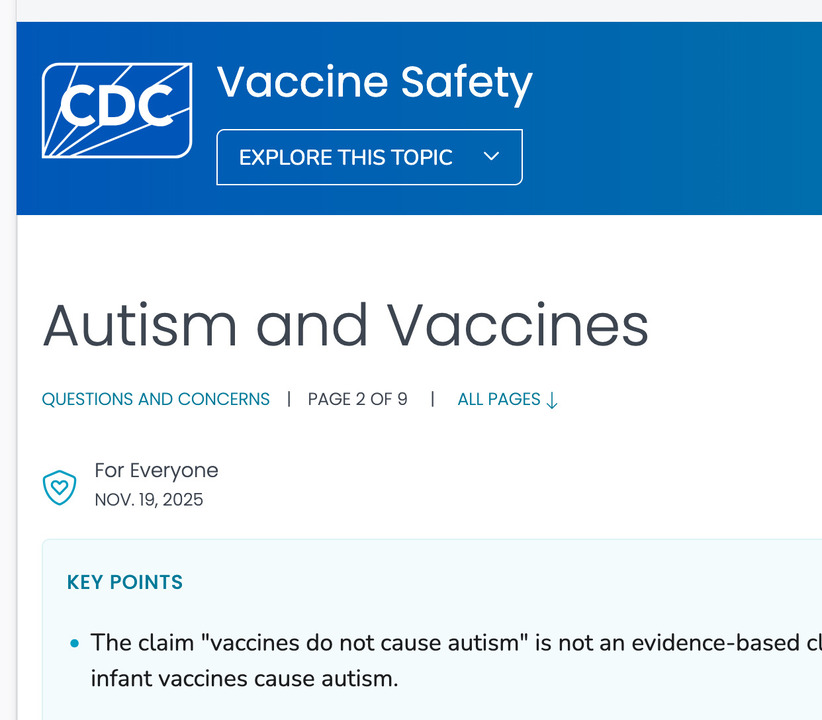
Unfortunately, this has not yet reached our current Secretary of Health, Robert Kennedy. Initially, he announced that he would get to the bottom of autism within nine months, which, of course, did not happen. However, the well-known vaccine skeptic and opponent Kennedy couldn't resist and actually ordered the wording regarding vaccinations and autism on the official CDC website ("Center for Disease Control") to be subtly changed. Instead of continuing to explicitly assure that vaccinations do not cause autism, it now states that "Scientific studies have not ruled out the possibility that infant vaccines contribute to the development of autism". This just leaves me speechless. Not only is it unsettling to parents, but there is also the danger that autism research will be steered in the wrong direction again. Not to mention that we are already experiencing increased measles outbreaks in the USA because parents are no longer vaccinating their children. I had measles as a child because the vaccine wasn't available to us yet, and I can only say that measles is no picnic, and I would have gladly done without it.