
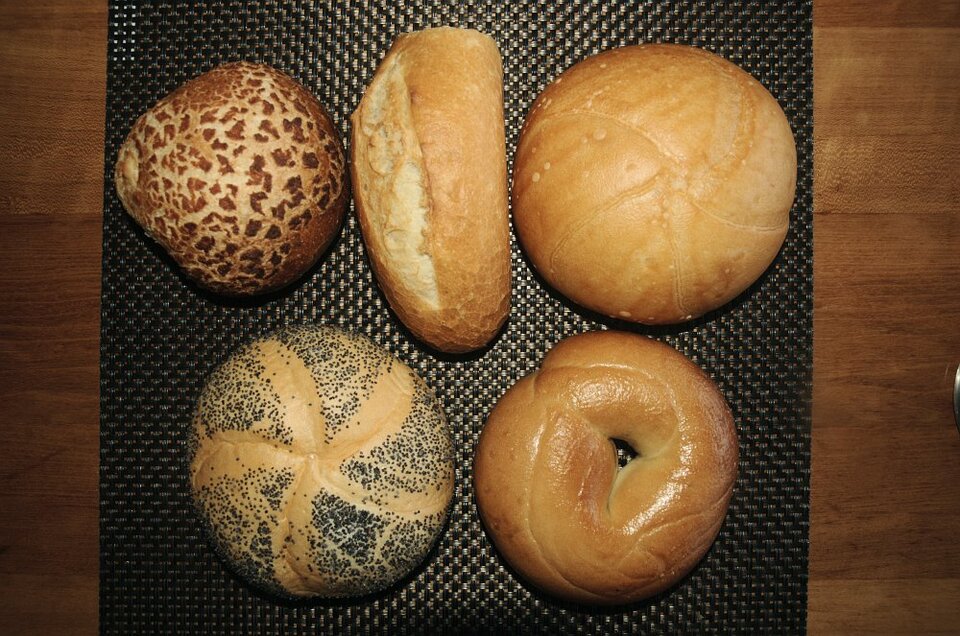
Michael In the realm of baked goods, America has completely lost touch with Europe sometime in the middle of the last century. Instead of normal oven-baked loaves, they switched to machine-produced "Wonderbread," a rubbery type of toastable bread. This unfortunate trend also made its way into the realm of rolls, and even if you find a pretzel at a fair, its "crust" is rubbery soft. When an American chews on German bread or rolls, they start to complain because the hard crust assaults their softened gums in an unfamiliar way.
Twenty years ago, it was almost impossible to find regular bread anywhere in America. Nowadays, however, every big city supermarket offers more or less decently baked baguette or Italian-inspired ciabatta. But beware, if you leave the metropolises and head out to the countryside, you're back to rubbery bread that still tastes somewhat empty even after extensive toasting and doesn't really fill you up.
Large supermarkets like Safeway offer a wide range of bread-like items that are sometimes baked fresh several times a day. The so-called Kaiser Roll is the most similar to the German "Semmel," but it is about twice the size and tastes like a white bread that is about two days old. Not bad if you can't find anything else. The elongated French Roll resembles a North German "Brötchen," but tastes more bland and dry. The dough of the Dutch Crunch Roll is the closest to that of the German "Semmel," and finely ground crust crumbs stick to its top, giving it a fine crustiness. Due to the funny crumb pattern, the term "Leopard Roll" became established in our household many years ago, and when I go to get rolls on Sundays, it's usually Leopard Rolls that end up on the breakfast table.
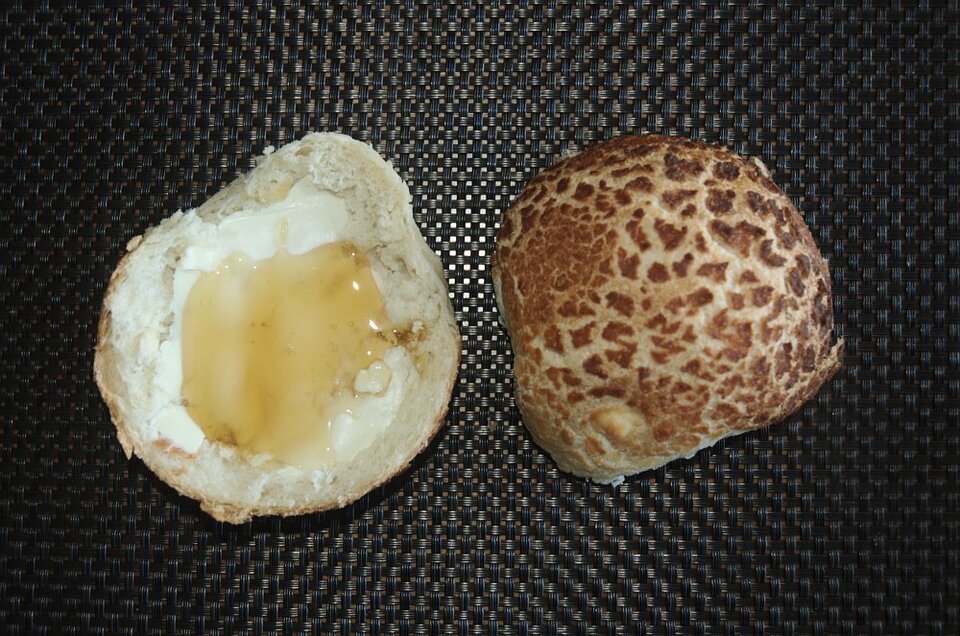
Unlike the German "Semmel," a Kaiser roll, by the way, retains its consistency in the bread box for a long time. Recently, I cooked a fine goulash soup on Thursday and looked for a "Semmel," but I only found a forgotten one from Sunday in the bread box. It tasted perfectly fine!
The bagel, on the other hand, is merely a misshapen pretzel. Instead of rolling out the dough properly thin and then twisting it into a pretzel shape, it is rolled out thick and formed into a ring. As a result, when baked, it doesn't become crispy like a pretzel but doughy like the thick part of an Oktoberfest pretzel. Machine-made bagels (the word derives from "beugen," meaning "to bend") look like a brown roll with a hole in the middle. The crust tastes like leather rinsed with Lenor. There is really only one form of an enjoyable bagel: you cut it in half, spread Philadelphia cream cheese on both halves, add salmon with onions, and perhaps capers, and then put the two halves back together. This is then called "Bagel with Lox" according to Jewish tradition, even though "Lachs" in English is actually "salmon."
"Another tip for good baked goods: As is well known, we often tour the wine region of Napa Valley and always stop in Yountville at the hipster place Bakery of the French restaurant 'Bouchon' to buy a so-called "Epi" baguette. This white bread costs only $2.50 and consists of individual segments that you can tear off with your bare hands, spread butter on, and enjoy with a light French red wine while engaging in animated discussions and gesturing wildly with your hands. By the way, the adjacent restaurant serves excellent food. For visiting Europeans, this might be less interesting, but if you've lived in America for a whopping 14 years, like we have, and only get delicacies like tongue, liver, and blood sausage on your plate every leap year, you're happy to spend around 200 dollars at this place for appetizers, main courses, desserts, and suitable wines for two people from good old Europe.