
Michael Even after 13 years in America, I still can't make sense of the Fahrenheit scale for temperatures. Well, by now I know that a thermometer shows a body temperature of 100 degrees Fahrenheit for a healthy patient, and that on an arctic cold winter day in Alaska, it's 0 degrees Fahrenheit.
If the pilot announces that the weather service at the destination reports 50 degrees Fahrenheit, I put on my fleece jacket before disembarking. At 70 degrees, a T-shirt is sufficient, and at 110 degrees, one hopes that the booked hotel has a well-functioning air conditioning system.
That's about it. I usually set the oven to 350 degrees without knowing how hot that actually is. And when I read in the travel guide that on cold winter days in Alaska it can get as low as minus (!) 50 degrees Fahrenheit, I had to look it up in a table to find out that this is minus 45 degrees Celsius. Converting it in your head isn't quite simple, because it's not enough to just multiply a value by a constant; you also have to subtract an offset. Roughly speaking, you subtract 30 from the Fahrenheit value and then divide the result by two.
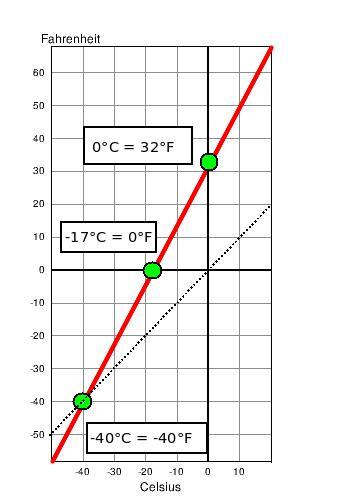
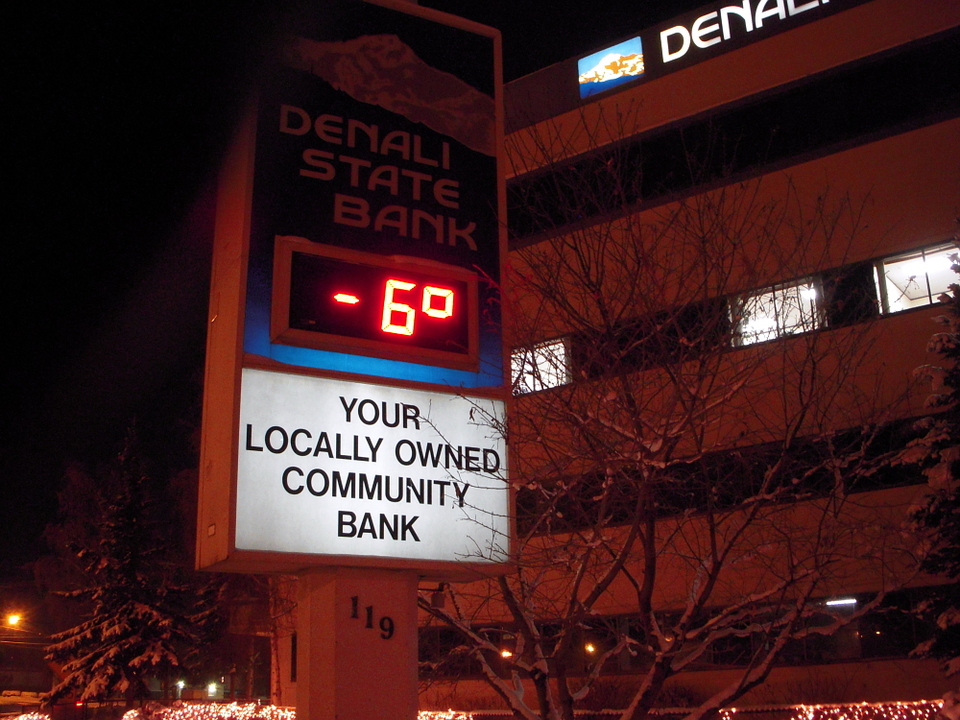
When looking at the graph in Figure 2, some striking points appear that one might not have expected. For example, would you have known that minus forty degrees Fahrenheit is exactly minus forty degrees Celsius? And the -6 degrees Fahrenheit in the photo in Figure 1, which we took one evening in Fairbanks as we trudged through the snow on uncleared sidewalks in our moon boots to the restaurant, can be converted to -21 degrees Celsius.