
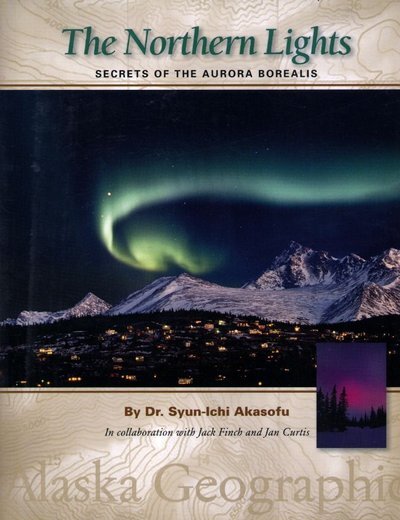
Michael In areas near or north of the Arctic Circle, a strange celestial phenomenon often occurs at night: a green, sometimes red light that seems to dance in astonishing movements, sometimes covering the sky from horizon to horizon. This is known as the Northern Lights, or "Aurora Borealis," a term even recognized by Americans who are not typically fond of Latin.
As one learns in a movie screening at the Museum of the University of Alaska in Fairbanks, and one can also read in relevant specialized books, the phenomenon has quite complex physical causes: It is an electrical discharge in the atmosphere, about 150 km above the Earth's surface. The energy required for this is provided by elementary particles from the so-called solar wind, a stream of particles emanating from the sun's surface. When it reaches the Earth's atmosphere, the Earth's magnetic field deflects it at the magnetic pole, creating playful patterns. The solar wind intensifies noticeably after observable eruptions on the sun's surface and will arrive here 2-4 days later.
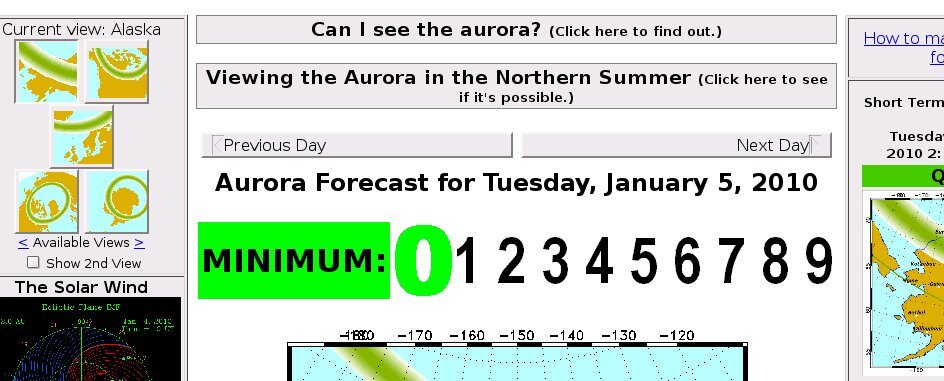
So that people know what to expect, the University of Alaska in Fairbanks provides a Northern Lights forecast on the internet. This way, the unsuspecting tourist can read on a scale from 0 to 10 on how likely it is they'll see northern lights. Unfortunately, during our visit, the measurements fluctuated only between 0 and 1, and the landlord of the bed-and-breakfast accommodation informed us that these were the lowest values in years, if not decades!
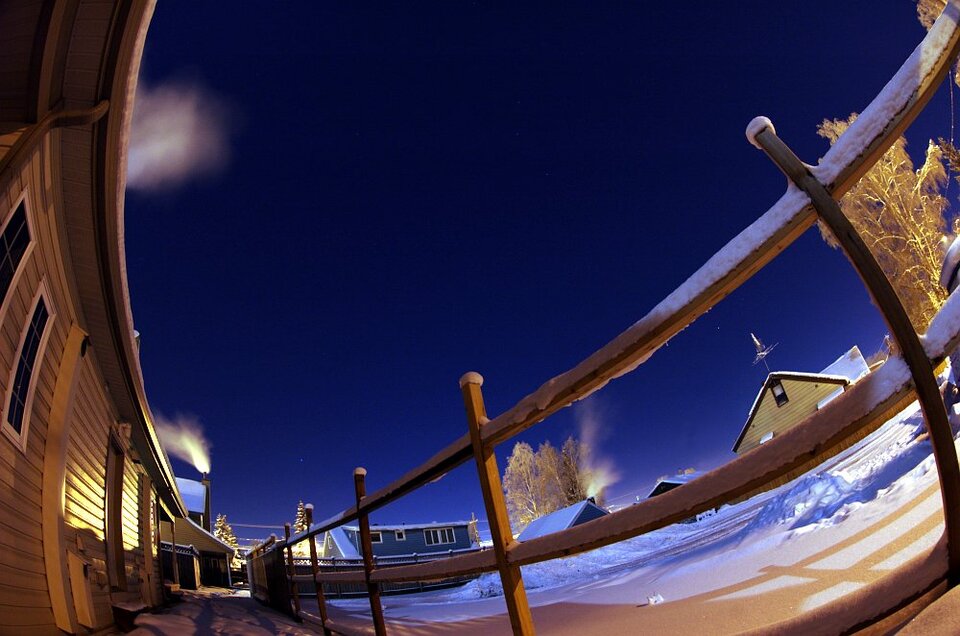
One night, however, I actually got up at four in the morning, dressed warmly because of the -25 degrees outside, and even threw on a so-called Balaclava, a face mask previously purchased at the mountaineering store for polar expeditions and bank robberies. With thick down mittens on my hands, I set up a tripod outside. The camera, equipped with a fish-eye lens, was pointed in the direction of the expected northern lights, and I initiated a 30-second exposure. As you can see in Figure 3, there was absolutely no activity in the sky! Grumbling, I trudged back to bed.
On the second to last evening of our trip, back in Anchorage, we observed a greenish glow as we looked towards Fairbanks from the balcony. Due to a few patches of fog, the view was slightly obstructed, but we believed we could even perceive gradual changes in intensity. However, the spectacle couldn't be photographed, as the effect was too weak. We probably need to go back to Alaska next year to capture a proper photo!