05/02/2008   English German

Previous
edition
  Edition # 74  
San Francisco, 05-02-2008
Next
edition


Figure [1]: The intrepid newsletter reporter gets caught by a red light camera.

Michael During our stay in the USA, which has now lasted more than 10 years, none of us has ever received a traffic ticket. Well, okay, parking tickets don't count, as they are as much a part of everyday life in San Francisco as brushing your teeth. And we don't drive particularly slowly either, but the speed traps on the side of the highway are so obvious that only the absent-minded would fail to notice them.

Automatic camera radar traps are illegal in the USA, but unfortunately, there are more and more speed cameras at traffic lights, which apparently are allowed due to a legal loophole. And recently, a letter from the "Department of Traffic Enforcement" arrived, stating that our new car, the so-called "Rocket," ran a red light on the east side of the Bay in the Emeryville district (Alameda County).

Figure [2]: The money-making intersection in Emeryville.

The letter included a web address where one could watch a video illustrating the sequence of events. Indeed, the video showed the rocket, driven by Michael, who had made a quick right turn on red after shopping at Ikea, which is generally allowed in the USA. However, one must come to a brief stop beforehand, similar to a stop sign. Apparently, the driver wanted to get home as quickly as possible at the time of the incident, to assemble the newly purchased Ikea furniture. In any case, he interpreted the rule a bit too liberally and sped around the corner without stopping. I've uploaded the video for your entertainment, click on the link below.

Video: The intrepid newsletter reporter doesn't make a complete stop before making a right turn at a red light.

The "ticket" wasn't exactly cheap, 381 dollars! The city of Emeryville, a thoroughly rundown East Bay rat hole, apparently needs every cent and is happy to squeeze innocent visitors from the metropolitan city of San Francisco, who don't want to waste time in the godforsaken place and quickly pass through!

Figure [3]: The traffic light camera run by the County of Alameda

No worries, I can afford it. But the problem with such an offense is, of course, that you get a point on your California driving record, which your car insurance company finds out about, and they will promptly raise the monthly premiums. This can amount to thousands of dollars a year!

Figure [4]: The court is being lenient and allows attendance at a traffic school so that the car insurance company does not find out about the incident.

To avert this misfortune, there is the option to pay a slightly higher fee ($410) and spend a day in a traffic course ("Traffic School"). While this doesn't directly save money, you still receive a point, but your car insurance won't find out about it. However, this is only possible if you haven't used this trick in the last 18 months.

Figure [5]: The insatiable court charges an additional fee if one attends traffic school.

The training lasts 8 hours and is conducted by specialized and licensed private companies, which you can choose from a list. To prevent people from getting bored while studying, there are even comedy schools where comedians present the dry traffic rules with humor! Personally, I prefer to sit at home and drink my beer, so I chose an online school.

With $20 via credit card, I enrolled in the course and was then presented with page after page of traffic rules, videos of severe traffic accidents, and animations of typical traffic situations. It mainly focused on the consequences of drunk driving, uncontrolled speeding, and the so-called "road rage," where people become so angry behind the wheel that they yell at other drivers and insult them with obscene hand gestures (which in the USA is not a punishable offense) and to shoot around with pistols from the glove compartment. The latter, however, is illegal.

You can pause the course as often as you like, but altogether I spent spent about eight hours in front of the computer. You have to be as watchful as a hawk and read the text on the pages very carefully, because after each chapter there is an interim exam where you have to answer 10 multiple-choice questions without any mistakes. If you get one or more wrong, another ten partially different questions will follow.

To ensure that the driving school knows that the same test-taker is sitting in front of the computer the entire time and hasn't handed over the task to a friend, you have to answer ten personal questions at the beginning of the course (Figure 6): how many siblings you have, what your favorite sport is, and so on. Then, at random intervals during the course, one of these questions will pop up, and you must know the correct answer within 90 seconds. Since, for security reasons, I never answer such questions truthfully, I actually had to save the answers I provided separately!

Figure [6]: Ten questions whose answers you need to know for the attendance check.

Before the final exam, some courts, such as the Oakland court responsible for my case, require that the examinee also be identified by name. To do this, one can either go to a certified testing center, present an ID, and take the test there, or be identified online with the help of one of the three major credit bureaus. In Rundbrief 05/2004 we have already reported on these institutions that, similar to Schufa in Germany, meticulously track the credit history of every American. To identify the person taking the test, three multiple-choice credit bureau questions pop up, the answers to which should only be known by the person in whose name the ticket was issued. For example, they might ask at which of the following four banks you have taken out a mortgage. Or what the last four digits of the person's secret Social Security number are, with the correct number to be selected from a list of four given options.

The questions in the final exam are not easy. One example was: How many fatal traffic accidents were there in the USA in 2005 that were caused by drunk driving? The options are (a) 16,000, (b) 25,000, (c) 5,000, or (d) 10,000. Or: "What should you be aware of if your car breaks down and you park it on the side of the road?" Possible answers are: (a) Watch out for tall grass, (b) open the trunk, (c) park the car facing oncoming traffic, or (d) turn on the high beams. If you haven't read the text beforehand, you're out of luck. Would you have known? The answers will be in the next newsletter.

I passed the final exam with 88%, while 80% was required. I'm quite a clever little fox who can remember numbers pretty well, but how someone with a bit less in the brain is supposed to manage this test is beyond me. After passing the exam, the driving school sent me an official-looking paper certificate by mail, which I then sent to the court by registered mail. This concludes the process and they supposedly keep quiet towards the insurance company. You can check the progress online. Let's hope it all works out...

American Housing Market In Crisis

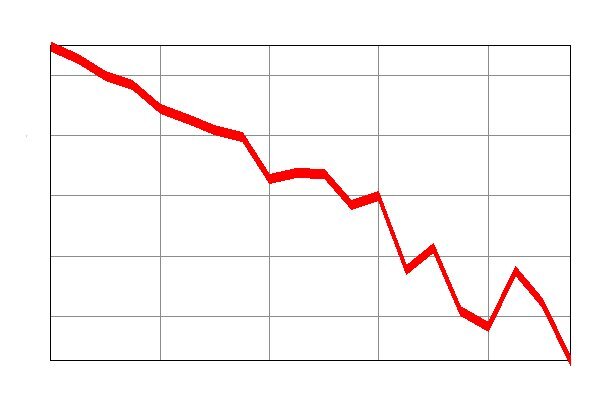
Figure [7]: The housing market in the USA is collapsing.

Angelika For quite some time, Michael has been predicting that the American housing market would eventually collapse. He regularly sent newspaper articles to the homeowners among his colleagues that supported his hypothesis. We are considered a bit of an anomaly since we still rent. In overpriced cities like San Francisco and New York, where real estate prices, along with the property taxes to be paid, have long taken on surreal proportions, renting is indeed the more financially sensible solution.

But owning a home is part of the American dream. According to common belief, those who rise to the ranks of homeowners have made it into the middle class. American campaign slogans always include promises to increase the percentage of homeowners, especially among minorities.

Figure [8]: Real estate offers no longer find any takers.

Now, after the internet bubble burst in 2001, the housing bubble has also recently burst, causing international stock markets to tremble. The lamenting is widespread, although we were surprised that the whole situation lasted as long as it did. It was clear that house prices couldn't continue to rise at such a frantic pace, if only because of the laws of supply and demand. But the unyielding optimism of many Americans, low interest rates, greedy real estate agents, and unscrupulous bankers who smelled big money and issued risky loans, inevitably led to the crisis.

Would-be homeowners were enticed with too-good-to-be true conditions on loans. Many buyers paid nothing upfront when purchasing a house and opted for adjustable-rate mortgages. In these cases, the interest rate is often initially unbeatably low for the first one or two years and then rises rapidly. There were also models where the borrower initially only had to pay the interest on the borrowed amount, but not make any payments against the principal. But why did financial institutions engage in such risky maneuvers? As long as house prices were rising, everything was fine, because even if the homeowner could no longer make their payments, the bank would be pleased, as the house would go back to the bank, which would then sell it off at a much higher price.

Figure [9]: Nobody even wants this yuppie bunker.

Additionally, so-called "Home Equity Loans" became extremely popular. These are loans that homeowners took out based on the increased value of their homes. Originally, these loans were used, for example, to finance home improvement projects. However, during the euphoria of the recent real estate boom years, many people spent the money on other consumer goods, or simply to afford a higher standard of living. But as house prices continue to plummet, resulting in millions of Americans having mortgages that are now higher than the actual value of their homes, the equation unfortunately no longer works out. Credit card companies are now concerned that their customers, lacking "Home Equity," will instead charge their expenses to their credit cards and eventually be unable to pay them off. As a precaution, they have significantly increased the interest rates for people who do not pay their bills on time and are therefore considered high-risk.

In turn, the stock market tremor arose because credit institutions continued to sell the mortgages to the financial markets. They bundled individual loans into tradable securities, which were then rated as safe by the experts. However, when the mortgage loans started to default one after another due to falling house prices, unrest suddenly spread among investors. Credit institutions that had been particularly eager to invest in these actually high-risk securities suddenly incurred significant losses. Meanwhile, caution is once again the order of the day, and banks are no longer granting loans as freely as they used to. However, this is currently causing the economy to stagnate. Even the eternally consuming American has taken a hit and seems to be holding onto their money more tightly. At least they are drinking fewer lattes and frappuccinos, as the coffeehouse chain "Starbucks" announced this week a profit decline of up to 28 percent.

Figure [10]: Financially struggling customers save money first by cutting back on small pleasures, like a cup of coffee at Starbucks.

But rescue is in sight. Starting this week, the tax administration, under the directive of President Bush and the American Congress, is sending checks to citizens to encourage them to spend more. Anyone who filed a tax return in 2007, had an income of at least $3,000, and possesses a Social Security number will receive up to $600 from the government ($1,200 for married couples filing jointly). An additional $300 is added for each child under 17. However, higher earners will have to settle for less. Most economic experts, however, doubt that these gifted sums will turn the tide.

Figure [11]: But the president is sending us money ...

Figure [12]: ... so that the economy gets stimulated!

According to the latest statistics released at the beginning of the week, California, along with Florida, Arizona, and Nevada, has the highest percentage of foreclosed homes. Interestingly, the statistics for San Francisco look different. While homes in surrounding areas like San Leandro, Daly City, and Fremont are being taken over by banks one after another, this is not the case in San Francisco. Here, house prices not only increased by 0.4 percent in March, but the foreclosure rate was also a low 2.4 percent. There are indeed a lot of wealthy people in San Francisco who are hardly affected by the economic downturn, or people who have owned their homes for decades. Additionally, many first-time homebuyers have been drawn to the surrounding cities, as houses there are somewhat more affordable than in San Francisco itself.

The fact that rents are rising during a housing crisis is somehow logical, because more people are entering this market. San Francisco is also a leader in this regard, despite low foreclosures. Rents in San Francisco have increased by 14.4 percent compared to last year. Somehow, we seem to be magically drawn to cities that come with high rents!

American Showers

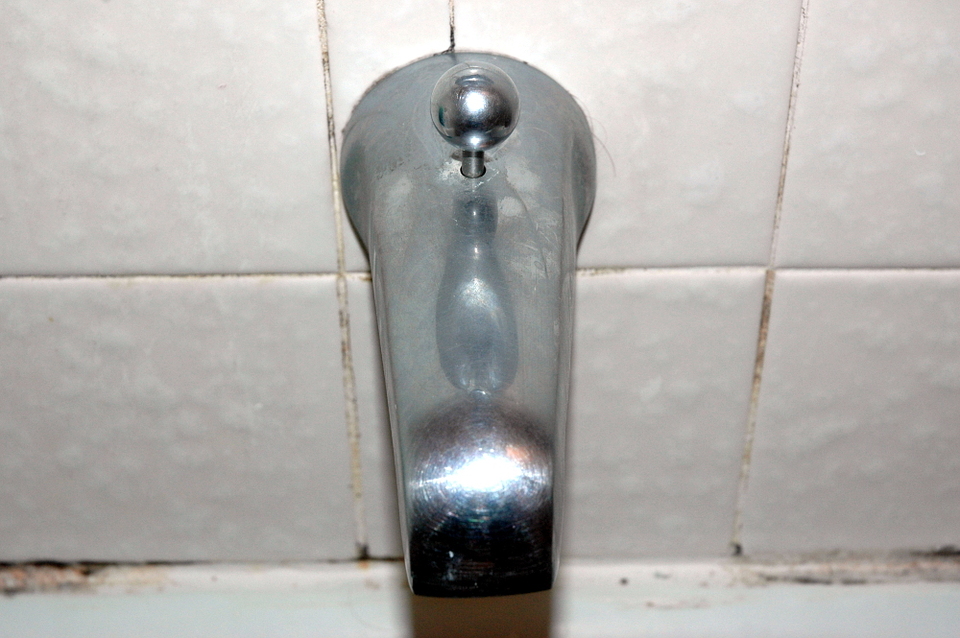
Figure [13]: The lever that you have to pull up to divert the water from the bathtub to the shower.

Angelika In Rundbrief 08/2007 I previously reported on the somewhat unusual windows here in America, but American showers also have their quirks. There have been several amusing scenes in our apartment when German overnight guests were baffled by our shower because they didn't know how to turn on the water.

In older houses and simpler motels that don't have modern shower cabins but instead have bathtubs combined with showerheads, you need some detective skills to operate the fixtures. When you turn on the faucet, the water initially comes out of the bathtub spout. First, you need to determine the desired temperature by turning the knob. Then, you have to pull the lever with the round head (see Figure 13) on the bathtub faucet to redirect the water to the showerhead.

Figure [14]: The faucet to turn the water on and off.

The knob in illustration 14 serves two functions: If you push it upwards, it turns on the water. If you turn the knob to the left, so that the arrow moves towards "H" (Hot), the water gets hotter. To the right towards "C" (Cold), it gets colder. In some hotels, however, you can only turn the knob, not push it upwards. You turn on the shower by turning the knob clockwise (!). Initially, you go through cold water, and if you keep turning, it gets warmer. Michael, who cannot tolerate cold water at all, always stands outside the shower in motels while he lets the shower run warm with his fingertips. Once a comfortable temperature is reached, he gets in.

One more quirk: The showerheads in the U.S. are usually fixed to the wall, not removable, and without a hose. It's a miracle that we manage to get clean every day.

Mandatory Health Insurance For Employees

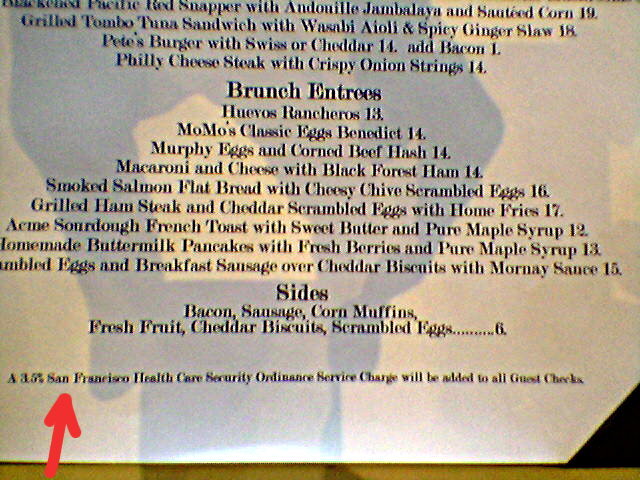
Figure [15]: A crooked restaurant simply adds an imaginary tax.

Michael Recently, we had lunch at the restaurant "MoMo's" in San Francisco's Soma District and, to our surprise, found a note in small print at the bottom of the menu: It read that the place simply adds 3.5% to every bill without asking, a so-called "San Francisco Health Care Security Ordinance Service Charge" (Figure 15).

In fact, there has been a law in San Francisco since January 8, 2008, the so-called "Health Care Security Ordinance (HCSO)" which requires employers to provide health insurance for their employees if the establishment employs more than 20 people. Naturally, this doesn't sit well with the restaurants, and they have not only filed a lawsuit against the city but also seem to be ripping off unsuspecting guests. The waiter working at the restaurant in question only knew that it was a "New San Francisco Thing" and that he hadn't seen any of the money yet.

There is certainly nothing wrong with health insurance for employees, but it's simply wrong to surreptitiously add this amount to the bill. In that case, the restaurant should simply raise the prices on the menu! However, it seems that some prefer to lead their guests by the nose instead.

Figure [16]: The amount is listed separately on the bill.

And, a few days later, at the "Incanto" restaurant in our neighborhood, we noticed a "Service Charge" of 5%, supposedly to cover the tip for the kitchen staff. In theory, as a guest, you could deduct this amount from the waiter's tip, but who really does that? The waiter isn't responsible for the greedy management's schemes. The only solution is to boycott these places for the time being; if the guests stay away, maybe they'll get the message.

Figure [17]: The restaurant "Savor" in our neighborhood also boldly adds a dollar per guest to the bill to pay for their employees' health insurance.

Let's face the facts: On a $50 bill, not only do you have an 8.5% sales tax (which is $4.25) and an additional 15-20% tip for the waiter on the total amount ($8.14 - $10.85), but also a new restaurant fantasy tax of 3-5% ($1.50 - $2.50)? So, the $50 on the menu becomes $67.60? Where are you going with this, San Francisco?

Parking On the Edge Of Madness

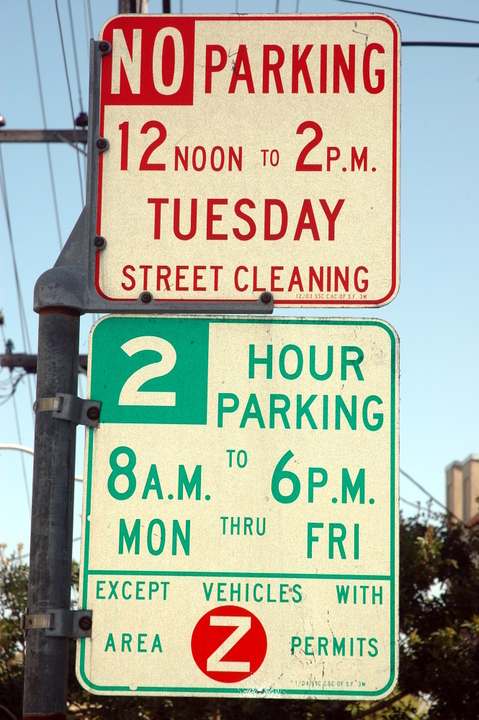
Figure [18]: Top: The street sweeper comes on Tuesday between 12 and 2 PM. Bottom: The new silly residential parking zone Z.

Michael We have often described the catastrophic parking conditions in our neighborhood, but recently the situation has worsened. To make matters worse, there is now also the residential parking zone "Z," which is marked by appropriate traffic signs. Within this zone, you are only allowed to park for 2 hours on weekdays from 8 a.m. to 6 p.m. if you do not have the corresponding permit on your car.

This badge is only given to those who live on the respective street. Now, our place is on 24th Street, where there is no parking zone, only parking meters, and we don't get a badge and are screwed. We have to search for spots in the few remaining side streets without parking zones until we're blue in the face! Initially, only a few streets had the new regulation, but more and more residents couldn't find a parking spot because of the change and submitted petitions to have their street included in the nonsense as well.

We now have two cars, the old Perlman and the new rocket (Rundbrief 02/2008). The rocket is in the garage, Perlman has to spend the night on the street. But that also means that we're busy playing the old parking games again (Rundbrief 07/2001). Once a week, the street sweeper comes to our neighborhood, and then Perlman has to be moved, otherwise there will be a parking ticket that costs $40.

However, residents are reluctant to give up a good parking spot, and many just drive off briefly, let the street sweeper pass, and then immediately squeeze back into the old spot. What tourists don't know, and locals are reluctant to reveal: Even if the traffic sign (illustration 18) states that the street sweeper passes through on Tuesday between 12 and 2 PM, you can still park there during that time frame after the street sweeper has done its work.

Through years of time-consuming studies, I have discovered that the street sweeper on 23rd Street, where street cleaning according to the traffic sign takes place on Tuesdays between 12 and 2 PM, passes by almost exactly at 12:25. I assume that the street sweeper follows a set schedule, which is established somewhere in the secret archives of the city of San Francisco, and which he must read, memorize, and then eat.

Video: Documentary video: The street sweeper is coming to our area.

Minutes before the street sweeper comes by, an armada of what I call "parking ticket wasps" (Rundbrief 07/2001) are scurrying the area Before the street sweeper, what I call wasps drive (Rundbrief 07/2001) to distribute parking tickets to those cars that are still parked there. (By the way, the official name of these cute three-wheelers, whose drivers wear bicycle helmets, is "Interceptor".) Now, the trick is to move your parked car around 12:15, keep lurking nearby, and as soon as the street sweeper passes through at 12:26, reclaim the old parking spot.

Since I always work from home on Tuesdays, I quickly leave the house at noon, get the car, and repark it. Recently, I even shot a documentary video (see above).

Figure [19]: An anonymous coward on Jersey Street hung a nasty note on our car.

Overregulation of this kind is sprouting up in San Francisco like mushrooms. The former city of revolutionaries has become a home for prematurely aged people in their late thirties who have nothing better to do than sit in their million-dollar homes, count their money, and start neighborhood initiatives when there are no parking spaces. Recently, we had parked the Perlman on Jersey Street in our neighborhood for almost a week, and technically, you're not allowed to do that due to a relatively unknown and absurd regulation: the maximum parking duration is 72 hours, after which you have to move the car at least one block away. No one really adheres to this, but sure enough, some desk jockey from Jersey Street stuck a note on our car and accused us with harsh words (see illustration 19). What an idiot!

Figure [20]: The neighborhood newspaper writes about uncool prematurely aged people in our district who complain about the Google buses.

Another source of complaints seems to be the company Google picking up its employees by shuttle in San Francisco. These buses are rumbling through the quiet streets at night, and there was an immediate outcry! In illustration 20, you can see the corresponding article in the neighborhood newspaper 'Noe Valley Voice'. The headline, by the way, features the rarely used verb "to rankle." Look it up in the dictionary to see what it means. Among cool people, there is once again a tendency to move to the South American neighborhood "Mission" or even to quite run-down areas like Hunters Point (Rundbrief 02/2008) to escape the wannabe alternatives in our neighborhood.

Election Campaign And No End In Sight

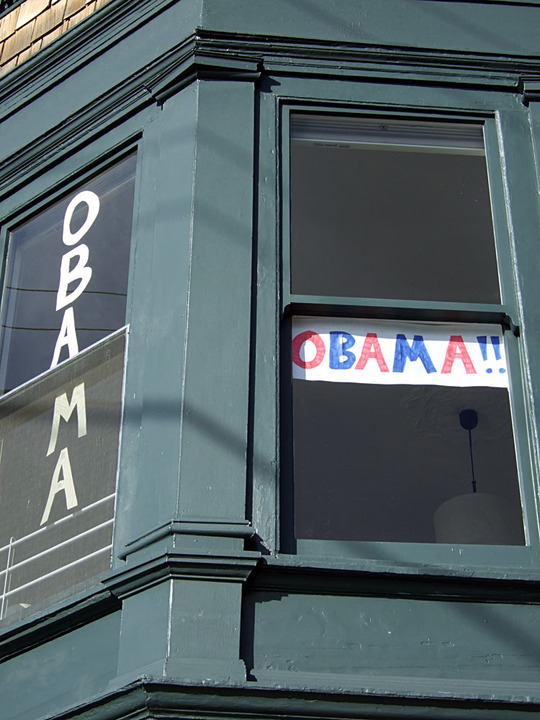
Figure [21]: The resident of this apartment in the Castro is an Obama fan.

Angelika Currently, the Republican presidential candidate has been determined, while Barack Obama and Hillary Clinton are still in a neck-and-neck race for the Democrats. John McCain can be confident of his official nomination at the Republican National Convention in the summer. For the Democrats, this time the superdelegates will play the decisive role, as I already predicted in the last newsletter(Rundbrief 02/2008).

Without the superdelegates, Clinton cannot win the nomination, even if she overwhelmingly defeats Obama in the remaining primaries. Clinton is fighting like a wild lioness in a cage and is taking on increasingly unappealing traits. To appeal to white workers, a group from which Obama has received the fewest votes so far, she sometimes jumps onto a pickup truck and rides with a worker to a gas station, only to lament about the high gas prices. Or she drinks beer in a bar in Indiana, where the next primaries will take place on Tuesday, simultaneously with the state of North Carolina. I have never seen anyone so in love with power. Hillary and Bill want to return to the White House, no matter the cost.

Figure [22]: The gasoline prices have exceeded the 4-dollar mark.

Hillary's latest mantra is that she--like John McCain--wants to suspend the gas tax (a mere 18.4 cents per gallon) over the summer months so that prices temporarily drop and everyone can pump more gas into their huge cars again. A gallon (about 3.8 liters) of gas currently costs around $3.60 on average, which is extremely high by American standards. Gas prices tend to rise in the summer anyway, as demand increases because everyone drives to their vacation destinations, and refineries reach the limits of their capacities.

Experts suspect that the gasoline price will soar above four dollars nationwide; in San Francisco, we're already paying this much anyway. Economic and environmental experts are pulling their hair out. Firstly, the math doesn't add up, because if the tax is removed and people drive more, demand increases, which drives prices up even further. Secondly, this action obviously doesn't solve the problem in the long run. Conservation and driving less are necessary, and for that, gasoline prices should actually be raised through a tax, as it's the only way to force consumers to change their behavior. Thirdly, the gasoline tax is used to maintain the country's infrastructure, which is desperately needed, as bridges and roads are partly in miserable conditions.

To be fair, I must mention that Clinton wants to pass the tax onto the oil companies through the back door, while McCain seemingly doesn't care about how to fill the gap. Additionally, both of them overlook in their adventurous proposals that such decisions cannot be made without the approval of the Senate and the House of Representatives. I hope that the voters see through the game.

Obama categorically rejects the proposal by McCain and Clinton regarding the gasoline tax. However, Obama currently has entirely different problems, as his somewhat radical pastor, from whom he has just distanced himself, is traveling across the country in a media-effective manner and delivering speeches that are making life difficult for Obama. And once again, we have reached the point in the American election campaign where it is only about platitudes, even though there are important issues like the economic crisis, the Iraq war, and healthcare for all, that need to be discussed.

Die Without Inheritance Tax In the Year 2010

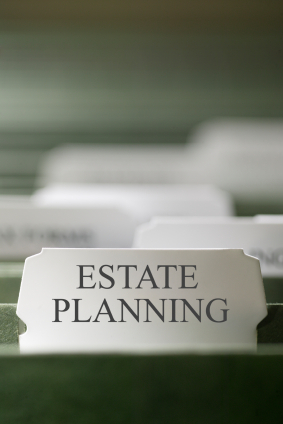
Figure [23]: The taxes on an estate will be eliminated in 2010.

Michael Just like in Germany, heirs must pay inheritance tax, the so-called "Estate Tax," on an inheritance. However, there is an exemption limit set at 2 million dollars.

Surviving spouses are exempt from paying estate tax. However, this does not apply to people who are not American citizens. This is the reason why many Green Card holders eventually apply for American citizenship, even though it offers few advantages other than the ability to vote. By the way, the Germans have an Agreement with the USA according to which in the year 2006 there's an exemption of $2,000,000 between German/American and German/German spouses.

The above-mentioned exemption limit for Americans of 2 million dollars, for example when someone bequeaths money to their children, only applies in the year 2008. Next year, 2009, it will be temporarily raised to $3.5 million, and then in the following year, 2010, it will be completely eliminated.

And now comes the kicker: In 2011, it returns with an exemption limit of only one million dollars! So if the American Congress does not come together and pass a new law for the Estate Tax, also known as the "Death Tax," dying in 2010 will be cheaper than ever before. One can easily imagine the societal impacts this could have, and it is hoped that the government will promptly avert this.

Easter in Dolores Park: Hunky Jesus

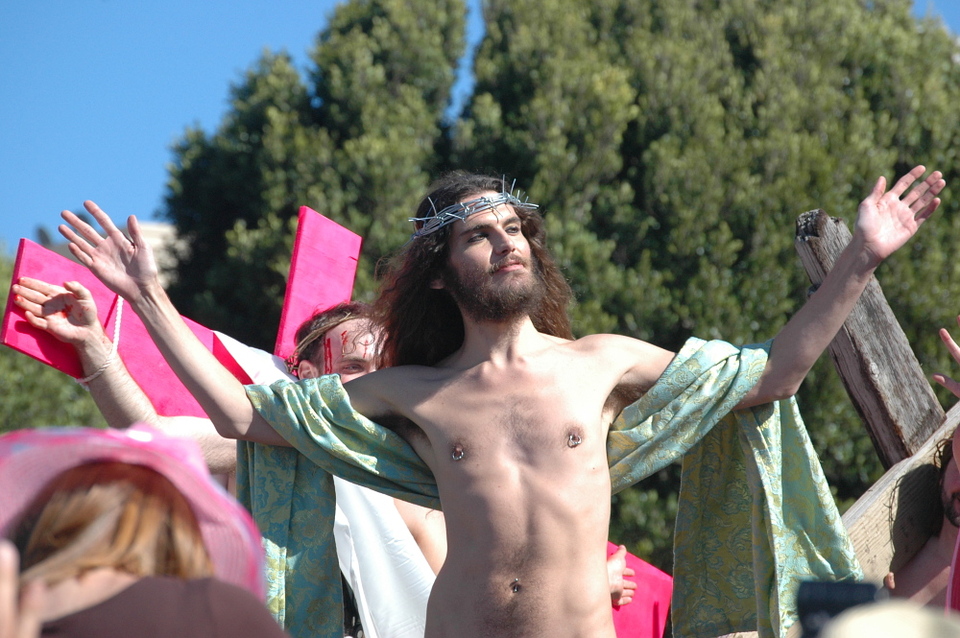
Figure [24]: The winner of the "Hunky Jesus Contest" 2008

Angelika In America, aside from December 25th for Christmas, there are no religious public holidays where employees have a day off work. Good Friday and Easter Monday are just regular workdays. However, many Americans do celebrate Easter. Children hunt for Easter eggs, and the churches are full. San Francisco celebrates a very special event every year at Easter, which falls into the "Only In San Francisco" category. The "Sisters of Perpetual Indulgence" celebrate Easter Sunday in Dolores Park, just around the corner from us, in a very unique way.

Figure [25]: The popular Dolores Park around the corner from us.

The sisters are homosexual men dressed as colorful nuns and represent a non-profit organization whose members tirelessly collect donations for charitable projects. They raise money for AIDS projects or support groups that advocate for more tolerance. Funds are directed to institutions that care for homosexual seniors, local hospices, or homeless shelters for families, as well as to breast cancer aid, with a particular focus on smaller organizations that might otherwise be overlooked. Sexual education and ending discrimination against people with different sexual orientations are also important to the group.

Figure [26]: The "Sisters of Perpetual Indulgence" with the participants at the "Hunky Jesus Contest".

The sisters founded their somewhat unusual order in 1979 in San Francisco. It originally consisted exclusively of gay men. Nowadays, the group is more diverse, and women are also among the members. There are also branches in many American cities and foreign countries. In Germany, you can find the "Sisters of Perpetual Indulgence" in Cologne, Berlin, and Hamburg. However, San Francisco is still considered the motherhouse.

Of course, it has not escaped your notice that the clothing and chosen names are intended as a humorous parody of the rituals and customs of the Catholic Church. Naturally, some church leaders and strict Catholics do not appreciate this. It has been suggested that the special Easter celebration of the sisters should no longer be held on Holy Easter Sunday but on another day, though this has not been successful so far. I can only say, stay relaxed, because the San Francisco sisters have raised over 1 million dollars through their voluntary efforts since their inception and have distributed it charitably.

Figure [27]: Crazy people in Dolores Park.

But back to the Easter fun at Dolores Park. The "Sisters of Perpetual Indulgence" are known not only for raising a lot of money but also for putting on an entertaining show. Easter at Dolores Park starts innocently enough in the morning with an Easter egg hunt for children. Later, you might want to send them home, as the crazy hat competition ("Bonnet Contest") follows, along with the particularly popular "Hunky Jesus" contest, where the craziest/most beautiful Jesus is chosen. An endless line of men in original or less original outfits (some barely dressed) attempt to portray Jesus. The winner, whom you can see in illustration 24, impressed this year not with any frills but solely with his natural demeanor and convincing gestures. If you happen to be in San Francisco for Easter, don't miss this San Francisco institution!

Greetings from by far the craziest city in the world:

Angelika & Michael

RSS Feed
Mailing Liste
Impressum
Mike Schilli Monologues


Get announcements for new editions

New editions of this publication appear in somewhat random intervals. To receive a brief note when they're available in your mailbox (about once every two months on average), you can register your email on the 'usarundbrief' Google Groups list.

Your email address


All Editions:


Send us a comment
We'd like to hear from you, please send us feedback if you want to comment on the content or have suggestions for future topics.

Simply write your your message into the text box below. If you'd like a response from us, please also leave your email. If you want to stay anonymous, simply put 'anonymous' into the email field. This way we'll get the message, but we have no way to respond to you.

Your email address


Message

 
Contact the authors
Latest update: 12-Jun-2026