

Michael During our stay in the USA, which has now lasted more than 10 years, none of us has ever received a traffic ticket. Well, okay, parking tickets don't count, as they are as much a part of everyday life in San Francisco as brushing your teeth. And we don't drive particularly slowly either, but the speed traps on the side of the highway are so obvious that only the absent-minded would fail to notice them.
Automatic camera radar traps are illegal in the USA, but unfortunately, there are more and more speed cameras at traffic lights, which apparently are allowed due to a legal loophole. And recently, a letter from the "Department of Traffic Enforcement" arrived, stating that our new car, the so-called "Rocket," ran a red light on the east side of the Bay in the Emeryville district (Alameda County).

The letter included a web address where one could watch a video illustrating the sequence of events. Indeed, the video showed the rocket, driven by Michael, who had made a quick right turn on red after shopping at Ikea, which is generally allowed in the USA. However, one must come to a brief stop beforehand, similar to a stop sign. Apparently, the driver wanted to get home as quickly as possible at the time of the incident, to assemble the newly purchased Ikea furniture. In any case, he interpreted the rule a bit too liberally and sped around the corner without stopping. I've uploaded the video for your entertainment, click on the link below.
| Video: The intrepid newsletter reporter doesn't make a complete stop before making a right turn at a red light. |
The "ticket" wasn't exactly cheap, 381 dollars! The city of Emeryville, a thoroughly rundown East Bay rat hole, apparently needs every cent and is happy to squeeze innocent visitors from the metropolitan city of San Francisco, who don't want to waste time in the godforsaken place and quickly pass through!

No worries, I can afford it. But the problem with such an offense is, of course, that you get a point on your California driving record, which your car insurance company finds out about, and they will promptly raise the monthly premiums. This can amount to thousands of dollars a year!
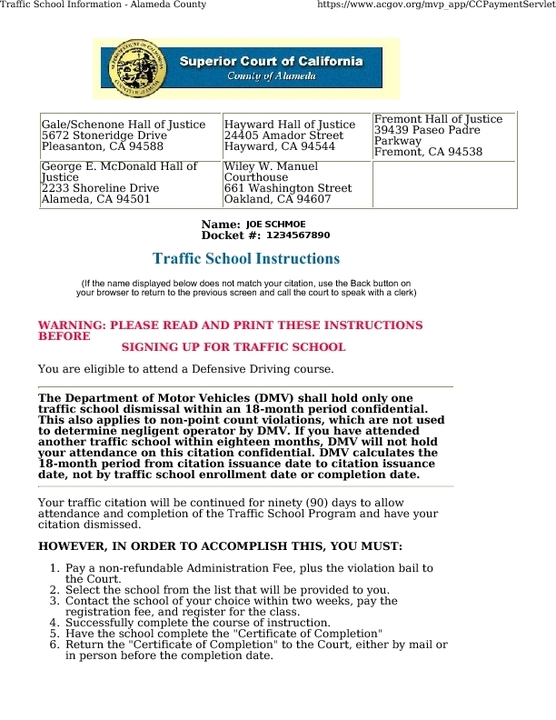
To avert this misfortune, there is the option to pay a slightly higher fee ($410) and spend a day in a traffic course ("Traffic School"). While this doesn't directly save money, you still receive a point, but your car insurance won't find out about it. However, this is only possible if you haven't used this trick in the last 18 months.

The training lasts 8 hours and is conducted by specialized and licensed private companies, which you can choose from a list. To prevent people from getting bored while studying, there are even comedy schools where comedians present the dry traffic rules with humor! Personally, I prefer to sit at home and drink my beer, so I chose an online school.
With $20 via credit card, I enrolled in the course and was then presented with page after page of traffic rules, videos of severe traffic accidents, and animations of typical traffic situations. It mainly focused on the consequences of drunk driving, uncontrolled speeding, and the so-called "road rage," where people become so angry behind the wheel that they yell at other drivers and insult them with obscene hand gestures (which in the USA is not a punishable offense) and to shoot around with pistols from the glove compartment. The latter, however, is illegal.
You can pause the course as often as you like, but altogether I spent spent about eight hours in front of the computer. You have to be as watchful as a hawk and read the text on the pages very carefully, because after each chapter there is an interim exam where you have to answer 10 multiple-choice questions without any mistakes. If you get one or more wrong, another ten partially different questions will follow.
To ensure that the driving school knows that the same test-taker is sitting in front of the computer the entire time and hasn't handed over the task to a friend, you have to answer ten personal questions at the beginning of the course (Figure 6): how many siblings you have, what your favorite sport is, and so on. Then, at random intervals during the course, one of these questions will pop up, and you must know the correct answer within 90 seconds. Since, for security reasons, I never answer such questions truthfully, I actually had to save the answers I provided separately!

Before the final exam, some courts, such as the Oakland court responsible for my case, require that the examinee also be identified by name. To do this, one can either go to a certified testing center, present an ID, and take the test there, or be identified online with the help of one of the three major credit bureaus. In Rundbrief 05/2004 we have already reported on these institutions that, similar to Schufa in Germany, meticulously track the credit history of every American. To identify the person taking the test, three multiple-choice credit bureau questions pop up, the answers to which should only be known by the person in whose name the ticket was issued. For example, they might ask at which of the following four banks you have taken out a mortgage. Or what the last four digits of the person's secret Social Security number are, with the correct number to be selected from a list of four given options.
The questions in the final exam are not easy. One example was: How many fatal traffic accidents were there in the USA in 2005 that were caused by drunk driving? The options are (a) 16,000, (b) 25,000, (c) 5,000, or (d) 10,000. Or: "What should you be aware of if your car breaks down and you park it on the side of the road?" Possible answers are: (a) Watch out for tall grass, (b) open the trunk, (c) park the car facing oncoming traffic, or (d) turn on the high beams. If you haven't read the text beforehand, you're out of luck. Would you have known? The answers will be in the next newsletter.
I passed the final exam with 88%, while 80% was required. I'm quite a clever little fox who can remember numbers pretty well, but how someone with a bit less in the brain is supposed to manage this test is beyond me. After passing the exam, the driving school sent me an official-looking paper certificate by mail, which I then sent to the court by registered mail. This concludes the process and they supposedly keep quiet towards the insurance company. You can check the progress online. Let's hope it all works out...