![]() |
| Angelika/Mike Schilli |
Michael The World Cup is indeed long over, but I still wanted to report on how such an event unfolds in a country where soccer is a completely exotic sport. The World Cup matches were broadcast almost exclusively on the sports channel ESPN, which we unfortunately don't have due to frugality. Fortunately, the Spanish channel also aired them, and this even had the advantage of not having to listen to the uneducated comments of the American soccer commentators. In Rundbrief 07/2002 we have already reported that South Americans always shout "Goooool!" when a goal is scored. Do you want to hear it live? This time we present the goal commentary as an MP3, listen in: TV sound during the 1-0 in the Germany vs. Portugal match.
At Yahoo, the games were shown on large flat-screen TVs in our coffee bar on the ground floor. Most of them started at 9:00 in the morning or at 11:00 AM, and there were always smaller and sometimes larger groups of employees who took two hours off to watch a match. Even some Americans joined in! By the way, during the Argentina game, most people were cheering for Germany.
Large screens like those in Germany did not exist in the USA, so a German immigrant in San Francisco came up with a plan: He wanted to rent a large TV screen and show the game in Dolores Park in San Francisco. He probably had the thought in the back of his mind that maybe the German team would be playing in the final, but unfortunately, that didn't happen.
But no sooner said than done, German man Jens-Peter Jungclaussen obtained the necessary permits for the event from the city of San Francisco, rented the required number of portable toilets, and even had to hire police officers responsible for security.
All in all, the fun cost about $17,000, which he hoped to recoup through sausage sales and voluntary donations. He probably expected a few hundred spectators, but what happened due to word of mouth, an email avalanche on the internet, and finally an announcement in a major newspaper was incredible: About 7,000 people showed up! San Francisco is not lacking in Italians, and there is also a considerable number of French people. And even a German flag was spotted! I have never seen so many people in the relatively small Dolores Park; people were really sitting shoulder to shoulder on the grass.
The German-American Chamber of Commerce in San Francisco did not hold back and contributed to the costs for the TV screen, and I think that the donations and sausage sales easily covered total expenses.
In America, you are not allowed to drink beer in public, and the permit for the event in Dolores Park was apparently granted only on the condition that no alcohol would be consumed. The announcer pointed this out over the loudspeaker, and the police officers on duty also admonished beer drinkers, but with a wink. Overall, it was still an exhilarating event!
Angelika San Francisco is notorious for its natural air conditioning, namely the cool air and fog. This makes many tourists, dressed only in T-shirts and shorts, shiver during the summer months. The fog forms because the hot air from inland flows towards the ocean, which is quite cold, and -- voila -- everything is enveloped as if in cotton. The meteorologists amongst you may forgive me for this simplified explanation.
Since the temperature difference is particularly large in the summer months, there is also the most fog between June and August. Now, you shouldn't think that we are constantly sitting in a gray soup. During the day, the fog clears, the city heats up to over 75F, and only later in the late afternoon does the fog slowly creep back into the city. Neighborhoods close to the ocean are most affected; those who live in the "Richmond" or "Sunset" pay less rent but sit in the soup more often. Our neighborhood "Noe Valley" and the nearby "Mission" are considered the sunniest. However, the fog phenomenon provides the city of San Francisco with a pleasant breeze, and thus generally good air. Smog, we like to joke, we generously leave to Los Angeles.
However, there are occasionally hot days without wind that cause ozone levels to skyrocket. And when the thermometer rises in San Francisco, people in the rest of the Bay Area groan and moan even more, because in cities like Mountain View or San Jose, which are further inland, the thermometer rises above 95F, and the heat becomes unbearable. To improve air quality on such days, the "Bay Area Air Quality Management District" introduced the so-called "Spare-the-Air" days in 1991.
If the ozone levels are expected to exceed a certain value, the day is declared a "Spare the Air Day" in advance. To encourage people to leave their air-polluting cars, all public transportation in San Francisco and the surrounding area ("Bay Area") is free on those days. Even the train that runs from San Francisco through Silicon Valley to San Jose is free all day. Previously, this only applied to the morning commute, but this year it has been extended to the entire day. Surprising, isn't it? The whole initiative actually seems to be working, as 10% more people use public transportation on such days. Additionally, there is hope that some people will develop a preference for it and continue using the subway, streetcars, trains, and buses.
Unfortunately, there were three hot days in June that were declared "Spare-the-Air" days, which exhausted the budget for this season, running from June to mid-October for the "Spare-the-Air" program. Hmm! However, the responsible authorities scraped together an additional 5.3 million, partly from the "Vehicle Registration" fund (similar to the German vehicle tax). This amount will probably be enough for three more days this year. The various transportation companies receive compensation from this source for the money they lose.
Angelika The myth that anyone who wants to live and work in America is immediately handed a green card upon arrival is indestructible. But that's false, America has not kept its doors wide open for everyone for a long time. If you want a work permit, you not only have to navigate the thicket of bureaucracy but also win the race against the quota, as typically only a certain number of work visas or green cards are issued in various categories each year.
These hurdles have led to many people becoming tired of waiting and risking being in the country illegally. It is estimated that there are now 11 to 12 million illegal immigrants living in the USA, with almost 80 percent of them coming from Mexico or other Latin American countries. This problem is not exactly new. Back in the late 1980s, then-President Ronald Reagan tried to curb the influx of illegal immigrants through legislation: any employer who knowingly hired someone without a work permit would be committing a crime. However, no reliable system was implemented to verify this. At the same time, Reagan granted amnesty to illegal immigrants who had already been in the country for several years.
Bush Jr. promised during his first election campaign to solve the problem of illegal immigrants. However, other issues like September 11th and the Iraq War caused the topic to disappear from the spotlight. But now it has resurfaced for quite some time. Hardly a day goes by without the press addressing the issue of immigration. Since a large portion of Americans can trace their own immigration history (even if it often dates back generations), the topic is emotionally charged here like no other.
It began in December 2005 when the American House of Representatives (known as "Congress") passed a draconian bill that not only proposed to seal the border with Mexico using a high-tech fence stretching over 700 miles but also aimed to elevate illegal residence in the USA to a criminal offense ("felony").
Until now, this has been a civil matter that violates existing immigration law. There was an uproar mainly because the draft law criminalizes helpers (such as family members, priests, social workers) who assist illegal immigrants, which so enraged the Catholic Cardinal of Los Angeles that he called on his priests to engage in civil disobedience.
Overall, none of the politicians really expected the protest from the Latinos (as Latin Americans are called), because everyone quietly assumed that illegal immigrants would not dare to take to the streets. However, in the spring of this year, there were large demonstrations in many American cities. In Los Angeles, half a million people protested for more liberal immigration laws. The illegal immigrants find broad support primarily among their compatriots, who often now possess an American passport but arrived in the USA in similarly adventurous ways. Since Latinos are the fastest-growing population group in many states (including California), politicians must be concerned about the votes of the immigrants legally living in the country.
On May 1st, there was another protest action to demonstrate that without illegal immigrants, many economic sectors would collapse and that immigrants in general contribute to the economic well-being of Americans. Immigrants (both legal and illegal) were called upon not to go to work. In San Francisco, many businesses in the Mission district, which has a high percentage of Latin Americans, were closed as a result. The action was also supported at the Tenderloin Childcare Center, where I work, because most of our children come from foreign countries.
Since a bill in the USA goes through several instances, the Senate transformed the draft described above into a more moderate version in May. The Senate's bill also mentions better securing the border with Mexico, but at the same time allows illegal immigrants who have been in the country for longer to obtain legal status after paying a fine and back taxes. A guest worker program is also planned, which is particularly important to President Bush. Furthermore, among other things, the number of H-1B visas issued annually is to be increased (Rundbrief 05/2000).
Now the whole thing goes back to Congress, and both bills need to be reconciled with each other. And that's where opinions differ. Currently, nothing is moving forward at all. To make matters worse, Congress will be re-elected here in November, and everyone wants to exploit the immigration debate for their political purposes.
Michael Through a service introduced in the second-to-last newsletter, named onlinetvrecorder.com, we can now also receive German television in San Francisco. So I watch the Tagesschau almost every day now, and Angelika watches her beloved Tatort.
If you plug the laptop into the TV, the picture appears on the screen in top quality, and as you can see in illustration 13, we have nicely set up our little dinner tables while watching the Friday TV crime show. Ah, that's a real treat again!
We usually only know hours of commercial-free television from our pay channel HBO. However, with the shows streamed over the internet, we also watch the German commercials, which often seem completely absurd to someone who has spent almost 10 years in the USA.
What also stands out is the courage of broadcasters like 3Sat to air programs that really only interest niche audiences. How many people can actually engage with a program about Sigmund Freud? 0.1%? It's amazing that this somehow pays off. You can really see what's missing in the American television world, where every 'public' broadcaster has to operate profitably without license fees and therefore has to focus on mainstream tastes.
The service offered by onlinetvrecorder is apparently completely legal, as the receivers that capture the German TV programs are located close to the German border in Holland, and the internet servers that offer the files for download are in the relatively lawless zone of Antigua. Let's see how long it takes for the TV giants in Germany to find a way to shut down the service. Until then, we'll be watching recklessly! I've even built a kind of TiVo for onlinetvrecorder.com, using Perl, so I can enjoy watching the shows from my computer.
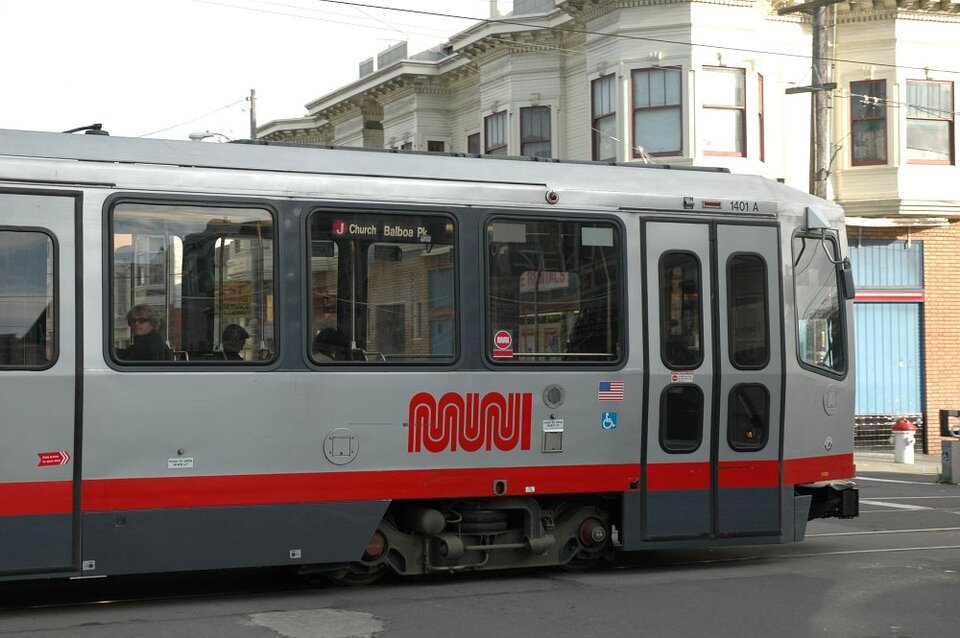
Michael In San Francisco, the streetcars are known to run according to a fantasy schedule. The train doesn't arrive at a specific time; instead, the schedule literally states "approximately every X minutes," with X varying between 10 to 30 depending on the time of day.
It is, of course, annoying to walk down three flights of stairs to the stop and then wait there for 29 minutes because the tram just left right in front of you.
As is often the case, Americans use advanced technology here to make the chaos manageable. The streetcars have recently been equipped with a transponder, and along the route, there are receivers that record whenever a street car passes by.
The live measured data is sent to the Website nextbus.com which calculates in how many minutes the next train is expected to arrive at a defined stop. This can then be queried for free and in real-time over the internet.
The system works perfectly. If I want to take the J streetcar to downtown, I simply check on my computer shortly beforehand, which is running 24 hours a day anyway. If the web browser then shows that the next car will arrive at the intersection of 24th and Church "In 2 Minutes," a frenzy breaks out, I dash down the stairs and rush onto the street. However, if it shows "In 15 Minutes," I fool around for another 10 minutes before starting a leisurely descent. One of my colleagues even has a cell phone with which he retrieves the data!
Michael When installing a ceiling light in Germany, a so-called Lüsterklemme" is often used. This is a plastic piece with small screws and holes, into which you insert the stripped wire strands from the back and front and then secure them with a screwdriver.
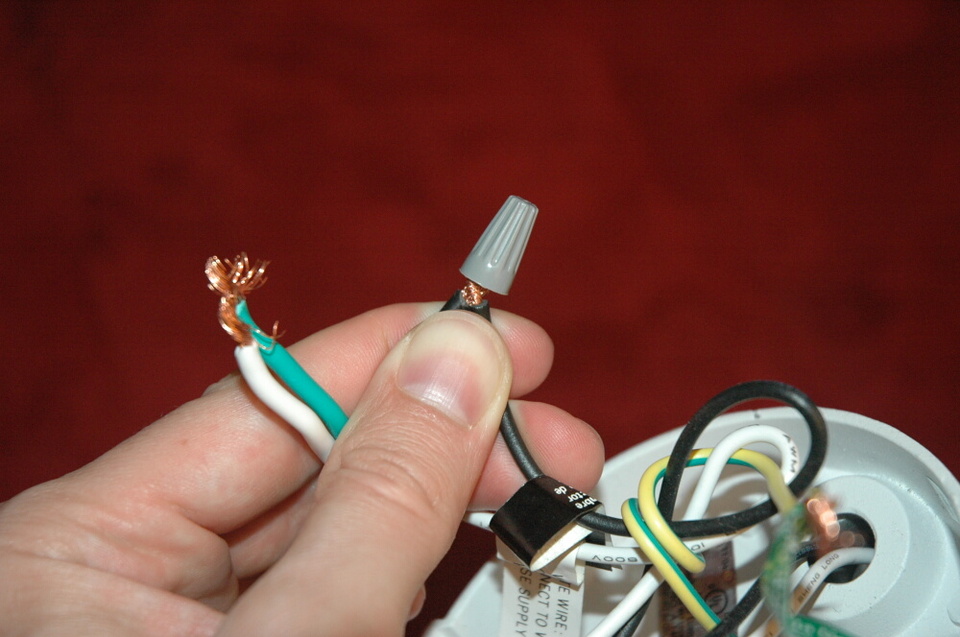
In the USA, there don't seem to be any terminal blocks, at least not in the hardware stores I frequent. As I discovered by unscrewing old ceiling lamps, small caps with an internal metal thread are commonly used here instead, called screw nuts.
To connect the two strands of two 110-volt lines, you twist the copper wires together and then place a cap on top, so that the metal wires catch in the inner metal thread of the cap. Then you screw the cap down clockwise, so that it grips the cable ends until no bare wire is visible.
The paint job is done! Such practices are known as "botched work" in Germany, but here it goes through perfectly. The method is cheap, insulates, and you don't need a screwdriver. And luckily, it's only 110 volts here and not 220, otherwise, it could be quite frightening!
The cap is called in technical jargon, by the way. http://en.wikipedia.org/wiki/Twist-on_wire_connector The company Ideal Industries introduced the groundbreaking world novelty in 1920 as the "Wire Nut" and registered the name as a trademark. And just like people in Germany say "Tesa" instead of "Scotch Tape," the term "Wire Nut" has become commonly used in American vernacular for the caps, even though nowadays they are, of course, only produced cheaply in China.
Michael Every language translates animal sounds slightly differently. Sometimes, something similar comes out, like with the cow, which goes "Muh" in German and the similar-sounding "moo" in English. But did you know that the sound for a horse neighing is "neigh" (pronounced "neehii")? By the way, in America, you don't urge a horse on with "Hüh" and stop it with "Brr," as you do in Germany. Instead, you start it with a double tongue click in the side/back of the mouth, similar to how you might attract a horse or cow in Germany when holding a carrot. A horse is stopped with "Whoa!" The latter is also the warning sound you make when you would say "Achtung!" in German, like when a piano is about to fall on someone's head.
In written English, the sound is called "tut-tut. Tut-tut It is spoken like typing with the tongue.
A dog goes "arf arf" or "bow wow" depending on its size. A trumpeting elephant goes "baraag," a frog goes "ribbit," a goat goes "baa," and a squealing pig goes "wee wee." On the internet, there are sites that list Animal sounds in different languages There are quite a few surprises for non-native speakers!
TODO
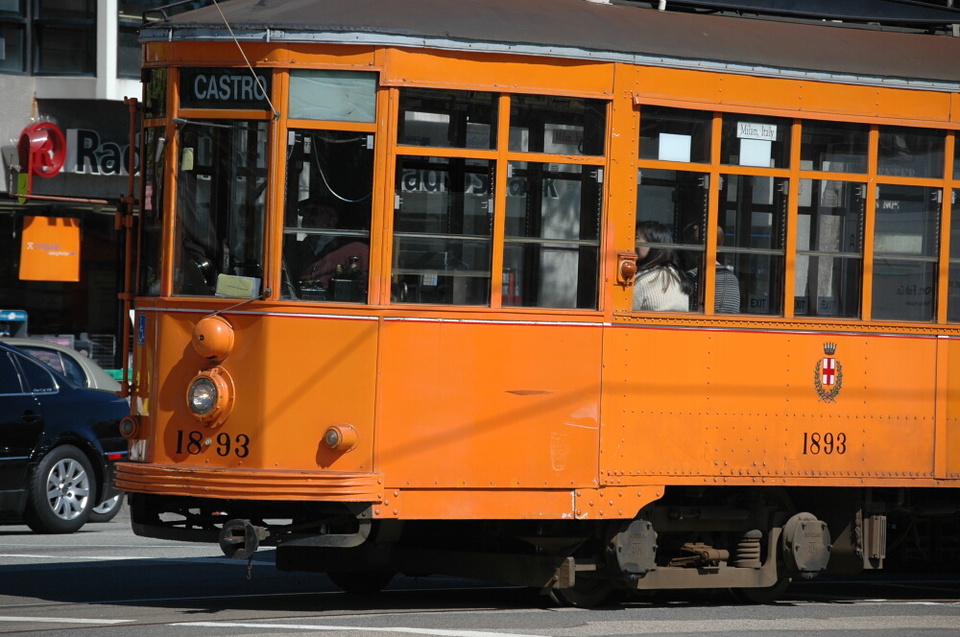
Michael We have often reported on our neighboring district, the Castro. Hardly any other district is as typical of San Francisco, and few are as tidy and picturesque. The area, formerly known as "Eureka Valley," became the center of the gay movement in the early 1970s. Harvey Milk, a political activist and later the first openly gay city supervisor of San Francisco, opened a camera shop in the Castro at that time. He was later shot by a homophobe, and the "Harvey Milk Photo Center" still commemorates him today, where Angelika often develops her pictures in the darkroom.
When someone at a party mentions that they live in the Castro, you automatically think to yourself, "Aha! Gay." According to statistics, 41% of people in the Castro identify as gay, while it's only 11% across the entire city. But believe me, being gay or lesbian is completely normal in San Francisco. Sure, tourists are always shocked, and even people from Silicon Valley giggle awkwardly when they come to San Francisco and stumble around the Castro with bright red faces. But let's be honest, in the end, the topic is irrelevant. If you live in San Francisco long enough, you eventually ignore the difference.
Interestingly, the Castro is a relatively affluent area where people with almost conservative inclinations live. No one drives just any car; it's almost always the latest Mercedes, BMW, Porsche, or Audi. No one lives in just any house; everything is appealing and lovingly arranged and furnished. The shops offer exquisite wines and stylish clothes, and even the household goods store "Cliff's Variety" only carries items for people with taste who value details. Angelika recently spent twenty dollars there on a simple egg timer! It's crazy!
The rainbow flags are ubiquitous in the Castro, and noticeably many men have short hair. There is a rich selection of excellent restaurants, and people love to stroll through the streets, chatting as if everyone knows everyone. The "Castro Theatre" is one of the oldest cinemas in the city, and it features an excellent selection of alternative, intellectually inclined films. Once a year, the so-called "German Festival" takes place there, showcasing new German films with English subtitles.
However, the Castro is brutally hilly. Anyone who wants to ride a bike through it should be prepared for quite a challenge, as it has some of the steepest hills in San Francisco, with gradients of 30% and upwards. We residents of Noe Valley often wander around the friendly Castro, as there is a lot to see and you can never have enough top-notch restaurants.
Angelika And here's a quiz question: Which is the American holiday (apart from December 25th and New Year's) that is always celebrated on the same date? Correct, Independence Day on July 4th, which is why it's commonly referred to as "4th of July." Other American holidays are based on the weekday in a specific month, such as "Labor Day" on the first Monday in September or "Thanksgiving" on the fourth Thursday in November.
The 4th of July 1776 is considered, so to speak, the birth of the United States, as the Declaration of Independence freed the nation from the yoke of the English. Nowadays, Independence Day is mainly characterized by somewhat patriotic parades, fireworks, and the obligatory barbecues with friends and family. In San Francisco, the fireworks often disappear into the fog. During the day, the weather is fantastic, but just before the fireworks, the notorious summer fog lives up to its name. This year, for a change, it was actually clear. Due to the limited American vacation days, we use every holiday to get away, and Yahoo! had also declared July 3rd a holiday. So we sped up north in our beloved car "Perlman" to Humboldt County, home of the Redwood National Park and various state parks under the patronage of California.
The so-called "Coast Redwoods" are truly a special kind of tree. These "coastal redwood sequoias" can live up to 2000 years and, in some cases, tower over 110 meters into the sky. About 60 meters is the average height. There's nothing better than lacing up your hiking boots and wandering through the redwood forest. How small and insignificant one suddenly feels. We did this in the "Prairie Creek Redwoods State Park.
To reach the parking lot of the hiking trail, we not only had to drive a few miles on an unpaved road, but also cross two small streams. Thankfully, the Perlman managed it with ease, even though it sits quite low compared to American cars. And although the campground, which was right on the beach, was bustling, we hardly encountered anyone on the seven-mile loop trail.
During our hike, we repeatedly came across plaques that named small sections of the forest after families. However, these are not gravesites; the plaques simply bear the names of generous donors whose funds were used to purchase Redwood land to protect the trees from commercial exploitation. The groves named after the donors do not belong to them; the plaques are merely a recognition of their willingness to donate. This "Save-the-Redwoods-League-Program" was established back in 1921 to preserve the Redwoods for future generations. Even today, Redwoods are considered one of the most sought-after types of timber.
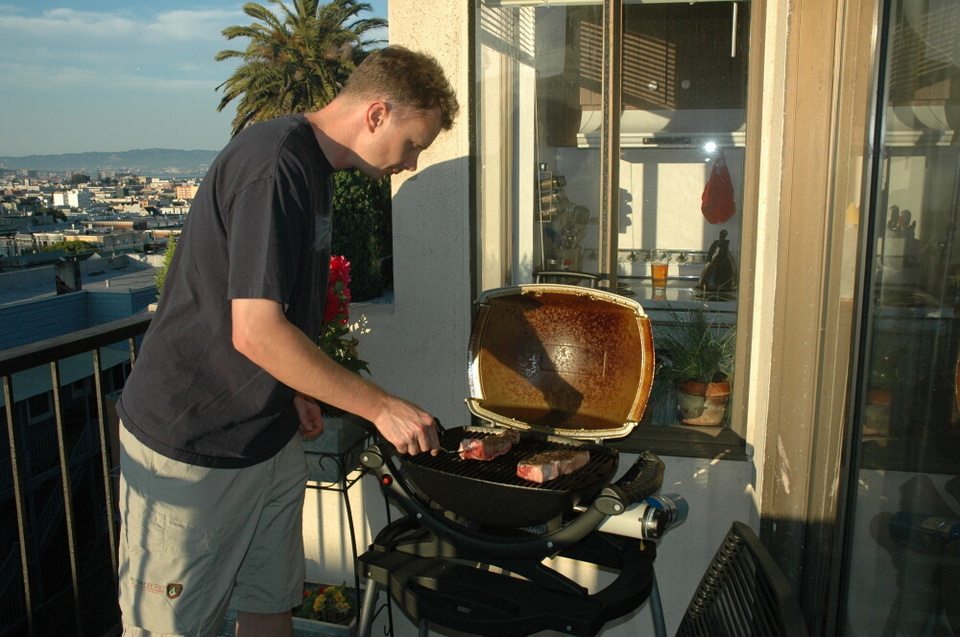
Michael The terms "home" and "grilling" are inseparably linked in America. A home is not complete until there is a so-called barbecue (BBQ) in the garden. The head of the family stands at it and prepares hamburgers or steaks for the whole family. Important: Grilling is a man's job.
Grills are sacred devices. Everyone has "the best one," and owners enjoy discussing how many... BTU Whether you have a grill or want to know the best way to prepare a particular cut of meat. Since we don't have a garden but only a small balcony, it was important not to buy a 32-hamburger monster. The "Weber Q" (pronounced "Webber Kju") is just right: serving up to six guests is no problem, and the unit is so handy that it takes up hardly any space. And you can really tell that it embodies the extensive experience of the renowned... The translation of "Grillfirma Weber" toEnglish is "Grill company Weber. The heat is distributed evenly, so nothing burns and nothing remains raw. It runs on small propane gas cartridges, which last for about 5 grilling sessions and cost $2. You can also buy an adapter for really large propane gas tanks, but Angelika is always afraid that I'll blow up our balcony.
I still remember exactly how the "Weber Q" came into the house. I had ordered it online from Amazon and was still working at AOL at the time. While I was sitting in the office, I suddenly received a call from the mailroom saying that the grill had arrived. Great, I said, when can you bring it to my cubicle? Well, stammered the AOL mailman, it's not that simple; it was clear that this was a personal item, and therefore I had to pick it up myself at the mailroom on the other side of Sunnyvale. I was shocked! Up until then, I had ordered at least a hundred things online, and the items had always been delivered to my cubicle by the mailman working at AOL.
I didn't make a big fuss and just went to the given address in God's name: "Caribbean Drive, Sunnyvale." Just before the post office, I saw that there was a company called Yahoo! located there, right before Caribbean Drive. A few weeks later, I applied there. The rest, as they say, is history.
Michael As loyal newsletter readers, you surely know the video website youtube.com, as we've mentioned it a few times before. A revolution is currently taking place there, with more and more people creating their own TV shows. A young lady named 'Brookers' has apparently influenced an entire generation of young people with her self-made clips. Video with theBrookers story Of course, it's on YouTube, and now the lady is supposedly going to get her own TV show.
More and more often, emails with funny links to YouTube videos are being sent, for example, recently the apparently Indian one. The video "TunakTunak" is a popular Punjabi music video by Indian artist DalerMehndi. The song itself is in Punjabi, and the title "Tunak Tunak"doesn't have a direct translation to English as it is more of arhythmic expression or catchy phrase used in the song. The video isknown for its vibrant visuals and energetic dance moves. which is immediately a However, this is a fragment and may not convey a complete thought without additional context. Cover version byRomanian teenagers The phrase "auf den Plan rief" can be translated to English as "called into action" or "brought into play.
And finally, the best from my email haul of the last few weeks: The Video of an Indiantraffic intersection The German word "die" translates to "the" in English. However, without additional context, it's important to note that "die" is the feminine definite article in German, used for feminine singular nouns. Ninja SpecialDelivery on the Topic of Net Neutrality The German word "ein" translates to "a" or "an" in English, depending on the context. However, the comma before "ein" suggests that this might be part of a larger sentence or phrase. If you provide more context, I can offer a more accurate translation. Boy plays Pachelbel'sCanon and Gigue in D major on the electric guitar. The German word "ein" translates to "a" or "an" in English, depending on the context. Funny commercial withbear attack The German word "ein" translates to "a" or "an" in English, depending on the context. The German phrase "ein offensichtlich" translates to "an obvious" in English. Crazy personcomplains to city council about helicopter noise The translation of "Und schlieÃlich" to English is "And finally. The worst dancevideo of all time .
Have fun with it!
The translation of "Angelika und Michael" to English is "Angelika and Michael.
Verrückte Videos" translates to "Crazy Videos" in English.