
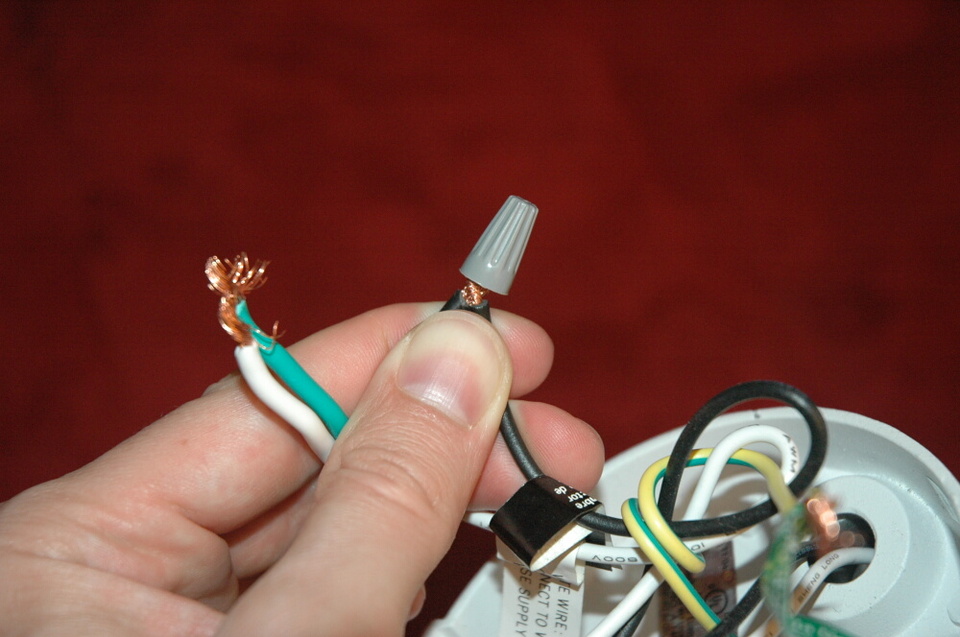
Michael When installing a ceiling light in Germany, a so-called Lüsterklemme" is often used. This is a plastic piece with small screws and holes, into which you insert the stripped wire strands from the back and front and then secure them with a screwdriver.
In the USA, there don't seem to be any terminal blocks, at least not in the hardware stores I frequent. As I discovered by unscrewing old ceiling lamps, small caps with an internal metal thread are commonly used here instead, called screw nuts.
To connect the two strands of two 110-volt lines, you twist the copper wires together and then place a cap on top, so that the metal wires catch in the inner metal thread of the cap. Then you screw the cap down clockwise, so that it grips the cable ends until no bare wire is visible.
The paint job is done! Such practices are known as "botched work" in Germany, but here it goes through perfectly. The method is cheap, insulates, and you don't need a screwdriver. And luckily, it's only 110 volts here and not 220, otherwise, it could be quite frightening!
The cap is called in technical jargon, by the way. http://en.wikipedia.org/wiki/Twist-on_wire_connector The company Ideal Industries introduced the groundbreaking world novelty in 1920 as the "Wire Nut" and registered the name as a trademark. And just like people in Germany say "Tesa" instead of "Scotch Tape," the term "Wire Nut" has become commonly used in American vernacular for the caps, even though nowadays they are, of course, only produced cheaply in China.