
Angelika Just like every year, we didn't miss out on our Hawaii vacation in 2010 either. In mid-September, we went to Kailua on the island of Oahu for a week. Michael, of course, tried to hone his surfing skills, which he had just acquired in San Diego, and was practicing tirelessly, trying to jump onto the board and staying there. We've often mentioned that in many ways, Hawaii is not very different from the American mainland. Especially on Oahu, there are, in our opinion, too many of the ubiquitous chains and so-called "Big Box Stores" like Walmart and Target, but then we also keep discovering truly unique things.
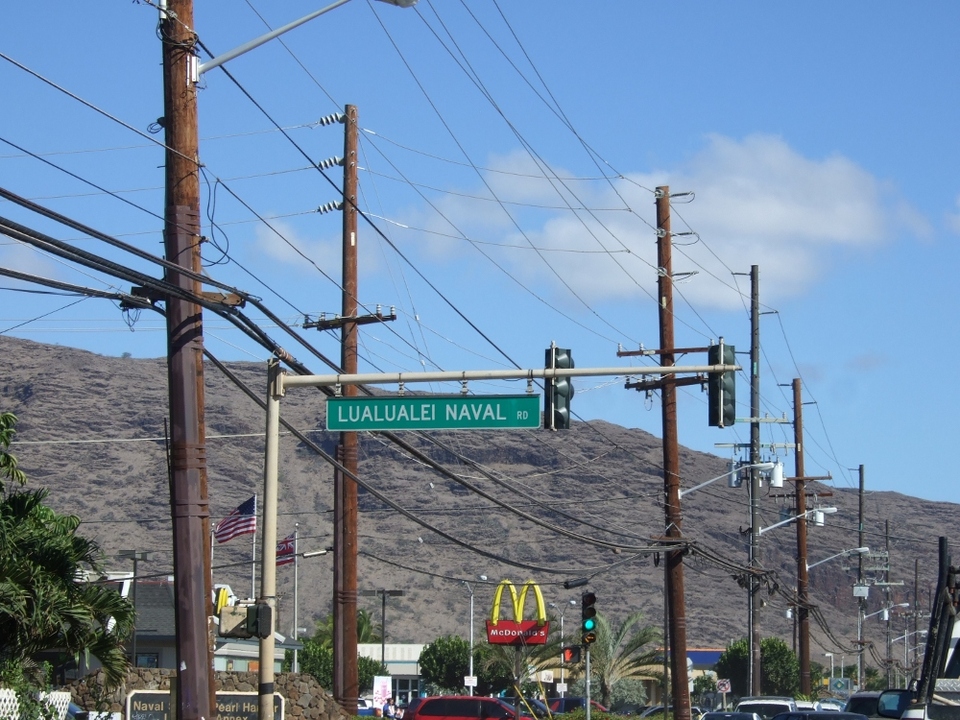
One of the more obvious typically Hawaiian phenomena is the language. English and Hawaiian are considered the official languages of the state. However, it's not the case that Hawaiian is spoken much in everyday life; only on the privately-owned island of Niihau is communication exclusively in Hawaiian. On the other islands, Hawaiian terms constantly flow into English. For "thank you," we always hear "Mahalo," and for greetings, "Aloha." Almost all place and street names are also Hawaiian.
Since the Hawaiian language has one of the shortest alphabets in the world and few phonemes, many things sound the same to us or are so similar that we often find it difficult to remember place names; not to mention the fact that there are identical place names on different islands. Like in German, there are often compound words. One of the best is: Humuhumunukunukuapua'a, a Hawaiian fish. The pronunciation is quite simple with knowledge of German. There are 5 vowels (a, e, i, o, u) and seven consonants (h, k, l, m, n, p, w) and the so-called 'okina. This is not an apostrophe, but it helps with pronunciation. It indicates where the speaker must pause. The correct spelling of Hawaii is actually Hawai'i, meaning the speaker stops briefly after Hawai (ai is pronounced like the German ei in this case) to emphasize the trailing "i" after a short silent pause. A macron over a vowel indicates that it is a long vowel.
Hawaiian belongs to the group of Polynesian languages. Until the arrival of missionaries in Hawaii around 1820, it existed only as a spoken language. The missionaries then used the Latin alphabet to write it down. Hawaiian was almost on the brink of extinction, but interest in preserving the language for future generations is now increasing. There are language courses again at the university and in high schools and kindergartens where only Hawaiian is spoken.