![]() |
| Angelika/Mike Schilli |
TODO
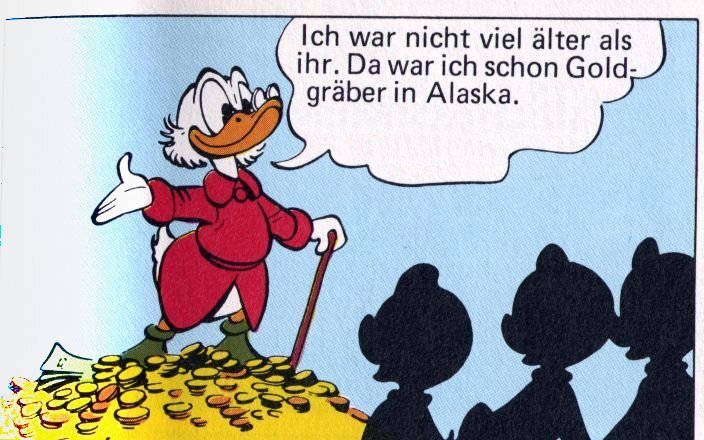
Michael If, like me, you used to enjoy reading Donald Duck comics, you surely remember that Uncle Scrooge laid the foundation for his fantastillion fortune in the Klondike. In this context, Scrooge always emphasizes that only the toughest and most cunning gold prospectors made it in the Klondike, and that this cold and inhospitable region in Canada's Yukon Territory is no place for wimps.
In Seattle, we recently visited the "Klondike Museum" and learned about how things unfolded back in 1897. Initially, rumors of gold discoveries from the northern territories reached the port cities of America, and since the American economy was quite stagnant in the last 10 years of the 19th century, hundreds of thousands set out to search for gold in Alaska. They gave up their jobs as salespeople, factory workers, or bank employees, liquidated their belongings, traveled to Seattle, and purchased a year's worth of provisions along with gold mining equipment. Ships then transported the so-called "Stampeders" (from stampede = trampling herd of buffalo) from Seattle in the northwest of the USA up to Alaska.
In Skagway and Dyea Translated to English, the passage reads:
"(pronounced: 'Die-ii'), two spots on the map without a proper harbor, where they unloaded the provisions, disembarked, and first had to overcome a muddy 70-kilometer mountain pass on foot to reach Lake Bennett, where they continued with self-built boats and rafts. In the Yukon area, there was naturally nothing to eat, so the brought provisions had to last for a year, weighing about a ton per man. Many traversed the pass up to 50 times to get their luggage to the other side, which took some people up to three months! The pass was crammed with caravans of men and lined with dead horses. The hard-hearted gold seekers were not exactly friendly to each other. I read that men who briefly rested by the roadside were often not allowed back into the caravan for hours, which snaked up the mountain pass man-to-man. That's how they are, the Americans, and it's still the same in traffic today!
Many realized that they had brought too little provisions or were not up to the hardships, so they sold off their equipment and returned home disappointed. Others recognized that they could make money in the interim camps by selling equipment or offering services, and they stayed in Skagway and Dyea without ever seeing the Yukon. When the ice on the waters finally broke after the long winter on May 29, 1898, 7,124 makeshift vessels, cobbled together from the surrounding timber, set off within 48 hours to travel on the Klondike River to the gold rush tent city of Dawson City in the Yukon. The makeshift settlement turned into a bustling town with wooden houses, streets, and 30,000 inhabitants by summer. It still exists today, even though the gold rush in Dawson ended after just two years.
Only a very few became rich in the Klondike, and those who did really lived it up, even though in Dawson City, prices for everyday goods were sometimes a hundred times the usual rate at the time. Supply and demand, of course. Many brought canned fruits or flour, but only a few thought to bring a broom. The latter were then traded for $17, an absurd price considering that a haircut and shave cost about 25 cents back then. However, in Dawson City, it was already $1.25.
However, after the initial gold discoveries, some enterprising individuals staked all the gold-bearing claims. Those who arrived later often had no choice but to toil for someone else for a daily wage. In the photo book... The Klondike Quest The translation of the provided text is: "everything is described in detail, an exciting story! And about the California Gold Rush in 1849 and the remaining ghost towns, we have already in the Rundbrief 02/2002 briefly reported
Arnie in Not" translates to "Arnie in Distress" or "Arnie in
Trouble" in English.
Angelika As the presidential campaign enters its dirtiest phase, our "Governator" Arnold Schwarzenegger is fighting his own battle in California: Until recently, the legislature of our Sunshine State had not managed to pass a budget.
The budget is supposed to be finalized by July 1st, when the fiscal year begins in California. However, it was only this week, more than 80 days later, that the politicians reached a compromise with Arnie. Passing the budget in California requires a two-thirds majority in both the state Senate and the House of Representatives. Therefore, bipartisan cooperation is currently essential.
The dispute revolved around how to fill the $15.2 billion budget gap. The Democrats wanted to increase our California sales tax, which is at least 7.25% in California, to 8.25% (San Francisco: from 8.5% to 9.5%). The Republicans, who view tax increases as one of the greatest evils of humanity, could not agree with this idea at all. Their solution was to cut state funds and borrow against future revenues from the state lottery.
Schwarzenegger, who, as you all know, is himself a member of the Republican Party, found the proposed tax increase by the Democrats to be acceptable. However, he only wanted to allow the increase for three years, and then in the fourth year, slightly reduce the sales tax below the current rate of 7.25%. This, in turn, made the Democrats furious.
Let them bash each other's heads in Sacramento," thought many. However, an unapproved budget means that the state of California is inadequately meeting its obligations, including to nursing homes and public schools. Due to the missing budget, the schools received only about 70% of what they are actually entitled to. Students waited in vain for their California student loans (the state's equivalent of federal student aid), and state employees in California had to temporarily accept a pay cut to the federal minimum wage of $6.55 per hour.
The union of the affected employees in the correctional system was so enraged by this that they initiated a "recall" action against Governor Schwarzenegger. This is almost amusing, as Arnie himself ousted our then-serving governor from office through a "recall" in 2005. Rundbrief 10/2003 However, the action of the prison guards fell on deaf ears among the population of California.
But back to the budget. On September 16, a two-thirds majority was finally found for a fourth proposal. In addition to cuts, the gap was to be filled by bringing forward tax revenues. California primarily generates its tax revenues through income or business taxes. Therefore, starting January 1, 2009, politicians wanted to withhold an additional 10 percent of California taxes from salaries and businesses. However, this would be done without effectively increasing the tax rate, as taxpayers would receive a refund of any overpaid amounts when they file their California tax returns months later. Ultimately, this was an accounting trick and an interest-free loan from the citizens to the state of California. Politicians justified it by arguing that most taxpayers in California underpay their taxes in advance and only settle the difference when they file their tax returns.
More money in the coffers ultimately doesn't result from this either. Schwarzenegger raged, among other things, about the absurdity of the financial gimmicks in the proposal and threatened to veto it, meaning he would not sign the budget. In response, the legislators shouted that they would override his veto, which in California requires a two-thirds majority.
However, it didn't come to that. The proposed withholding of California income tax through increased deductions from salaries is off the table. However, companies are expected to pay significant penalties if they do not prepay enough California taxes. Schwarzenegger also ensured that the "Rainy Day Fund" (the fund where reserves for tough times are kept) is strengthened and that there are stricter rules on when it can be tapped. The borrowing against anticipated lottery revenues remained in the budget but still requires the approval of California voters. Sometimes, one might think we are living in a banana republic and not in the state that is currently considered the eighth-largest economy in the world.
Michael In American rental apartments and cheap hotels, the bathtubs are often ridiculously small. Our tub, for example, is 134 cm long, 58 cm wide, and 30 cm deep. Someone like me, who is 1.85 m tall, has to contort quite a bit to fit in. That wouldn't be so bad, but to make matters worse, there's a lever (illustration 10) that opens and closes the bathtub drain, and its metal cover has an emergency overflow hole at the bottom. As a result, in a bathtub that's only 30 cm deep, the water can only rise to 21 cm before it drains through the emergency overflow!
That's obviously madness; only a trained yoga enthusiast could stay underwater with all body parts like that. When we were recently in a specialty store for bathroom supplies ("Bed, Bath and Beyond"), I noticed a new product at the checkout: the bathtub drain stopper. It's a cap made of soft plastic that you place over the overflow drain and attach to the edge of the tub with suction cups on the back (see illustration 11).
The bathtub drain stopper has a hole at the top, through which water can seep in during an emergency and flow out through the emergency drain of the outlet lever. The advantage: the water level can now rise to a full 29 cm instead of 20 cm, which is 50% more delightful hot bath enjoyment! Hot water is already included in the rent for us, as in many apartments, which is why the bathtub drain stopper is surely on the hit list of all landlords and hotel owners in San Francisco. It will probably be banned soon and only available on the black market, so quickly buy one for your next USA vacation! It costs 6 dollars at "Bed Bath and Beyond," a sky-high price for a piece of plastic, but I'm happy to pay for the idea.
Michael If you find it great that two Germans like us, who live in America, blog about America, you might also be interested to know that there is the reverse phenomenon: Americans who live in Germany and blog about Germany.
In Düsseldorf, for example, lives Andrew Hammel, an American lawyer and law professor. In his blog, German Joys He reports in English about all sorts of things that seem absurd from an American perspective, which take place in Germany. For example, Hammel provided a detailed account of Obama's visit to Germany and described the security measures, which required everyone who wanted to see Obama to pass through a metal detector, briefly turn on any electronic devices they were carrying, and take a sip from any drinks they had brought with them.
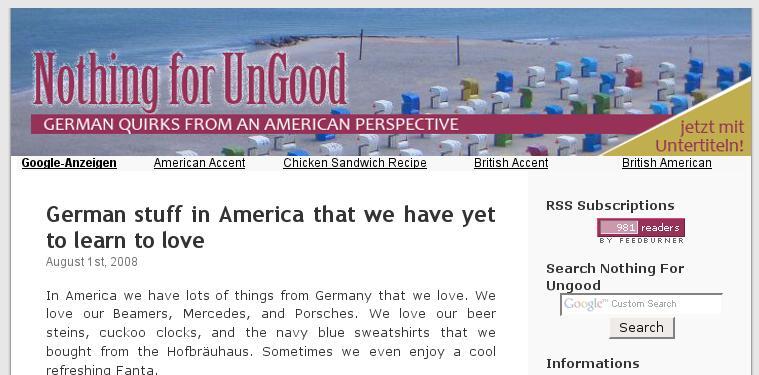
Another remarkable publication is Nothingforungood.com The text discusses the intentionally incorrect translation of "Nichts für ungut" (no offense). The writers correctly point out, for example, that while it's easy to get alcohol late at night in Germany, you might have to drive across the city to find an emergency pharmacy to buy aspirin, which you could easily get in any supermarket in America. They also note that at American parties, it's best to play songs that people have never heard before, whereas in Germany, it's more effective to play music that people know by heart and can sing along to when drunk. How true!
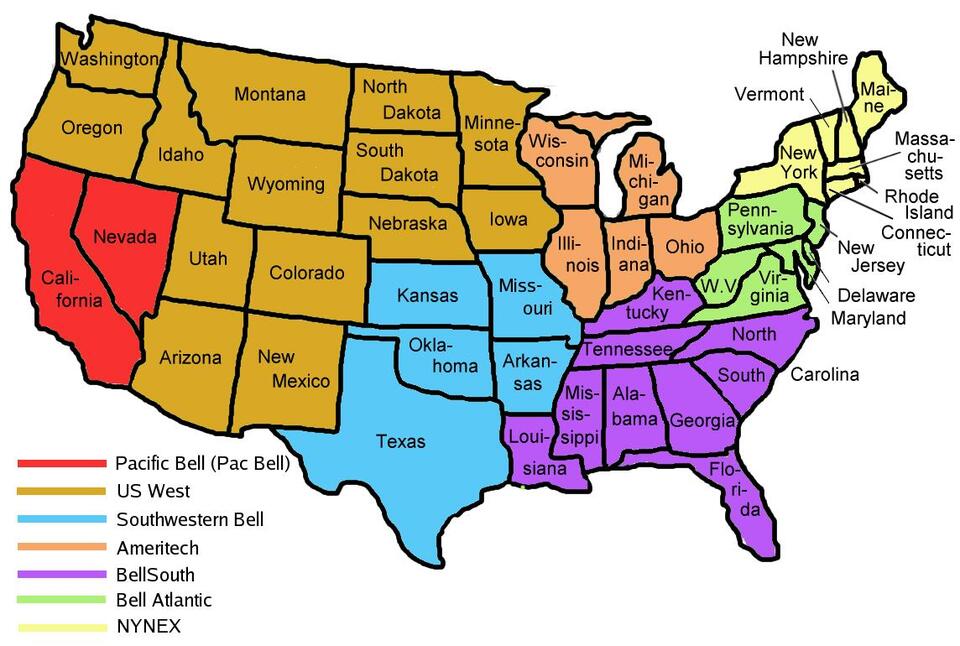
Michael The history of telephone companies in America dates back to 1875 when Alexander Graham Bell founded the "Bell Telephone Company," which later became "Bell Systems." For long-distance calls across state lines, the company AT&T entered the market ten years later and absorbed Bell Systems in 1899. For nearly a hundred years, AT&T operated a government-regulated monopoly until a judge in an antitrust case decided in 1984 that the giant should be divided into what were later called the "Baby Bells" (illustration 13). They were named "Pacific Bell," "Southwestern Bell," "US West," "Ameritech," "BellSouth," "Bell Atlantic," and "NYNEX." The 50 states were divided into seven regions, each of which was assigned one of the new entities to exclusively manage the telephone business in that area.
The parent company AT&T remained in the long-distance business, while the "Baby Bells" focused on local telephony. However, in 1996, the "Telecommunications Deregulation Act" allowed the Baby Bells to also engage in the long-distance business.
When we moved to California in 1996, we had a local telephone company called "Pac Bell," where we paid about $20 a month for a phone line. This included local calls, and for "local toll calls," which are calls in the nearby area, we paid a few cents per minute to Pac Bell.
For long distance calls, we could choose between three different providers: AT&T, MCI, and Sprint. The competing telephone companies tried desperately to poach customers from their competitors. They would call their competitors' customers at dinnertime, engage them in seemingly harmless conversations, and in the end, the telephone customer would find themselves with a different telephone company. This so-called... Slamming The translation to English is: "It was, of course, illegal, and the regulatory authority FCC stepped in after some time to rap the telephone companies on the knuckles.
One of the three long-distance providers, MCI, went bankrupt in 2002. Their CEO Bernie Ebbers is aproper noun, specifically a name, and does not require translation.Bernie Ebbers was a Canadian businessman known for being the CEO ofWorldCom, a telecommunications company that was involved in a majoraccounting scandal in the early 2000s. The translation to English is: "was slapped with 25 years for fraud and is now sitting with the Theterm "Häftlingsnummer" is German and translates to "prisoner number"in English. Therefore, "Häftlingsnummer #56022-054" translates to"Prisoner number #56022-054" in English. The term "Häftlingsnummer" is German and translates to "prisoner number" in English. Therefore, "Häftlingsnummer #56022-054" translates to "Prisoner number #56022-054" in English. In prison in Oaksdale, Louisiana. Expected release date: 2028.
And now pay close attention: In 1995, the AT&T subsidiary responsible for five states around Texas, "Southwestern Bell," renamed itself "SBC" and in 1996 purchased "Pacific Bell," which served California and Nevada. Later, it also acquired "Ameritech" and, brace yourselves: its own parent company, AT&T.
You have to imagine this: A company is forcibly split up, and after a few years, a child buys the parent. And not only that, the reunited family cheekily renamed itself AT&T, almost as if the forced breakup had never happened. A The translation toEnglish is: "Video of Stephen Colbert. Illustrates the story vividly and humorously (Many thanks to newsletter reader Daniel Scheibli for the link).
Soon, we received a letter (illustration 14) at our home, explaining that in the future, we would only need to pay one bill for phone, long distance, and internet service (which was previously also with Pac Bell). However, the three different phone numbers listed on the bill (illustration 15) for the three services give a hint that these are indeed three different companies under one umbrella. And when I recently tried to modify our long-distance savings plan (you pay a few dollars in advance each month and then get cheaper rates for minutes to, for example, Germany), I experienced the extent of the chaos in this company.
It starts with dialing a toll-free 1-800 number, telling an automated voice what you want, and then listening to idiotic music for an hour until a human comes on the line. I'm not exaggerating; I timed it.
Where do you end up? In India or Mexico, as you can easily tell from the speaker's accent. So, I explained my request, and they told me that the plan wasn't available with "AT&T Legacy" (which I had my long-distance plan with), but that I could get the plan with the new AT&T. Alright, I said, and I was transferred to a new representative to explain my request again. All clear, he said, he would switch the long-distance calls to the new AT&T with the savings plan I wanted, and to make sure everything was done properly, he would now transfer me to a "Third Party" (an independent third party) to confirm it, and then everything would be set. That made sense to me; this regulation was introduced to put a stop to "slamming.
It crackled on the line, and a totally annoyed gentleman with a robotic voice told me that he would now ask me some questions that I could only answer with "yes" or "no." Whether I wanted to switch my long-distance calls. "Yes." Whether I wanted to switch my "local tolls." "No," I said, because the guy hadn't mentioned anything about that before. Well, then he couldn't do anything, said the unfriendly gentleman, I must have been sent to him with incorrect information. I quickly asked if he could connect me back to the plan seller so that I wouldn't have to wait on the line for another hour. No, said the monster, and hung up. Unbelievable!
I didn't call again because we had to leave for the airport an hour later. After a week, we returned from vacation and I called again. The AT&T salesperson told me that my order was on hold because the confirmation had not been received. They explained to me that both "Long Distance" and "Local Toll" would be handled by the new AT&T, and transferred me again to the "Third Party," where I answered all questions with "yes" and got the plan I wanted.
That's just the problem with monopolies: the customer is left in the lurch. Or the postcard in illustration 16 that we recently found in the mailbox. AT&T sent us a confusing message, and even a call to the number provided only gave me fits of laughter. For your entertainment, I have the... Navigation through the phone labyrinth The translation to English is: "Recorded and posted on the internet. Completely crazy!
The translation of "Deutsche Spezialitäten in USA" to English is
"German Specialties in the USA.
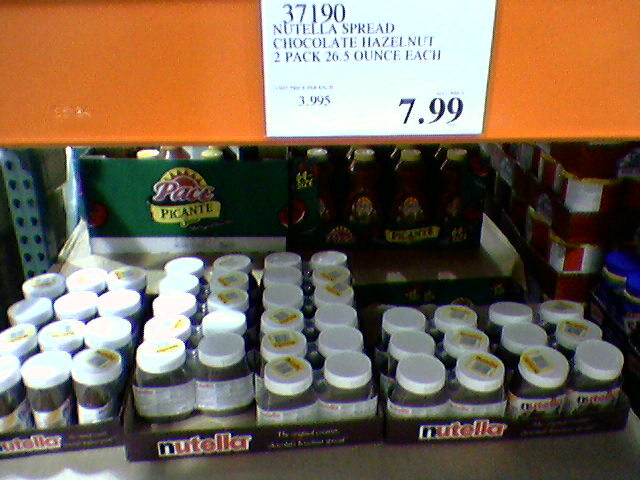
Michael We Germans in exile often crave familiar foods that aren't available in America. Examples include fresh rolls and pretzels, Duplo, blood sausage, peanut flips, and the hazelnut chocolate spread Nutella. In large US cities, you might occasionally find a deceptively similar imitation product on the supermarket shelf, but it can't be compared to the German Nutella.
Recently, travelers from Germany brought a jar of Nutella, and we conducted a blind test: a difference like day and night. The German Nutella tastes much more intensely of chocolate and nuts, while the American imitation is really bland and dull. Nutella entry onWikipedia The translation to English is: "It even states what ingredients the individual countries use. By the way, did you know that Nutella originally comes not from Germany but from Italy?
And recently I was at the Crossroads-Market Crossroads-Market In Mountain View, after more than ten years of unsuccessful searching, peanut flips were finally found. And they were actually rated as indistinguishable from the original by peanut flips connoisseur Angelika. The Iranian who runs the Crossroads store mainly sells Russian fish and sausage specialties, but also carries Jacobs Krönung coffee, Kinder chocolate, Pfanni potato dumpling packages, and German-style blood and liver sausages.
And a little further down San Antonio Road is the German butcher. Dittmer's Here's the translation to English:
", the Leberkäs, Kassler, calf liver sausage, Landjäger, WeiÃwürste, Hendlmaier mustard (8 dollars a jar!) has. He's not quite mastered making WeiÃwurst, but otherwise the products are top-notch. The nearby German bakery Esther's Bakery supplies the butcher with rolls and pretzels, but they often taste as if they were from the day before. However, what can you expect for $1.80 per pretzel in the diaspora? In Germany, Brezen Baur would sweep Esther away like a tornado sweeps away a loose tumbleweed.
The most fascinating thing about Dittmer's Butchery is the consistently Mexican sales staff. While in California they often only speak broken English, the Dittmer employees not only speak perfect English but also immediately understand what I mean when I say "calf liver sausage," "Landjäger," or "Leberkäse." It seems that Dittmer conducts special training! By the way, Dittmer himself is about our age, the son of German immigrants, and he only speaks a little German himself.
In the trunk of our car, there is a special cooler bag, and Dittmer sells bottles of frozen mineral water, so I can transport the highly sought-after meat and sausages to San Francisco, located 50 kilometers north, without any damage despite the Californian heat. What won't we do!
Angelika American party conventions are perfectly organized productions. The presidential candidate is officially nominated, presented in the best light, and the party itself is celebrated. There is an unparalleled cult of personality, and the speeches are full of self-congratulation. The candidates' wives and children add a personal touch to the whole affair. They are brought on stage to highlight why the candidate is suitable for the presidency. I much prefer Angela Merkel's husband, who does his own thing and always stays in the background or doesn't appear at all.
Nevertheless, I watched parts of the Democratic and Republican conventions on television and found myself grinding my teeth more than once. Traditionally, the party of the incumbent president holds its convention after that of the opposition party. Since Bush belongs to the Republican Party, Obama and the Democrats went first and held their convention in the last week of August in Denver.
Hillary Clinton put on a brave face and left no doubt that the bitter primary battle between her and Barack Obama was forgiven and forgotten. She no longer sulked over the fact that Obama chose longtime Senator Joe Biden from the state of Delaware as his vice-presidential candidate instead of her. Clinton even orchestrated the informal vote by acclamation (by voice vote/applause/show of hands) to confirm Barack Obama's nomination and to shorten the lengthy process of roll-call voting.
You may remember that during the close primaries, she threatened several times to let it come down to the convention with the help of the superdelegates in order to still be nominated. The highlight was the appearance of the terminally ill Senator Ted Kennedy, who showed up despite a malignant brain tumor. He embodies the American Democratic Party like no other, and the Kennedy clan still exerts an enormous attraction on the American population. What the royal family is to England, the Kennedy family is to many Americans. But I digress.
Barack Obama skillfully incorporated the issues important to the Democrats, such as healthcare, energy policy, education, the economic situation, and foreign policy, plus the Iraq War, into his speech. He also did not forget to weave in the better care and support of American soldiers. A must if one wants to make it to the White House.
He also tried to shake off the image of being elitist, which the Republicans were all too eager to pin on him. He talked about his single mother, who at times relied on food stamps to make ends meet. Such personal anecdotes are expected by the general public in the USA to be able to identify with the candidate. Quoting the American Dream (or the "idea of America," as Obama put it) was, of course, also a must. This is particularly true for Barack Obama, as he became the first Black person to win the presidential nomination of one of the major parties.
The columned backdrop as the stage set for his speech seemed a bit strange to me, though. The Democratic Party was still basking in the success of their convention and celebrating the historical significance of this nomination when John McCain stole the show from them by selecting Alaska's Governor, Sarah Palin, as his vice-presidential candidate.
The left-leaning press was stunned, while the right was in a celebratory mood. Sarah Palin embodies the myth of the American small town like no other: mother of five children, deeply religious, with ultra-conservative views on issues such as abortion, same-sex marriage, sex education in schools, and Darwin's theory. She not only knows how to handle a rifle but can also skin a moose and has taken on the oil industry in Alaska.
Now, Alaska is a very special state: vast in area, extremely sparsely populated, separated from the rest of the USA by Canada, rich in natural resources, and full of individualists who do not like being told by government officials how to live their lives. Although Palin is from Alaska and supposedly loves the natural beauty of her state above all else, she does not believe that global warming is caused by human behavior. This is despite the fact that in some areas of Alaska, the permafrost has become so softened by global warming that villages built on it are dramatically sinking and need to be relocated. She would also have no qualms about allowing oil drilling in the protected Arctic Wildlife Refuge.
McCain chose Palin as vice president purely for tactical reasons. First of all, she is a woman, and McCain hopes that disgruntled Hillary supporters will switch to Palin. However, Hillary Clinton and Sarah Palin have views as different as night and day, especially when it comes to women's issues. Additionally, McCain wanted to win over the Christian fundamentalist base of the Republican Party through Palin. McCain is not particularly popular there, as he has often made decisions in his long political career that contradicted their worldview.
What I absolutely do not understand, however, is that his plan also seems to be working. Since he placed Palin by his side, he has, in some polls, moved ahead of Barack Obama. As one of my favorite columnists, BobHerbert from the New York Times The statement correctly points out that the goal here is not to choose the next "American Idol" (the equivalent in Germany is "Deutschland sucht den Superstar"), but to find a qualified Vice President who can step in as President if necessary. As is well known, McCain is no longer among the youngest and has already had some serious illnesses.
Palin has no foreign policy experience and reportedly did not even possess a passport until recently. She believes that it is sufficient that Alaska is close to Canada and Russia. However, her platitudes are well-received. At the Republican National Convention, she repeatedly emphasized that she does not represent the establishment in Washington. Unfortunately, McCain has been part of it for almost 30 years. The slogan "Drill, Baby, Drill" also became a mantra for both Palin and McCain. Incidentally, McCain was against drilling for oil in the coastal regions of the USA before the election campaign.
When Sarah Palin isn't reciting pre-prepared lines, she often gets flustered. For instance, during an interview with Charlie Gibson from ABC, she didn't know what the Bush Doctrine entailed. I don't mean to brag, but as a newspaper reader, I know that the Bush Doctrine, among other things, states that countries posing a threat to the USA can be attacked preemptively. But it's likely that Sarah Palin and I don't read the same newspapers. In general, McCain's advisors allow Palin to give only a few interviews, and for the debates she will have with Joe Biden, a less open format is planned, as Biden is considered an experienced debater with a sharp tongue.
What annoys me the most, however, is the hypocrisy of the arch-conservatives. Shortly after McCain appointed Palin as his vice-presidential candidate, it leaked that her 17-year-old daughter is pregnant. Now, I believe that this indeed has nothing to do with Palin's qualifications for a high political office, but none of the religious right were upset about this "fall from grace." It happens in the best of families, and as long as the girl doesn't have an abortion, everything is fine. If Obama had a 17-year-old pregnant daughter, the ultra-right commentators would be all over it. Palin first insisted that her family was off-limits, only to then prominently display her pregnant daughter and her boyfriend on stage at the convention. She even brought her disabled baby along. I just hope that this country will still surprise me and elect the first black president in November. That would be something.
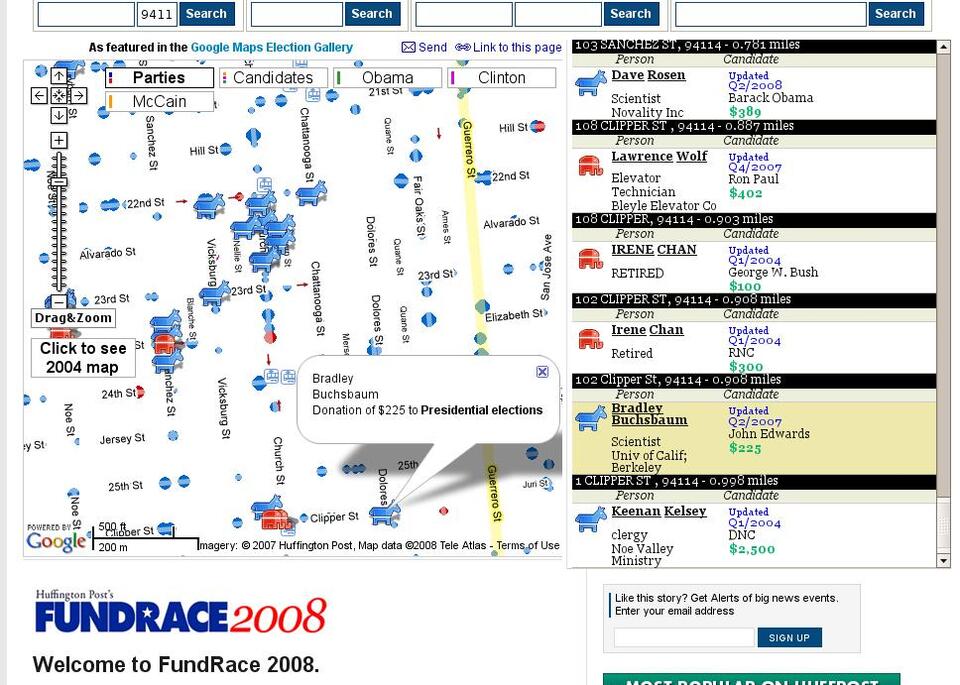
Michael Americans are very open about their political views; most have no problem sharing which candidate they plan to vote for in the upcoming presidential election in November. If they donate money to a candidate, this information is publicly accessible, and it was really only a matter of time before someone took the effort to display this on an online map.
The German word "auf" translates to "on" or "onto" in English, depending on the context. fundrace.huffingtonpost.com It is easy to find out which neighbors vote conservatively or which neighborhood donates the most money to which party. Donors can find not only their name and address there, but also their profession, the donated amount, which party received it, and before which election this happened. For example, I found out that one of my colleagues donated a whopping $1000 to John Kerry in 2004, who lost to Bush at the time! Naturally, I teased him quite a bit about it, as you can imagine.
The phrase translates to: "Greetings from two unwilling non-voters:
The translation of "Angelika & Michael" to English is "Angelika & Michael," as these are proper names and typically do not change when translated between languages.