
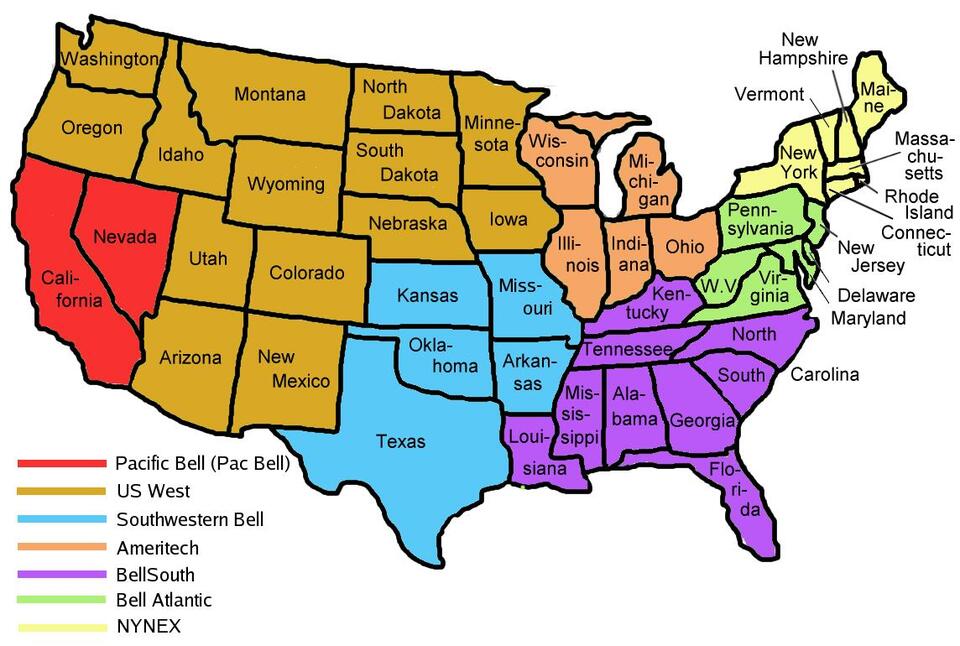
Michael The history of telephone companies in America dates back to 1875 when Alexander Graham Bell founded the "Bell Telephone Company," which later became "Bell Systems." For long-distance calls across state lines, the company AT&T entered the market ten years later and absorbed Bell Systems in 1899. For nearly a hundred years, AT&T operated a government-regulated monopoly until a judge in an antitrust case decided in 1984 that the giant should be divided into what were later called the "Baby Bells" (illustration 1). They were named "Pacific Bell," "Southwestern Bell," "US West," "Ameritech," "BellSouth," "Bell Atlantic," and "NYNEX." The 50 states were divided into seven regions, each of which was assigned one of the new entities to exclusively manage the telephone business in that area.
The parent company AT&T remained in the long-distance business, while the "Baby Bells" focused on local telephony. However, in 1996, the "Telecommunications Deregulation Act" allowed the Baby Bells to also engage in the long-distance business.
When we moved to California in 1996, we had a local telephone company called "Pac Bell," to which we paid about $20 a month for a phone line. This included local calls, and for "local toll calls," which are calls in the nearby area, we paid a few cents per minute to Pac Bell.
For long distance calls, we could choose between three different providers: AT&T, MCI, and Sprint. The competing telephone companies tried desperately to poach customers from their competitors. They would call their competitors' customers at dinnertime, engage them in seemingly harmless conversations, and in the end, the telephone customer would find themselves with a different telephone company.
This practice was called Slamming and was, of course, illegal. The regulatory authority FCC stepped in after some time to rap the telephone companies on the knuckles.
One of the three long-distance providers, MCI, went bankrupt in 2002. Their CEO Bernie Ebbers was slapped with 25 years for fraud and is now in prison, wearing prisoner number #56022-054 on his jumpsuit, in Oaksdale, Louisiana. Expected release date: 2028.
And now pay close attention: In 1995, the AT&T subsidiary responsible for five states around Texas, "Southwestern Bell," renamed itself "SBC" and in 1996 purchased "Pacific Bell," which served California and Nevada. Later, it also acquired "Ameritech" and, brace yourselves: its own parent company, AT&T.
You have to imagine this: A company is forcibly split up, and after a few years, a child buys the parent. And not only that, the reunited family cheekily renamed itself AT&T, almost as if the forced breakup had never happened. A video of comedian Stephen Colbert illustrates the story vividly and humorously (Many thanks to newsletter reader Daniel Scheibli for the link).
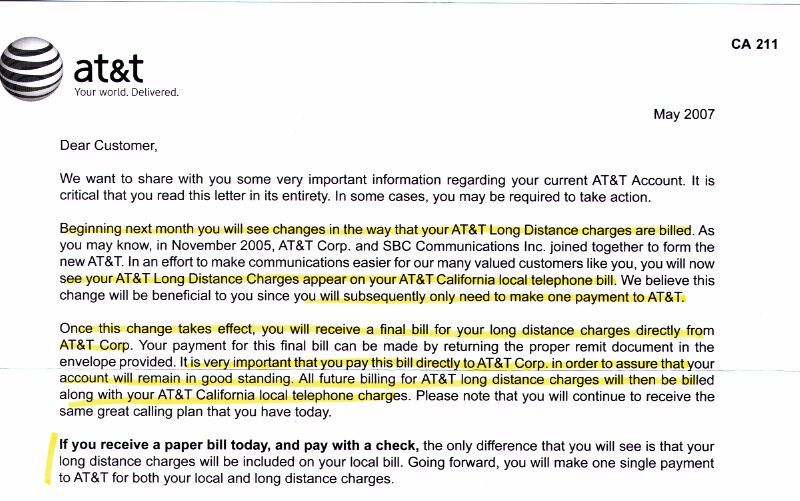
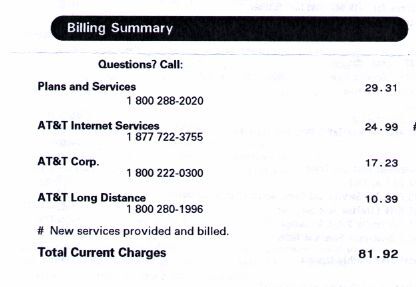
Soon after, we received a letter (illustration 2) at our home, explaining that in the future, we would only need to pay one bill for phone, long distance, and internet service (which was previously also with Pac Bell). However, the three different phone numbers listed on the bill (illustration 3) for the three services give a hint that these are indeed three different companies under one umbrella. And when I recently tried to modify our long-distance savings plan (you pay a few dollars in advance each month and then get cheaper rates for minutes to, for example, Germany), I experienced the extent of the chaos in this company.
It starts with dialing a toll-free 1-800 number, telling an automated voice what you want, and then listening to idiotic music for an hour until a human comes on the line. I'm not exaggerating; I timed it.
Where do you end up? In India or Mexico, as you can easily tell from the speaker's accent. So, I explained my request, and they told me that the plan wasn't available with "AT&T Legacy" (which I had my long-distance plan with), but that I could get the plan with the new AT&T. Alright, I said, and I was transferred to a new representative to explain my request again. All clear, he said, he would switch the long-distance calls to the new AT&T with the savings plan I wanted, and to make sure everything was done properly, he would now transfer me to a "Third Party" (an independent third party) to confirm it, and then everything would be set. That made sense to me; this regulation was introduced to put a stop to "slamming."
It crackled on the line, and a totally annoyed gentleman with a robotic voice told me that he would now ask me some questions that I could only answer with "yes" or "no." Whether I wanted to switch my long-distance calls. "Yes." Whether I wanted to switch my "local tolls." "No," I said, because the guy hadn't mentioned anything about that before. Well, then he couldn't do anything, said the unfriendly gentleman, I must have been sent to him with incorrect information. I quickly asked if he could connect me back to the plan seller so that I wouldn't have to wait on the line for another hour. No, said the monster, and hung up. Unbelievable!
I didn't call again because we had to leave for the airport an hour later. After a week, we returned from vacation and I called again. The AT&T salesperson told me that my order was on hold because the confirmation had not been received. They explained to me that both "Long Distance" and "Local Toll" would be handled by the new AT&T, and transferred me again to the "Third Party," where I answered all questions with "yes" and got the plan I wanted.
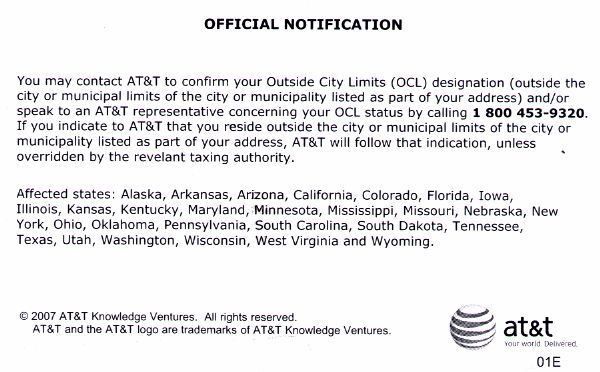
That's just the problem with monopolies: the customer is left in the lurch. Or take the postcard in illustration 4 that we recently found in the mailbox. AT&T sent us a confusing message, and even a call to the number provided only gave me fits of laughter. For your entertainment, I have the Navigation through the phone labyrinth recorded. Completely crazy!