![]() |
| Angelika/Mike Schilli |
Michael At the end of October, we were drawn to the state of Utah, home of the Mormons. If you're now thinking, "Oh God! A cult!", that's typically German, of course. In America, all religions are treated equally. There is no "right" religion, and when Scientology is persecuted in Germany, Americans just shake their heads and think of the old Nazi stories. Moreover, Mormons have been established in the USA for a long time and have 12.5 million members worldwide.
However, it must be said that the state of Utah in the USA has a rather medieval reputation, especially in progressive cities like San Francisco. If there is a political figure in America who appears even more reactionary than the current President George W. Bush, it is the senator from the Mormon state, Orrin Hatch.
Salt Lake City looks like a mix between Las Vegas and Disney World. It is so sprawling that our feet really hurt just from walking a few blocks. The streets are spotless, and even the few homeless people are clean and have carefully painted signs explaining why they need money.
When we arrived, it was already quite late, and we asked at the hotel reception where we could grab a bite to eat nearby. To our surprise, the porter immediately asked us if we also wanted to drink alcohol with it, which we laughingly affirmed.
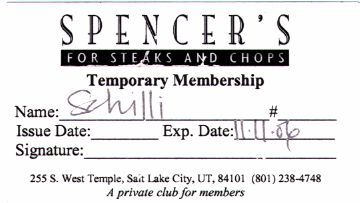
In Utah, there is a strict distinction between bars and dining establishments. If a place does not serve food, it only receives a license as a "Private Club." In such a club, one must become a "member" before being allowed to enter. This was the case at "Spencer's Steak and Chops," a dining establishment with an attached bar, where Angelika and I obtained a three-week temporary membership for the bargain price of $4, allowing us to try the legendary steaks along with two glasses of wine/beer. The steaks (highly recommended: the 12 oz. New York Strip Steak for $34) were truly excellent, even I, as a grill master, must admit. Overall, Utah has about 300 of these "Private Clubs."
Until recently, it was also illegal in Utah for two alcoholic drinks to be in front of a guest at the same time. For example, if a diner had not yet finished their white wine but had already ordered a red wine for the second course, the waiter had to insist on clearing the white wine glass before placing the red wine glass on the table. However, Utah has become more modern, presumably since the Winter Olympics a few years ago, and this absurd law was abolished. The article "What's up with Utah's liquor laws?" offers an amusing summary of the bizarre situation.
Salt Lake City even featuresthe excellent Brewpub 'Squatters', which brews and serves excellent beer. Beer in Utah can only contain 4% alcohol, while 6% is common in the rest of the country. The labels on the bottles hint with a wink at the precarious situation in the state: The Porter Ale is called 'Polygamy Porter' and likely alludes to some extreme Mormons who marry multiple wives, and the Pilsner is called 'Provo Girl', in reference to the town of Provo near Salt Lake City, where many conservative Mormons live.
Michael Salt Lake City is the Mecca for Mormons. If you are not familiar with this religion, here is a brief summary: The Mormons, known in America as "The Church of Jesus Christ of Latter-day Saints," believe in everything that is written in the Bible (Old and New Testament) but have their own prophet.
In 1823, an angel named Moroni appeared to the first Mormon prophet and founder of the Mormon Church, Joseph Smith. This happened on the American continent, in the northern part of the state of New York. The angel revealed to Joseph Smith the location of some golden plates that were written in an ancient language. Smith translated them and composed the "Book of Mormon" from them, the additional Bible of the Mormons.
The story begins with a man named Lehi, who sailed from Jerusalem to North America by ship 600 years before the birth of Christ. He had two sons, Nephi and Laman, who did not get along and founded two tribes, the Nephites and the Lamanites. After a thousand years of conflict, the Lamanites defeated the Nephites in the year 400 AD and exterminated them. The leader of the defeated Nephites was a man named Mormon, who had a son named Moroni -- and Moroni appeared to Joseph Smith 1400 years later as an angel.
The religion quickly gained many followers through Joseph Smith, and after some detours in the state of Illinois and some complications during which Joseph Smith was shot, the Mormons settled in a desert area in the state of Utah -- and from this settlement emerged what is Salt Lake City today.
The Mormons always have a living prophet. When the old prophet dies, the eldest of a group of twelve apostles automatically succeeds him.
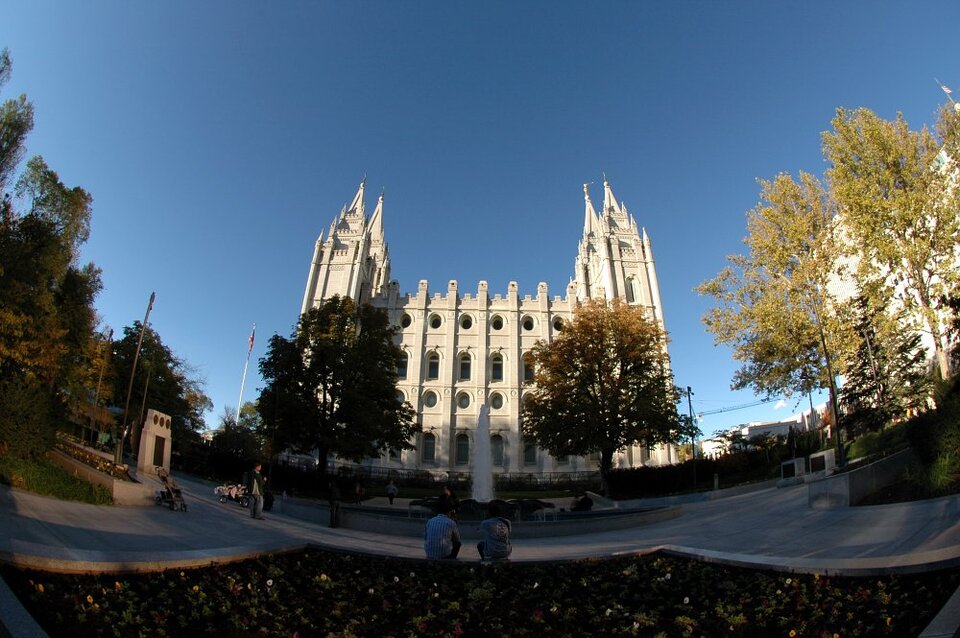
Mormons are always actively recruiting new members, and during our visit to the Mormon temple in Salt Lake City, we were repeatedly asked to fill out a form with our address, which we naturally declined with thanks.
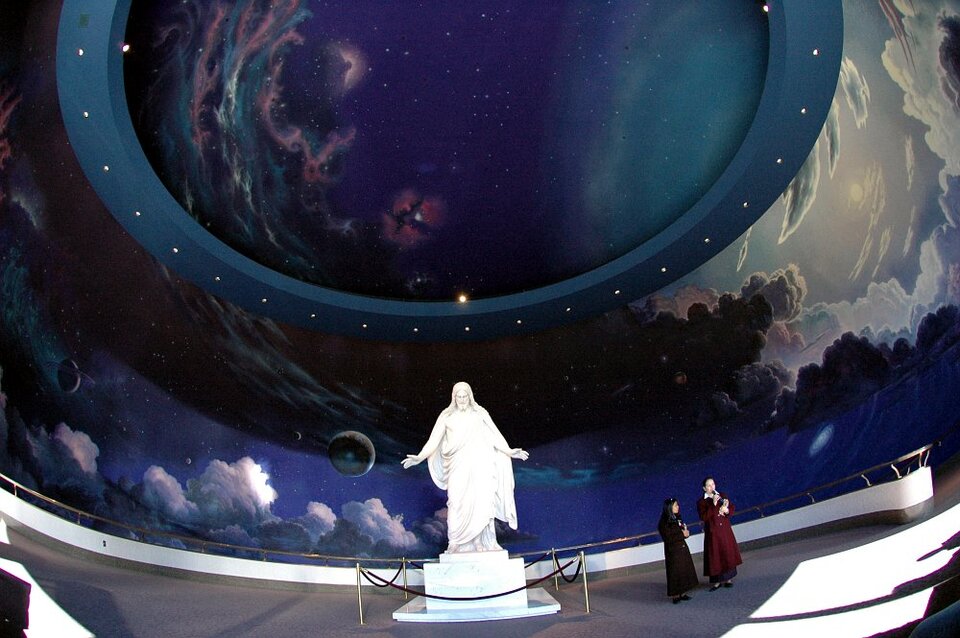
But we were allowed to participate in a tour, not inside the temple (which is members-only), but at least in the visitor center, where, in the dome hall, we heard a performance of the voice of Jesus Christ.
Michael Mormons believe that anyone who has not been baptized as a Mormon will inevitably go to hell. To spare their already deceased ancestors this inconvenience, they are simply baptized posthumously in the temple in their absence. That's why Mormons place great importance on genealogy. Everyone traces their ancestors back at least to their great-grandparents, and many even further.
To facilitate this time-consuming search, the "Genealogical Society of Utah" in Salt Lake City offers computer-assisted access to all sorts of old data collections, through which one can determine the names, life dates, and family relationships of ones ancestors.
In the library which is operated by the Mormon Church, there are hundreds of computer terminals available to everyone; you don't have to be a Mormon. We first watched an introductory film and were then guided to a computer by a friendly assistant.
Most queries are run through the website familysearch.org, which you can also try out at home. When searching for locations, the computer often displays a number that refers to a book in a nearby shelf or a microfilm in one of thousands of drawers.
We searched in the international department and couldn't believe our eyes: there were reams of German birth, death, and marriage registers from the 19th and 20th centuries available! I examined a microfilm with handwritten entries from my family's home village, Langerringen, a small village of 3,000 people near Schwabmünchen near Augsburg! Amazingly, I was even able to find several entries under the name I was looking for.
You can retrieve the microfilms yourself and without supervision, just open the appropriate drawer. It looks like a thick, wound film reel about 4 inches in diameter, roughly as wide as a photo negative. You then place the reel into a man-sized device, unwind the film a bit, and thread the loose end through a glass projection plate onto a take-up reel on the other side. Start turning the crank on the side panel of the apparatus and the individual frames are illuminated by a halogen lamp mounted above and projected onto a horizontal surface about 20 x 20 inches in size. As you wander through the aisles, you can see people busily turning the cranks, examining entries, and taking notes.
If you want to make a copy of an image you are currently viewing, you take the microfilm with both reels out of the machine and ensure that the image you are viewing remains open. Then you carry it over to the copy room, place it in a copier, and pay 23 cents for a paper copy.
The books in the library are also stunning. There are even editions of the old Nazi magazine "Ahnenerbe - Association for Clan and Heraldry Research Assistance, Heredity and Racial Care." And something I didn't know either: In 1529, the Turks were at the gates of Vienna, and the defense of the Western world was financed in the German Empire with the so-called "Turk Tax." In the collection of the "Family History Library," I found a book in which the Turk Tax register of 1584 was reprinted. In illustration 10, you can see who paid how much and when, and if not, why. If you are not familiar with old currencies: A gulden (fl. = florin) was worth 15 batzen (b.) at the time, and a batzen was worth 4 kreuzer (kr.).
You can search anonymously, it costs nothing (except for copying), and you can browse to your heart's content independently and without being bothered--a truly great service from the Mormon Church. We got so carried away in our research that we didn't even notice how time flew by. When we finally looked at the clock, five hours had passed. Unfortunately, we didn't see much of the rest of the city because it soon got dark, and we hadn't even eaten yet!
Angelika Most German tourists associate the state of Utah not with a Mormon stronghold, but with breathtaking national parks. Arches, Bryce Canyon, Zion, and Canyonlands are usually part of a German tourist's classic tour itinerary. Curiously, "Capitol Reef National Park," although also located in Utah, is one of the lesser known and visited parks.
We had also skipped the park during our big trip to America in 1987. It is quite out in the sticks, far away from major big cities. Salt Lake City is about 220 miles away and Las Vegas 360 miles. Many of the most beautiful spots in the national park can only be reached via unpaved roads or on foot.
Despite this seclusion, around the year 1880, Mormons settled in what is now the park and founded, among other things, the tiny settlement of "Fruita," a reference to the fruit-bearing trees they planted in the rock-enclosed valley, which still green the barren desert landscape today. Native Americans from the so-called "Fremont Culture" tribe had been, of course, there before the Mormons, but left the area for reasons that remain unclear. The park owes its somewhat unusual name to the fact that a rock formation resembles the dome of the Capitol in Washington, and the pioneers encountered difficulties crossing the steeply rising rocks, which reminded them of the insurmountability of a reef. The park's special feature is the so-called Waterpocket Fold, a geological shift of the Earth's crust at a fault. Geologists know this Waterpocket Fold as a classic "monocline," meaning a fold where the rocks rise steeply on one side and otherwise display horizontal layers.
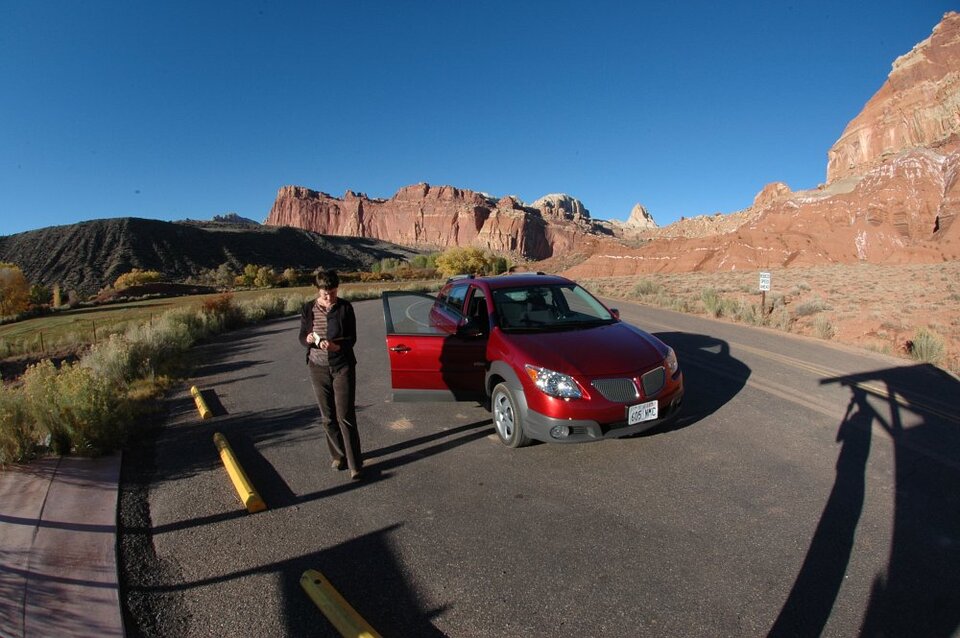
When we reached the park late in the afternoon, the lower sun made the red, yellow, and orange of the rock formations appear particularly dramatic. The view was magnificent, and we could have surely heard a pin drop, it was so quiet. In the following days, we hiked through deep rock canyons to remote waterholes and drove our old-fashioned-looking rental car on the "Burr Trail Loop," which spans a modest 120 miles (30 of which are unpaved!) through seemingly untouched landscapes. We hardly encountered anyone and felt like we were in another world. In such moments, I always reflect on how small and insignificant we humans really are. By the way, the rental car company's contract usually states that you shouldn't drive the vehicle on unpaved roads. This makes sense, because they don't want to have to pull you out of some mud hole in a godforsaken area. However, many unpaved roads can be driven on without any problems with a normal car, so we have often disregarded this rule (don't follow our example, though).
I still maintain the habit of always asking a ranger at the visitor center about the road conditions in a park. This time was no different. The ranger confirmed, "No problem at all, since the unpaved section was just leveled yesterday." So we set off undaunted until we came to the first mud hole. Our beloved "Perlman" would have easily managed to cross the little stream, but it was parked at home in our garage in San Francisco.
And the rental car was a Pontiac Vibe, which looks like a modern version of the old taxis in England and, with its small tires, and doesn't quite fit into the rugged desert landscape of Utah. But Michael, the terror of the road, was undeterred and maneuvered us through the water without getting stuck. Thankfully, we were spared any further surprises. However, the red sand had crept into every crevice of the car. The maintenance guy at the car rental company surely must have had his own thoughts about it.
Capitol Reef National Park is open year-round, by the way. We just wondered how one could still get something to eat in the winter. Not only did one restaurant after another close at the end of October, but even the grocery store shut down, and some motels also closed their doors until spring. The waiter in one of the still-open restaurants mentioned that Torrey, the small town where you stay when visiting the park, resembles a ghost town in the winter.
On our return trip to Salt Lake, winter suddenly set in. According to the car's external thermometer, the temperature dropped to 32 degrees Fahrenheit (which is 0 degrees Celsius) and it started to snow. When some snow actually stayed on the road, the sun-spoiled Californian driver started to sweat a little! But it wasn't too bad, and it was sunny again when we returned to Salt Lake City.
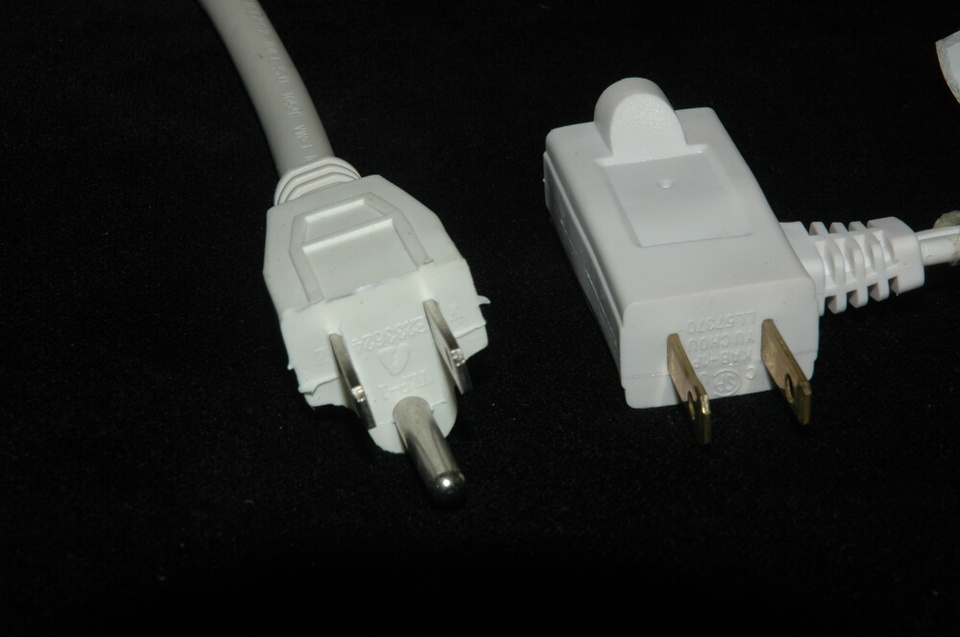
Michael If you've ever traveled to the U.S. with your German electical razor or hairdryer, you will have noticed that German plugs do not fit into American sockets. This is because, instead of the round plugs common in Germany, known as Schuko plugs, American plugs have flat metal prongs.
The best place to buy American adapters for German plugs is in Germany. In the USA, you usually only find the reverse version, meaning plugs for American globetrotters who need to adapt their flat plugs to the round sockets in Europe. However, in electronics stores like Fry's or Radio Shack in the USA, you can also find adapters for German plugs to American outlets, but be aware that they come at a premium price. A clever globetrotter trick is to buy just one adapter and bring a power strip from your home country, allowing you to connect multiple devices at once.
And it should be noted that not only the plugs are different. The voltage in the American power grid is only 110 volts, just half as much as the 220 volts common in the German power grid.
This means that when you connect a German device to an American outlet using an adapter, only half as much power is supplied. Without special measures, hairdryers or razors will therefore work very slowly, if they work at all.
In illustration 16, you can see our travel hairdryer, which can be switched from 230V (220 or 230V, it doesn't have to be exact) to 110V by inserting a coin into the slot and turning it. If you do this, you can use the hairdryer (provided you have the appropriate plug adapter) in the USA without any problems. However, if you forget to switch it back in Germany, the device might be blown to pieces if you plug it into the German power grid there at 220V.
Highly sophisticated devices, such as some laptop power supplies, desktop computers, or monitors, can even handle both voltages, 110V and 220V, without any adjustment. This is indicated on the power supply. Simply plug it in with a plug adapter, and you're good to go.
There is also the possibility of transforming the 110V from the American socket up to 220V. However, this is an old-fashioned method from the last century that requires thick metal cores with many wire windings and produces alarming energy losses.
If a device only consumes around 50 watts, you can get a small transformer for little money (about $7, see Transformer at Fry's). Buy one that converts the 110V from the American power line to 220V and also provides the correct round sockets for German electrical devices.
A razor or an electric toothbrush operate below the 50-watt mark and can be easily connected. However, even a small hairdryer consumes at least 10 times that amount, around 500 watts and upwards. If you connect such a device to a small transformer, it will overheat and can cause serious problems. Transformers for electrical devices up to 1000 watts cost around $30 and are very heavy. This is only worthwhile in exceptional cases. And, as mentioned, a small transformer consumes electricity even when idle and heats up. Such waste might have gone unnoticed in the 1960s, but nowadays it is completely unacceptable.
The frequency at which the alternating current from the outlet oscillates is 50Hz in Europe and 60Hz in the USA. In the 1980s, there were clock radios that utilized this oscillation and therefore did not function properly with the wrong frequency, but nowadays this is irrelevant, as they all use different methods.
As with German Schuko plugs, there are three-pronged versions (with a round grounding pin) in American power plugs and those with only two contacts. This can be super annoying, for example, when an American laptop power supply has a three-pronged plug, but the hotel outlet only provides two prongs, which does happen. For such cases, I have a probably illegal neon green adapter from a past trip to Japan (Japan has the same outlets), which converts three prongs into two.
In the case of two-pronged plugs, one of the metal contact plates is usually slightly wider (for the experts: this is the neutral prong, as opposed to the thinner phase), so the plug can only be inserted in one direction.
If you'd like to dig deeper, the Wikipedia entry on Power Plugs nicely compiles everything worth knowing about North American power outlets.
Michael Recently, I was watching the latest episode of "The Simpsons" as usual and couldn't believe my eyes: they were actually making fun of the US Army, which is currently having serious trouble recruiting new soldiers due to the dire situation in Iraq.
And that on the right-leaning government propaganda channel FOX, just imagine that! As seen in the movie "Outfoxed - Rupert Murdoch's War on Journalism", FOX employees, under the leadership of the sinister media mogul Rupert Murdoch, use unscrupulous methods to present news in a certain light.
In Germany, the Bundeswehr also doesn't have a good reputation, but the American Army never encountered such a negative attitude until now. Until about half a year ago, solidarity with the fighting troops prevailed in America, but recently this has started to crumble.
The former Democratic presidential candidate John Kerry recently claimed that those who are too dumb to learn cannot go to college and end up on the front lines in Iraq. This sparked protests from the Army in Iraq, and some US soldiers made a funny banner and sent it as a greeting back home.
And now, in the Simpsons TV series, lines like "Even the dumbest teens in the dumbest town in the dumbest state know better than to join the Army" are being said. This prompts your intrepid newsletter reporter to ask: Quo vadis, Ministry of Defense?
Whoever wants can view the excerpt from the Simpsons episode on alternet.org.
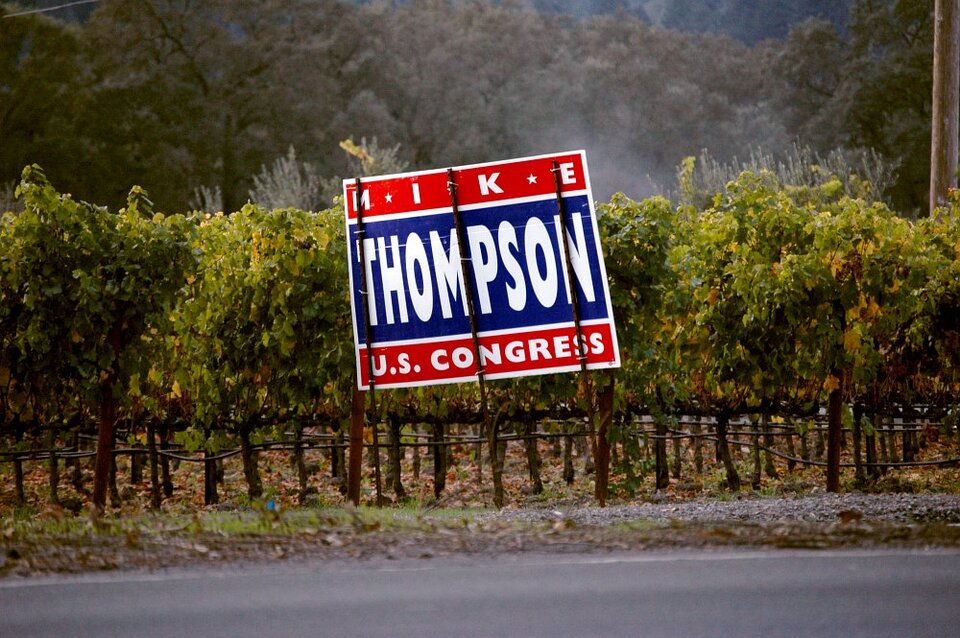
Angelika I had already given up hope, but Bush finally received a lesson for his policies in the congressional elections on November 7. Not only the House of Representatives, which had been firmly in the hands of the Republicans since 1994, but also the Senate returned to the Democrats after a long time.
The people have spoken and have settled on the golden mean. Although ultra-right Christian groups were mobilized, their tasteless propaganda campaign ads did not have the desired effect. Moderate to conservative Democrats gained votes. The Iraq War is no longer well-received by the population, and since there were no presidential elections, voters could only indirectly punish Bush by voting for the Democratic Party. The House of Representatives in the USA consists of 435 members, who are directly elected every two years. The number of representatives allocated to each state is determined by the population of the respective state. For example, the populous state of California elects 53 representatives, while the small state of Maine is only allowed to send two.
Within a state, there is an electoral district for each representative to be elected, known as a "congressional district." However, these districts are not always aligned with city boundaries and sometimes appear to be drawn quite arbitrarily. For example, the 8th Congressional District comprises almost all of San Francisco, with the exception of the 'Sunset' district. This predominantly Asian-inhabited neighborhood, on the other hand, falls within the '12th Congressional District,' which also includes the entire Silicon Valley.
The boundaries of the electoral districts are redrawn every 10 years after the census by the incumbent government of the respective state, which is interested in dividing the constituencies in a way that gives its party an advantage. Through clever so-called gerrymandering, it is rare for incumbents of the respective electoral district to be voted out. This practice is, by the way, Gerrymandering, is named after the former Governor of Massachusetts, Elbridge Gerry (1744-1814), who initiated it. The created electoral district resembled a salamander in shape on the map (Gerry + Mander = Gerrymander).
Electoral district boundaries are drawn based on factors such as the age, race, income, and religion of the voters, so that the opposing party's candidate cannot win there, effectively rendering the votes for the opposition irrelevant.
The 100 senators in the Senate are also directly elected. However, the crucial difference is that each state, completely independent of its population density and size, sends two senators. Senators are elected for six years, so approximately one-third of the senators are up for election every two years. The Vice President presides over the Senate. The fact that each state provides two senators is intended to give sparsely populated states more weight in political decisions.
And the election for the Governor of California was also happening, where our "Gouvernator" Arnie Schwarzenegger won by a landslide. You might be wondering how it is possible that in the House of Representatives and Senate elections the Democrats were successful, and yet in California, which usually votes for the Democratic Party, Schwarzenegger, who belongs to the Republicans, is still in office.
This was partly due to the unremarkable figure of his Democratic challenger Angelides and partly due to Schwarzenegger's skillful distancing from Bush. Schwarzenegger also emphasized bipartisanship in most of his commercials, which many voters appreciated. Some even go so far as to consider Schwarzenegger a closet Democrat, as he not only supports stem cell research but also wants to aggressively advance California's leadership role in environmental protection. In general, he approaches political matters quite pragmatically, which is well-received in laid-back California.
Another historic event is credited to California, specifically San Francisco. Nancy Pelosi, 66 years old and representing San Francisco in Congress since 1987, will become the first female Speaker of the House of Representatives, which formally elevates her to the third most important person in government. Pelosi belongs to the more left-leaning spectrum of the Democratic Party. However, it remains to be seen how many compromises she will have to make in her new position, but hopefully, the liberal spirit of San Francisco will continue to accompany her.
Angelika As a child, I loved the Meister Proper commercials on German TV. I think I just liked the catchy jingle "Meister Proper cleans so well that you can see your reflection." Funnily enough, "Meister Proper" is called "Mr. Clean" in America, but even there, he manages to keep homes sparkling clean with his products.
I'm not exactly known for being a cleaning fanatic, but one thing drives me crazy: black streaks on white walls that seem to appear out of nowhere. The Magic Eraser from Mr. Clean takes care of them. It's a little white sponge that you just wet and wipe over the streaks, and they're gone. By the way, "eraser" is a great name for this product. Supposedly, the Magic Eraser removes all kinds of dirt, but I haven't tried that yet. Clean walls are enough for me.
Michael As a counterpart to the top product, today we are also introducing a junk product: the sinus relief drug "Sudafed PE." "Sudafed" is the standard medicine in America for clogged sinuses, and the stuff is really good; I once used it to clear up a sinus infection so I could go on a diving course in Australia. Recently, I had a cold and wanted to buy Sudafed at the drugstore when I noticed "Sudafed PE." It supposedly contains the same active ingredient, just in the form of a palate adhesive strip, as previously mentioned (Rundbrief 03/2003).
But what did I have to find out! Upon opening the package, it turned out that 90% of the box's contents consisted of air! And in terms of effectiveness, I would say that this stuff is inferior to the real Sudafed. Total junk and rubbish!
Greetings from the land of the capital crooks:
Angelika & Michael