
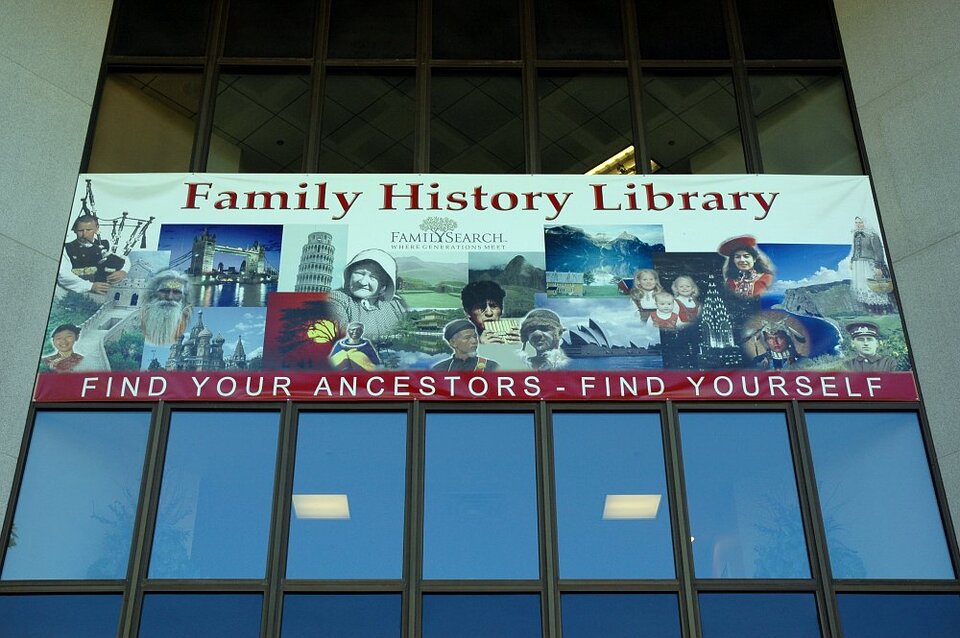
Michael Mormons believe that anyone who has not been baptized as a Mormon will inevitably go to hell. To spare their already deceased ancestors this inconvenience, they are simply baptized posthumously in the temple in their absence. That's why Mormons place great importance on genealogy. Everyone traces their ancestors back at least to their great-grandparents, and many even further.
To facilitate this time-consuming search, the "Genealogical Society of Utah" in Salt Lake City offers computer-assisted access to all sorts of old data collections, through which one can determine the names, life dates, and family relationships of ones ancestors.
In the library which is operated by the Mormon Church, there are hundreds of computer terminals available to everyone; you don't have to be a Mormon. We first watched an introductory film and were then guided to a computer by a friendly assistant.
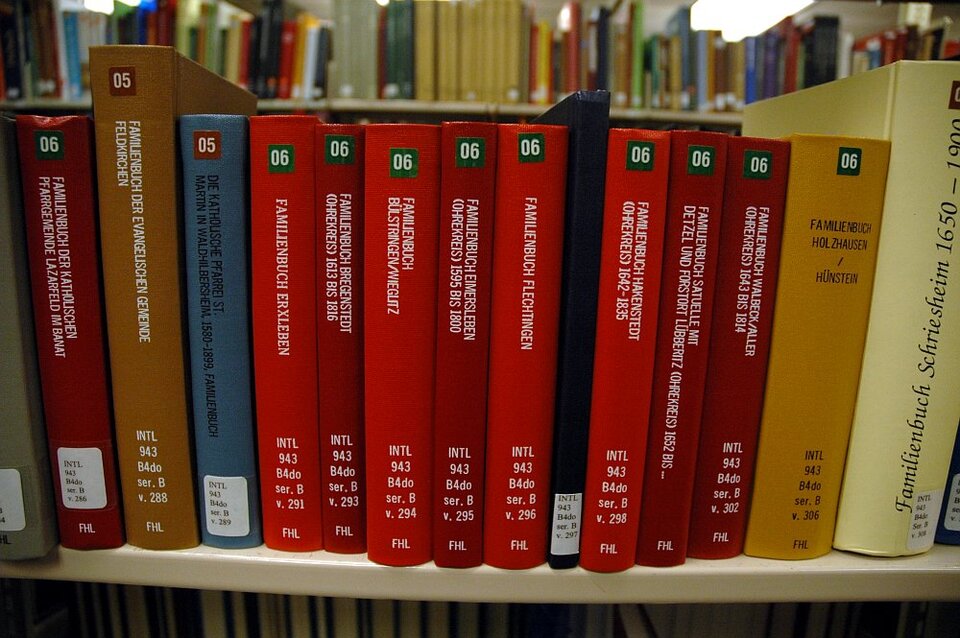
Most queries are run through the website familysearch.org, which you can also try out at home. When searching for locations, the computer often displays a number that refers to a book in a nearby shelf or a microfilm in one of thousands of drawers.
We searched in the international department and couldn't believe our eyes: there were reams of German birth, death, and marriage registers from the 19th and 20th centuries available! I examined a microfilm with handwritten entries from my family's home village, Langerringen, a small village of 3,000 people near Schwabmünchen near Augsburg! Amazingly, I was even able to find several entries under the name I was looking for.
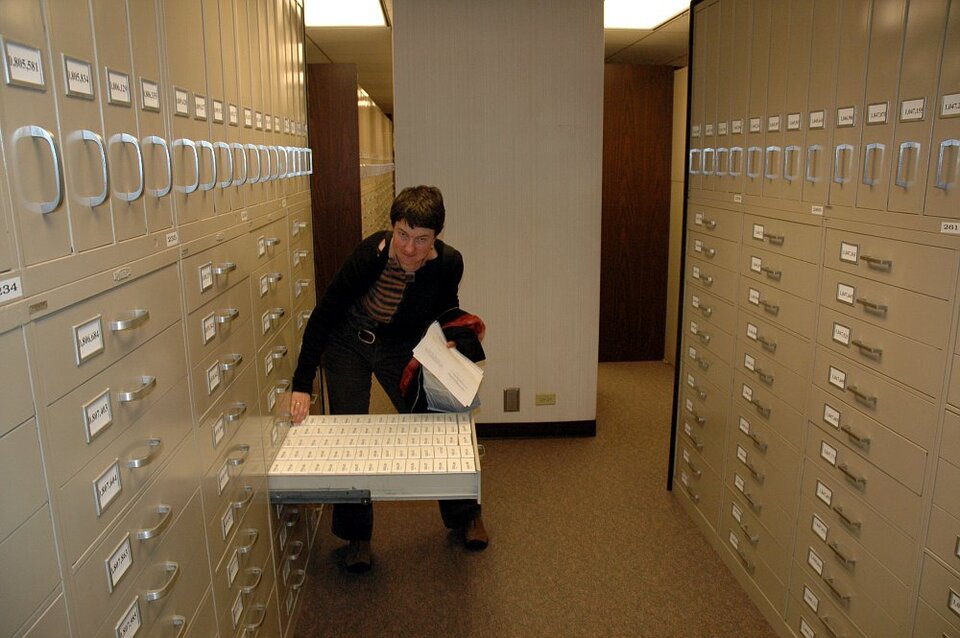
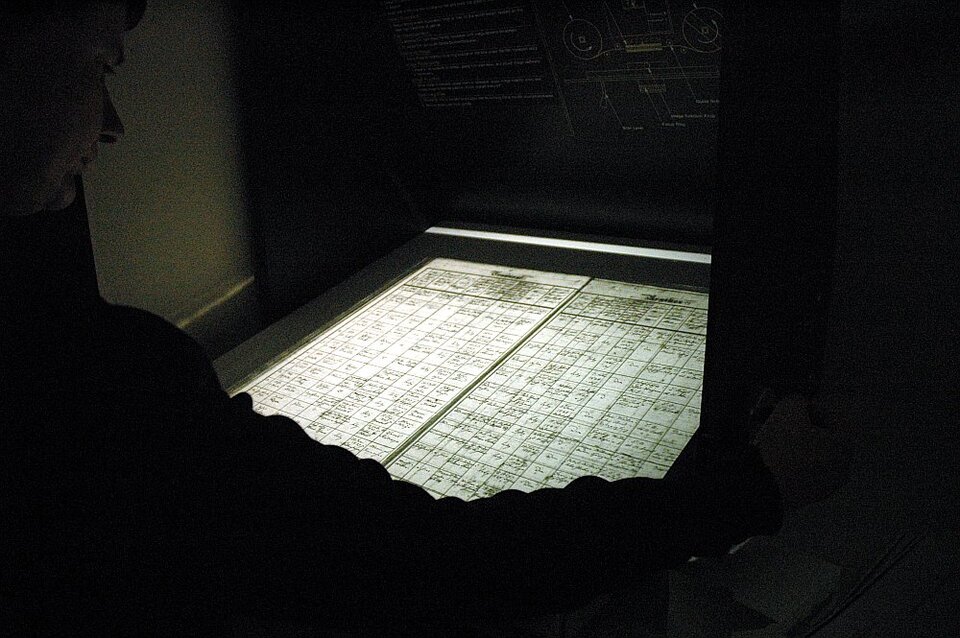
You can retrieve the microfilms yourself and without supervision, just open the appropriate drawer. It looks like a thick, wound film reel about 4 inches in diameter, roughly as wide as a photo negative. You then place the reel into a man-sized device, unwind the film a bit, and thread the loose end through a glass projection plate onto a take-up reel on the other side. Start turning the crank on the side panel of the apparatus and the individual frames are illuminated by a halogen lamp mounted above and projected onto a horizontal surface about 20 x 20 inches in size. As you wander through the aisles, you can see people busily turning the cranks, examining entries, and taking notes.
If you want to make a copy of an image you are currently viewing, you take the microfilm with both reels out of the machine and ensure that the image you are viewing remains open. Then you carry it over to the copy room, place it in a copier, and pay 23 cents for a paper copy.
The books in the library are also stunning. There are even editions of the old Nazi magazine "Ahnenerbe - Association for Clan and Heraldry Research Assistance, Heredity and Racial Care." And something I didn't know either: In 1529, the Turks were at the gates of Vienna, and the defense of the Western world was financed in the German Empire with the so-called "Turk Tax." In the collection of the "Family History Library," I found a book in which the Turk Tax register of 1584 was reprinted. In illustration 5, you can see who paid how much and when, and if not, why. If you are not familiar with old currencies: A gulden (fl. = florin) was worth 15 batzen (b.) at the time, and a batzen was worth 4 kreuzer (kr.).

You can search anonymously, it costs nothing (except for copying), and you can browse to your heart's content independently and without being bothered--a truly great service from the Mormon Church. We got so carried away in our research that we didn't even notice how time flew by. When we finally looked at the clock, five hours had passed. Unfortunately, we didn't see much of the rest of the city because it soon got dark, and we hadn't even eaten yet!