
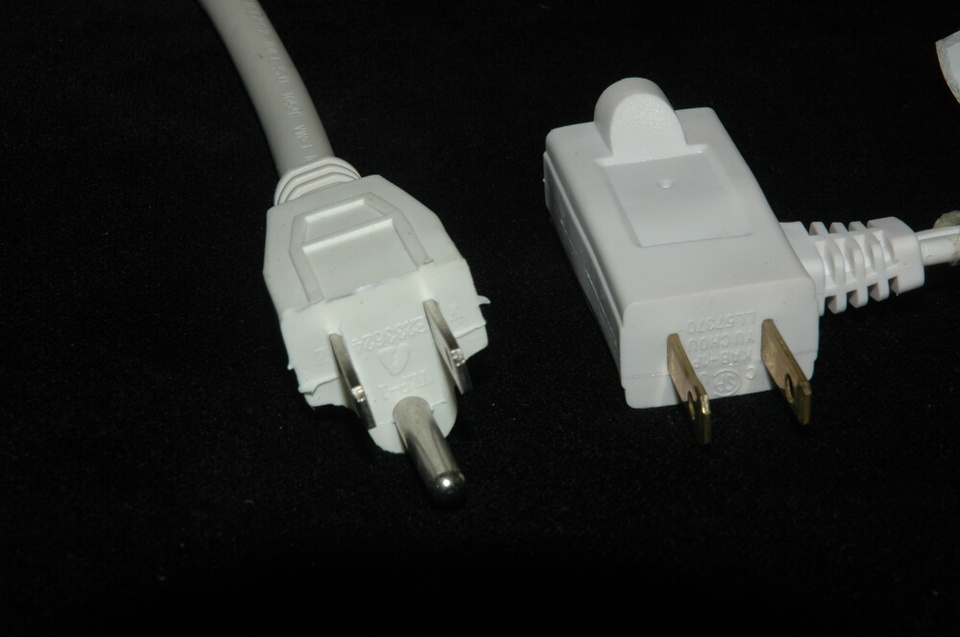
Michael If you've ever traveled to the U.S. with your German electical razor or hairdryer, you will have noticed that German plugs do not fit into American sockets. This is because, instead of the round plugs common in Germany, known as Schuko plugs, American plugs have flat metal prongs.
The best place to buy American adapters for German plugs is in Germany. In the USA, you usually only find the reverse version, meaning plugs for American globetrotters who need to adapt their flat plugs to the round sockets in Europe. However, in electronics stores like Fry's or Radio Shack in the USA, you can also find adapters for German plugs to American outlets, but be aware that they come at a premium price. A clever globetrotter trick is to buy just one adapter and bring a power strip from your home country, allowing you to connect multiple devices at once.
And it should be noted that not only the plugs are different. The voltage in the American power grid is only 110 volts, just half as much as the 220 volts common in the German power grid.
This means that when you connect a German device to an American outlet using an adapter, only half as much power is supplied. Without special measures, hairdryers or razors will therefore work very slowly, if they work at all.
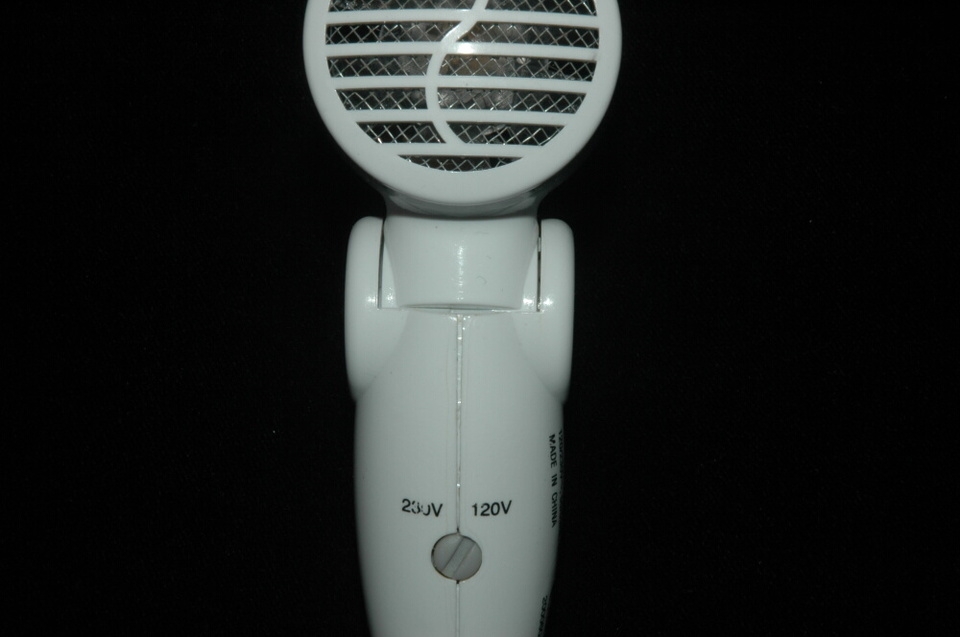
In illustration 2, you can see our travel hairdryer, which can be switched from 230V (220 or 230V, it doesn't have to be exact) to 110V by inserting a coin into the slot and turning it. If you do this, you can use the hairdryer (provided you have the appropriate plug adapter) in the USA without any problems. However, if you forget to switch it back in Germany, the device might be blown to pieces if you plug it into the German power grid there at 220V.
Highly sophisticated devices, such as some laptop power supplies, desktop computers, or monitors, can even handle both voltages, 110V and 220V, without any adjustment. This is indicated on the power supply. Simply plug it in with a plug adapter, and you're good to go.
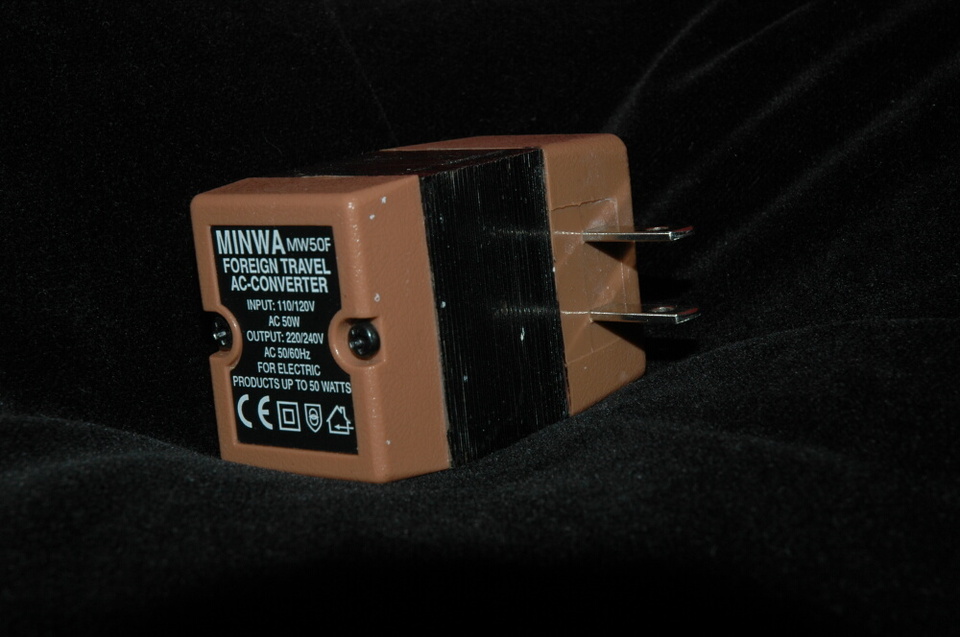
There is also the possibility of transforming the 110V from the American socket up to 220V. However, this is an old-fashioned method from the last century that requires thick metal cores with many wire windings and produces alarming energy losses.
If a device only consumes around 50 watts, you can get a small transformer for little money (about $7, see Transformer at Fry's). Buy one that converts the 110V from the American power line to 220V and also provides the correct round sockets for German electrical devices.
A razor or an electric toothbrush operate below the 50-watt mark and can be easily connected. However, even a small hairdryer consumes at least 10 times that amount, around 500 watts and upwards. If you connect such a device to a small transformer, it will overheat and can cause serious problems. Transformers for electrical devices up to 1000 watts cost around $30 and are very heavy. This is only worthwhile in exceptional cases. And, as mentioned, a small transformer consumes electricity even when idle and heats up. Such waste might have gone unnoticed in the 1960s, but nowadays it is completely unacceptable.
The frequency at which the alternating current from the outlet oscillates is 50Hz in Europe and 60Hz in the USA. In the 1980s, there were clock radios that utilized this oscillation and therefore did not function properly with the wrong frequency, but nowadays this is irrelevant, as they all use different methods.
As with German Schuko plugs, there are three-pronged versions (with a round grounding pin) in American power plugs and those with only two contacts. This can be super annoying, for example, when an American laptop power supply has a three-pronged plug, but the hotel outlet only provides two prongs, which does happen. For such cases, I have a probably illegal neon green adapter from a past trip to Japan (Japan has the same outlets), which converts three prongs into two.
In the case of two-pronged plugs, one of the metal contact plates is usually slightly wider (for the experts: this is the neutral prong, as opposed to the thinner phase), so the plug can only be inserted in one direction.
If you'd like to dig deeper, the Wikipedia entry on Power Plugs nicely compiles everything worth knowing about North American power outlets.