

Michael How do you buy a used car from a private seller in the USA? A few months ago, we bought a PERLMAN successor and can share our experiences with you today.
What kind of car should it be? I recommend Japanese cars by the brands Honda and Toyota. In America, Honda sells the more expensive models under the name "Acura," and Toyota presents them as "Lexus." Both are excellent brands that I highly recommend if you need durable, well-equipped, and absolutely reliable luxury vehicles.
Yes, yes, I'm not a fan of German cars. They are overpriced, rated as unreliable by 'Consumer Reports' (the American equivalent of 'Stiftung Warentest'), and recently have shown serious manufacturing defects. One of my colleagues bought an S-Class Mercedes, and after a few years, the trunk had rusted through. And that was in California, without snow, can you imagine that! Another colleague had to take a new Porsche Boxster to the workshop with a broken engine after four weeks. I have no understanding for such sloppy manufacturing. After our '91 Acura Integra got old, we recently bought a '98 Acura Integra. Almost 10 years old, 100,000 miles on the clock, but it runs like hell with its 170 horsepower. You may recall that we bought PERLMAN when it was seven years old and have been driving it for 10 years without any significant problems!
First of all, you need to negotiate a price with the seller. The standard value for a used car is listed in the "Kelly Blue Book," which is available for free online at kbb.com. You enter the make, model, and year, and also add extras like a sunroof or air conditioning. In America, 90% of people drive automatic cars, as manual transmission is less in demand. However, anyone who can really drive, which is only about 10% of Americans, drives cars with manual transmission.
The condition of the vehicle is either "Excellent," "Good," "Fair," or "Poor," depending on how dented the car is and what flaws it has. Furthermore, a distinction is made between "Trade-in Value" (what the dealer offers when you trade in your old car), "Private Party Value" (the price you can ask as a private seller), and "Suggested Retail Value" (the price used car dealers can charge).
To find out if the car has been involved in nay accidents, or failed emissions tests, or was stolen at some point, frequently bought/sold, or has had any other issues, the company "Carfax" offers an information service on the internet. You pay $29.95 and can then check as many vehicles as you want using their VIN ("Vehicle Identification Number") for a month. Not bad, but not flawless either, as Carfax, for example, did not know that our PERLMAN had already been in an accident (Rundbrief 09/2001).
After successful price negotiations, the deal can be sealed with the bill of sale form" that can be downloaded as a PDF from the California Department of Motor Vehicles (DMV). It is only half a page long and you only need to fill in the names and addresses of the seller and the buyer, the purchase price, and the VIN. The seller signs it. To exclude any seller liability, you should draft a document that includes the phrase "Sold 'As-Is' without Warranty.
The buyer then pays. But how? Most people carry a few thousand dollars around in their pockets, and besides, everyone is afraid of counterfeit money because dollar bills have very few security features. Additionally, cash leaves no traceable records in the banking industry, and proving how much money actually changed hands is almost impossible afterwards if a dispute arises.
American paper checks for larger amounts are not accepted by anyone who is reasonably sane. They are often not covered and "bounce," which means that the recipient simply won't receive any money. Even if everything goes well, it often takes up to a week for a check to "clear," meaning the money from the transaction arrives in the recipient's account. Usually, the money arrives earlier, but it cannot be withdrawn because the transaction has not yet been confirmed. It's hair-raising.

For car purchases, people use so-called "Cashier's Checks." The buyer goes to a bank branch (which is open on Saturdays here in the USA), requests a Cashier's Check from the teller for the negotiated car price, and has it made out to the name of the recipient. The amount on the check is immediately deducted from the buyer's account. This ensures that the check won't bounce. The check is signed by the teller, not the buyer. As part of the purchase process, the buyer hands the Cashier's Check to the seller, who then deposits it at their bank. One should not lose the check, as it cannot be easily canceled. There have been fraud cases with counterfeit Cashier's Checks, so sometimes the seller asks the buyer to accompany them to the bank to deposit the check. This way, any potential fraud would be immediately detected.
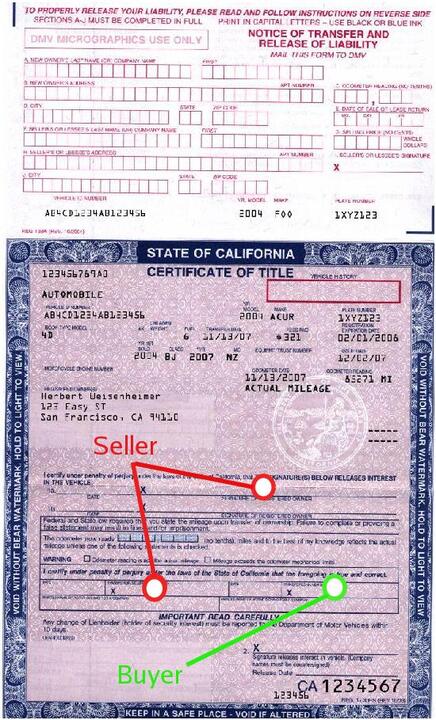
In order for a car to legally change ownership status, the seller must sign the vehicle title, known as the "Certificate of Title" (illustration 2), twice. Once to release the car ("the signature below releases interest in the vehicle") and once to confirm the stated mileage. Additionally, the buyer also signs to prove that both parties are aware of how far the vehicle has traveled. The "Certificate of Title" used to be pink and was called the "Pink Slip." This should not be confused with the termination notice for workers, also called a "Pink Slip," which was also printed on pink paper. "To get the pink slip" means "to be fired" in America. But I digress.
Following the pink period for the title, for a while, a colorful mixture of colors could be seen on the vehicle registration document, and it was called the "Rainbow Title." Nowadays, it is pink again with a blue border, and people usually just call it the "Title." At the very bottom, there is a signature field for a "Lienholder," but this is only relevant if the car doesn't actually belong to the seller but to the bank, for example, because it was financed. Otherwise, this field simply remains empty.
The "Title" is handed to the buyer after the seller has removed the top part with the red boxes. The seller fills out this form and sends it by mail to the Department of Motor Vehicles (DMV) so that they are informed of the transaction. This is important because the responsibility for the vehicle (accidents, tickets) is thereby transferred from the seller to the buyer.

When a private individual sells a car, in California they must ensure that a certificate for an emissions test ("Smog Test") has been obtained no longer than three months ago. The DMV has this data electronically, making it impossible to cheat. The buyer has the right to a valid smog certificate, but must explicitly request it from the seller.
On the back of the vehicle registration certificate 4, the buyer enters his information and takes it to the DMV office. There, he pays a re-registration fee (about $30) and a "Use Tax" on the purchase price. This tax is as high as the sales tax in California (8.5% in San Francisco). When buying a car from a dealer, the sales tax is typically added by the dealer, but since the insatiable state of California also wants to see money from private vehicle sales, the DMV collects this tax. It adds up: For a sale price of $5,000, you pay $425 to the DMV, which hurts the wallet! The DMV employees ask the buyer for the sale price, and if the buyer lies and the price is completely unreasonable, the value set in the "Kelly's Blue Book" is used.
The seller should insist that the buyer registers the car as soon as possible. Any tickets will still go to the seller until then. Although the seller is not liable, they must explain to the DMV each time that the car has already been sold, and the aforementioned form sent by the seller is solid proof. The buyer is required to register the car within 10 days, or else they will face penalties. It also happens that the seller asks the buyer to go to the DMV with them, so the seller can see with their own eyes that the car is re-registered and the transaction is completed.
The DMV retains the title, by the way, and sends a new one to the new owner within two weeks. On this new title, the signature fields are blank again, and the new owner can later sell the car again using the same procedure.
It is also common to have the car inspected by a mechanic pre sale for a price of about $50. The potential buyer bears the cost. Of course, you can never be completely sure that you won't be ripped off, which is why I recommend conducting such transactions preferably with colleagues at work.
Committing fraud between colleagues is relatively unlikely, after all, you knows where the other party works and can cause quite a stir if problems arise unexpectedly. I bought a colleague's car at Yahoo, and everything went smoothly. It was her husband's favorite car, but since she couldn't drive a manual transmission, he had to sell it!