![]() |
| Angelika/Mike Schilli |
TODO
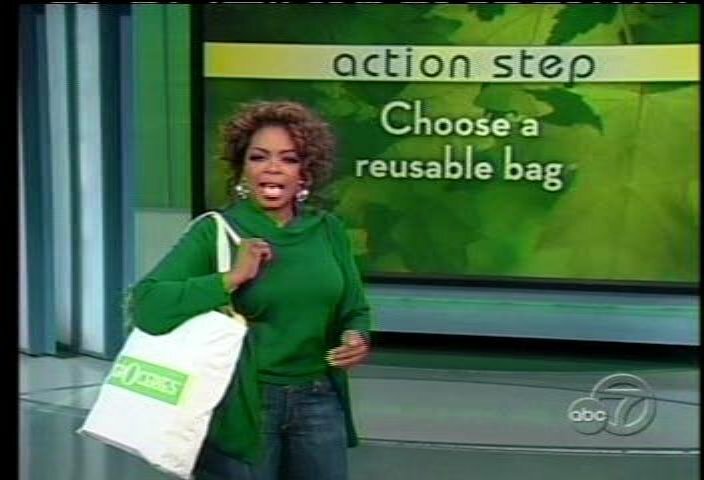
Angelika America has awakened from its slumber, as suddenly climate change and environmental protection are on everyone's lips. When the black talk show queen Oprah Winfrey takes up a topic, you know that a general trend has begun. Last week, Oprah encouraged her TV viewers to go to the supermarket with cloth bags, replace regular light bulbs with energy-saving ones, use environmentally friendly cleaning products, recycle, and defy the American packaging craze.
Now you must know that Oprah's admonitions are likely to have more impact than those of high-profile scientists and politicians. Especially the female portion of the population follows Oprah's mantra like a religion. Some time ago, Al Gore also had the opportunity to discuss his documentary "An Inconvenient Truth" on Oprah's talk show. In it, the former Vice President under Clinton explains the consequences of global warming using vivid photos and graphics. As is well known, the film received an Oscar this year for Best Documentary Feature, another indication that environmental awareness is becoming mainstream in America.
Even companies like Walmart, which are otherwise widely known for their poor working conditions and aggressive expansion tactics, are jumping on the trend. Walmart's green website encouraged their customers on "Earth Day," which is celebrated in the USA in April, to adopt more environmentally friendly purchasing behavior. PG&E (Pacific Gas and Electricity), the company that produces our electricity in San Francisco, also launched a PR campaign. If less electricity is consumed, PG&E does not have to expand its infrastructure at great expense, and so it is actually in the interest of the power generation company if people weniger Consume electricity. On
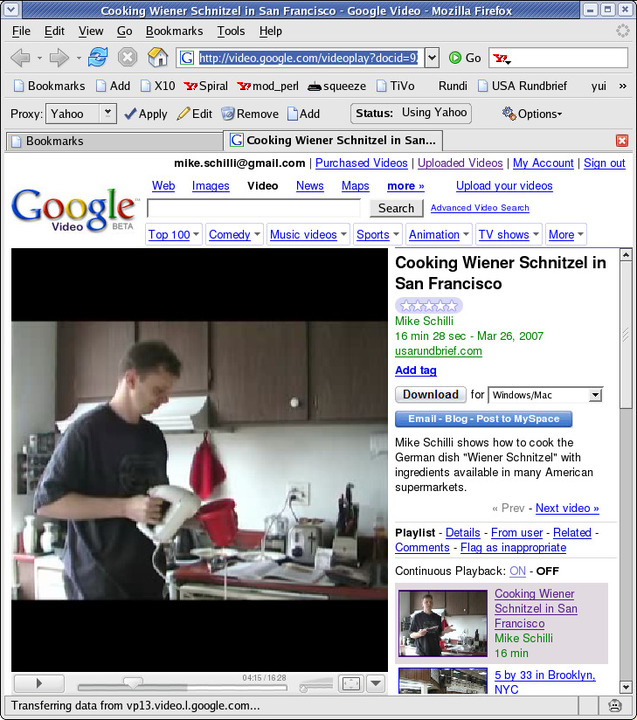
Michael And as threatened last time, we made a video about how I fry Wiener Schnitzel in our kitchen. Angelika operated the camera, and I just chatted and cooked away without a script, rhyme, or reason. Considering that, the result is surprisingly structured! Since the edited piece is about 16 minutes long, it's not on YouTube but on... Google Video .
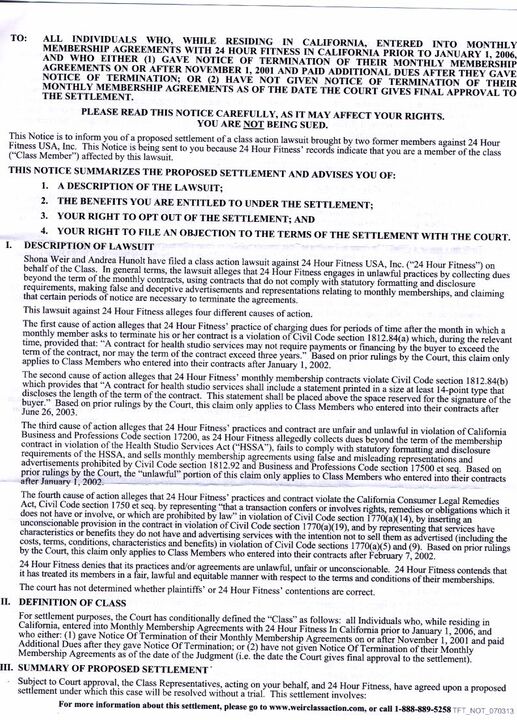
Michael Recently, a letter arrived at the house again, which, in its neutral white envelope with an address window, looked like an advertisement for a new credit card. However, inside were several densely written pages filled with legal jargon. As is often the case in America, the legalese was translated for the average person, and at the top of the letter it read: "You are *not* being sued.
We were merely informed that our fitness center "24 Hour Fitness" had become involved in unfair business practices. The company had not processed cancellations from their monthly paying customers immediately, but rather a month later.
In America, such a thing doesn't happen. While there is no lack of imaginative entrepreneurial spirit to circumvent the law and extract money from people using all possible and impossible methods, consumer protection in America is one of the best in the world.
It seems there are some encoding issues in the text you provided. Here's an attempt to translate it with the likely intended characters:
"When a company crosses the line again, consumers have the option of a so-called..."
If you can provide the correct characters or more context, I can offer a more accurate translation. "Class-Action" Legal proceedings. Resourceful private individuals find out who has been harmed by these business practices, seek out a law firm, and then sue the company on behalf of all those affected.
If a company manufactures defective child car seats, engages in misleading advertising, or fails to deliver promised services, it will quickly face consequences and, if the claims are found to be justified, will have to make substantial compensation payments.
The case is either tried in the court of the respective state or, if the case crosses state borders or violates federal law, in a federal court. To be accepted, it must meet certain criteria. For example, there must not only be a justifiable and precisely quantifiable damage, but the number of those affected must be so large that individual court proceedings would not be practical. If the court finds the company guilty and orders it to pay, the compensation amount is distributed to the affected parties after deducting expenses. These individuals then unexpectedly receive mail informing them that someone has conducted and won a lawsuit on their behalf! If an affected person then submits the form enclosed with the letter, they are awarded their share of the settlement.
a company sees a lawsuit worth millions or even billions coming its way, it often settles out of court and offers compensation on its own, as such cases often end in favor of the consumers. And if a company acts particularly maliciously and criminally, there is even the risk that the court will impose "punitive damages," which go far beyond the actual damage caused. In the case of BMW versus Gore In 1996, BMW had to pay $2,000,000 because the company sold their repaired cars in North America as new. The plaintiff's damage was only $4,000, but the court was so outraged by this audacious business practice of the Bavarians that it showed them who was boss.
In the case of "24 Hour Fitness," an out-of-court settlement was reached, likely because the company wanted to avoid the risk of a trial. As you can see in Figure 6, every customer can now choose from four possible compensation options, including a free half-hour private training session offered by 24 Hour Fitness! We can certainly appreciate that.
Michael Services are relatively cheap in America. If you take your car to a budget workshop in the Mission District of San Francisco, the mechanics will take apart half the engine for a few hundred dollars. However, this does not apply to bicycle repairs. Although there are an unusually high number of cyclists in San Francisco by American standards, the few bicycle mechanics charge exorbitant prices.
I do patch tires myself, but for other issues like broken gear or brake cables, I have so far gone to the bike shop I trust, which is also located in the Mission District. For such minor repairs, you pay about $20 plus the cost of materials, which is just about acceptable, although it's certainly a steep price by American standards. But every time I show up there, the mechanic takes me aside and says that I have such a nice bike, but the maintenance leaves something to be desired!
I should just leave the bike there for a "tune-up," and then worn parts like brake pads would be replaced, the gears adjusted, and so on and so forth. Among experts, it's well known that the tune-up is the "license to print money" for bike mechanics and costs $120. In Germany, I would respond to such a mechanic's suggestion by pulling down my lower eyelid, but unfortunately, no one in America understands this gesture!
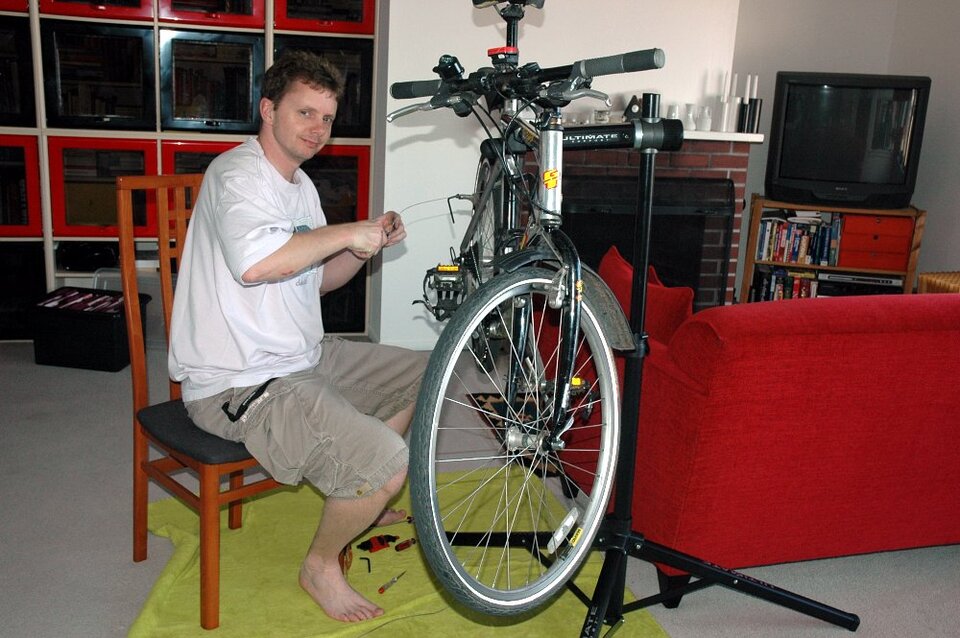
So that I can carry out bicycle repairs at home in the future, I recently... REI Through gritted teeth, I shelled out $140 for a bike repair stand, and I have to say, it was money well spent. I immediately repaired a brake cable at home, and it's really nice to have the bike so stably mounted in front of you without constantly having to worry about it tipping over when tightening screws. And when folded, the stand is only slightly larger than a camera tripod and can be easily stored in a closet. Top product!
Angelika The American postal service has to endure quite a bit of teasing because, even in the USA, it has a touch of bureaucracy about it. However, I swear by our post office on 24th Street and our good soul, the mailman George, who has been delivering mail in our neighborhood since time immemorial. He kindly leaves our packages from Germany at our apartment door when we're not home.
It is particularly unpopular when the postal service increases its fees and letters and postcards suddenly cost more. This has happened relatively frequently in recent years. When we moved here in 1996, a regular letter within America weighing up to one ounce (1 ounce = 28.35 grams) cost 32 cents. Now we pay 39 cents for it, and starting May 14, the postal service will raise the fee to 41 cents.
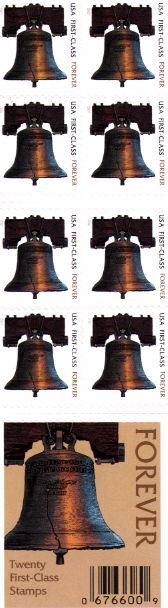
The evil email is to blame, as supposedly people are sending fewer letters, and the increase is intended to bring more money into the coffers. To appease public anger, the decision-makers at the United States Postal Services (that's what the postal service is called here) came up with the brilliant idea of introducing the "Forever" stamp to the market.
As the name suggests, this particular stamp is intended to remain valid even with future price increases. You pay the regular 41 cents now and can still stick it on the envelope in the future, even if, let's say, 43 cents are actually required. I naturally thought this would lead to panic buying, but when I stopped by the mentioned post office on 24th Street last week, I was still able to purchase the "Forever" stamp without any problems. However, the post office hasn't clearly indicated how long the stamp featuring the image of the Liberty Bell will be on the market.
Angelika I am still, as is well known, mourning the darkroom and the UC Berkeley Extension location on Laguna Street. I took quite a few courses there and spent hours developing my photos.
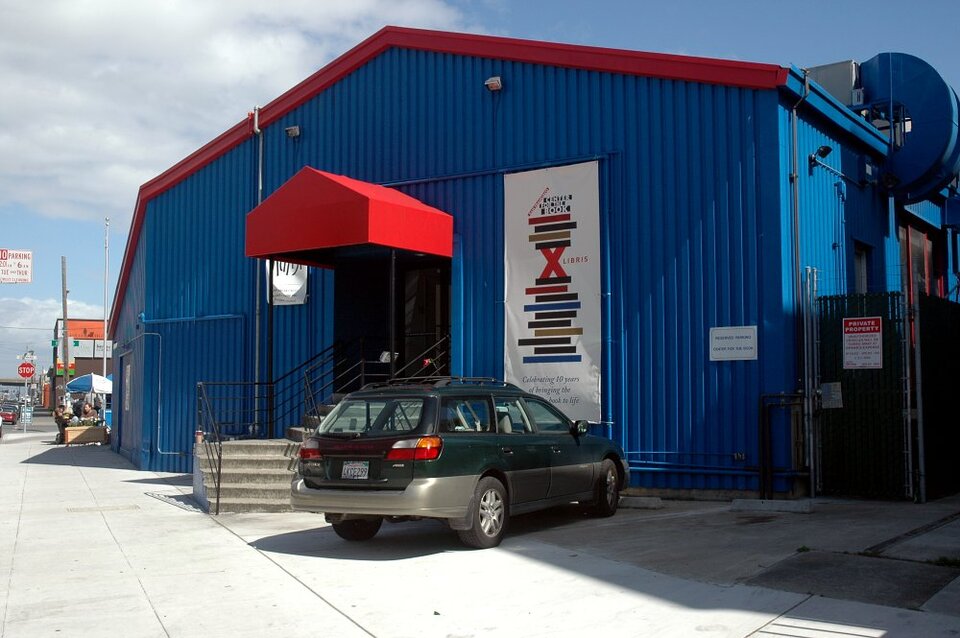
On the site, by the way, as we all suspected back then, nothing has happened. The buildings remain unused and idle. A pity! Thank God, however, there is still the so-called in San Francisco. Centro del Libro .. an institution that opened its doors in San Francisco in the summer of 1996 and is entirely dedicated to the art of the book.
Besides smaller exhibitions, the main focus of the institution is to teach eager students how to make handmade books. On one hand, you learn the craft skills, such as how to sew pages into a book cover with needle and thread. But it's also about the book as an art object. In the age of digital mass production, this craft is experiencing a kind of renaissance. A variety of courses are offered, which either take place over several evenings or on weekends. I have already taken a few, from classical bookbinding to creating books that house three-dimensional objects. However, I have not yet dared to approach the old printing presses that stand around the center like in Gutenberg's time.
Angelika We have just switched our car and household insurance, and since this topic is of interest to many expatriates, I have compiled the most important facts. Changing insurance is always quite annoying, but Michael had been insisting for years that our insurance was ripping us off, because even though we never reported a claim or received a fine, the premiums kept cheerfully increasing every year.
Guess who called the various insurance companies and requested quotes? That's right, I was on the phone until my fingers were sore. When dealing with such offers, you have to be careful not to compare apples to oranges. A car insurance policy is made up of standard components that can be purchased individually. By the way, they are quite similar to those offered by car rental companies for additional protection, as Michael has already described. Rundbrief 02/2002 First, there is the so-called "Collision" (full coverage). It covers damage to your own car caused by traffic accidents, regardless of fault. Another package, the "Comprehensive" (partial coverage), includes theft, as well as damage from fire and storm. Typically, both have a deductible. Since our car, the Perlman, is quite old and unfortunately not worth much on paper anymore, we don't need either "Collision" or "Comprehensive." However, you absolutely need liability insurance ("Liability"). It is divided into bodily injury and property damage. Except for a few quirky American states, almost all require auto liability insurance by law. However, the mandated coverage amounts are extremely low: In California, for example, $15,000 per injured person, $30,000 for all personal injuries per accident, and $5,000 for property damage. An absolute joke.
When registering a car in California, the car owner must provide proof of liability insurance. And every year, when the vehicle taxes are due, one must again present or mail in a certificate. Recently, insurance companies often report the status of the contract electronically to the Department of Motor Vehicles. Since October 2006, it has also been the case that the registration will be revoked if the liability insurance is no longer in place for any reason. Other states are significantly more lenient in this regard.
Anyone who is smart naturally buys liability insurance with higher coverage amounts; $500,000 is appropriate. Additionally, I have now realized that everyone in this crazy country should also purchase another package: the "Uninsured and Underinsured Motorist Coverage." This insurance kicks in when the other driver who caused the accident has no liability insurance, commits a hit-and-run, or is underinsured. This happens frequently due to the low minimum coverage amounts.
In the end, you essentially buy insurance for the other, irresponsible driver so that you can cover damages like long-term disability even if they cannot pay. In California, it's important to consider that many illegal immigrants often drive without a license and are usually uninsured. There always seems to be a way to circumvent legal requirements. Most people recommend having the same coverage amount for "Uninsured Motorist" insurance as for regular liability insurance, which is $500,000. You can also purchase something like auto medical insurance ("Medical Payments"), which covers all medical expenses in the event of a car accident for yourself and the passengers, regardless of who is at fault. This is especially useful if, like many Americans, you live without health insurance. The American household insurance is called "Homeowners" or "Renters Insurance," depending on whether you are a homeowner or a renter. At first glance, it looks similar to the German one. The household contents are replaced in the event of burglary, theft, fire, or water damage after a deductible. Earthquakes are excluded from household insurance in California, as it would be too risky for insurance companies! There are separate earthquake insurances for that.
It is interesting to note that in household insurance, liability coverage is included. If a visitor breaks a bone in an apartment because they trip over something, the household insurance pays for it. This is due to the peculiar fact that America does not have standalone personal liability insurance. In Germany, these are quite affordable and come with high coverage amounts.
The equivalent of personal liability insurance with a high coverage amount can only be obtained in America through a trick: In addition to home and auto insurance, one takes out a so-called "Personal Liability Umbrella Insurance.
Umbrella" (Schirm) is the name of the insurance because it provides the individual with a certain all-around protection and is spread over the other insurances like an umbrella. If a catastrophic event occurs and, for example, the car insurance reaches its liability coverage limit, the "umbrella" insurance steps in.
However, you will only get the umbrella if you have both car insurance and home insurance. However, I have no idea what someone does if they don't own a car. Additionally, the insurance companies usually require certain minimum liability limits for car and home insurance before they sell an "umbrella" insurance policy.
A translation of the text to English is:
"An example: If you take out household liability insurance for $300,000 and auto liability insurance for $500,000, you can purchase an 'umbrella' policy of 1 million dollars or more. We urgently need the umbrella policy, after all, Michael rides his bike like a madman every day and was known for his daring maneuvers even as a child.
The translation of "Wir leben gefährlich" to English is "We live dangerously.
The translation of "Michael und Angelika" to English is "Michael and Angelika.