

Michael When I once asked one of my colleagues about his somewhat unusual-looking signet ring on his ring finger during lunch, he replied that he would be happy to explain it to me, but it was a rather long story. "Well," I said, "I have plenty of time!"
The signet ring was silver, somewhat thick, and had the letter "G" and the silhouettes of a right angle and a compass engraved on its flat, blue-glossy top.
The ring, as my colleague explained, is a symbol for the Freemasons, an organization originating from the Middle Ages. In the past, some of the members were actually masons, and being a mason was a highly respected profession at that time. The compass and the square are the tools of the architect, and every mason back then was also somewhat of an architect, as they could have a say in the construction and had more influence on the final result than is the case today.

The "G" on the ring, by the way, is not worn by everyone, but it stands for the "higher being" that every Freemason believes in. Freemasons deliberately maintain a religiously agnostic stance, but they require their members to believe in a higher being. The Freemasons regularly meet in so-called lodges for meals, chats, and sometimes to perform secret rituals, such as initiating new members into the elite circle.
A few things are indeed quite old-fashioned: Women and non-members are not allowed access to the traditional lodges, and a guard with a sword (!) called the "Tyler" keeps a strict watch at the entrance. During the initiation ritual, a newcomer, who must be proposed by an existing member, is dressed in a suit with one trouser leg and one sleeve cut off, presumably to illustrate his imperfection.
And here's an interesting fact that hardly anyone knows: Nine of the founding fathers of the USA who signed the Constitution were Freemasons! The most famous: The first American President, George Washington, whose curly head adorns the one-dollar bill today. Other international Freemasons, as Freemasons are spread all over the world, not just in America, include: The Englishman Winston Churchill, the Frenchman Voltaire, and the Austrian Wolfgang Amadeus Mozart.

In the late 1970s, however, the organization made negative headlines when the so-called lodge "Propaganda Due" in Italy operated as a criminal organization under the guise of an officially recognized Masonic lodge and was involved in a financial scandal that almost drove the Vatican Bank into bankruptcy.
There are special groups within the Freemasons that establish their own rules. In 'regular' Freemasonry, one starts as an "Apprentice", then becomes a "Fellow of the Craft", and eventually a "Master Mason". However, the group known as the "Scottish Rite" introduces additional ranks from 4 to 32, and in special cases, even number 33 is awarded. The titles are quite obscure, ranging from "Master of the Ninth Arch" (13th degree), to "Prince of the Tabernacle" (24th degree), up to "Sublime Prince of the Royal Secret" (32nd degree).
Anyone who enters a lodge must wear a white lambskin apron, just like the stonemasons of the Middle Ages, who used it to protect their tools from the weather. Freemasons recognize each other through secret passwords and special handshakes.
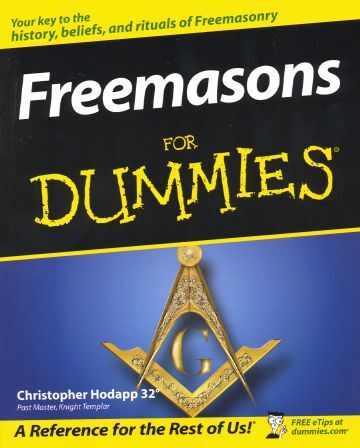
The best book about the Freemasons, according to my colleague, is "Freemasons for Dummies," which was written by a high-ranking Freemason (32nd degree). The author adheres to the rules imposed on members regarding the secrecy of the various rituals and does not reveal more than is permissible. But those who absolutely feel the need to tear down the curtain and harshly illuminate even the darkest corners can easily purchase one or another book on Amazon that divulges all the secrets.