10/11/2006   English German

  Edition # 63  
San Francisco, 10-11-2006


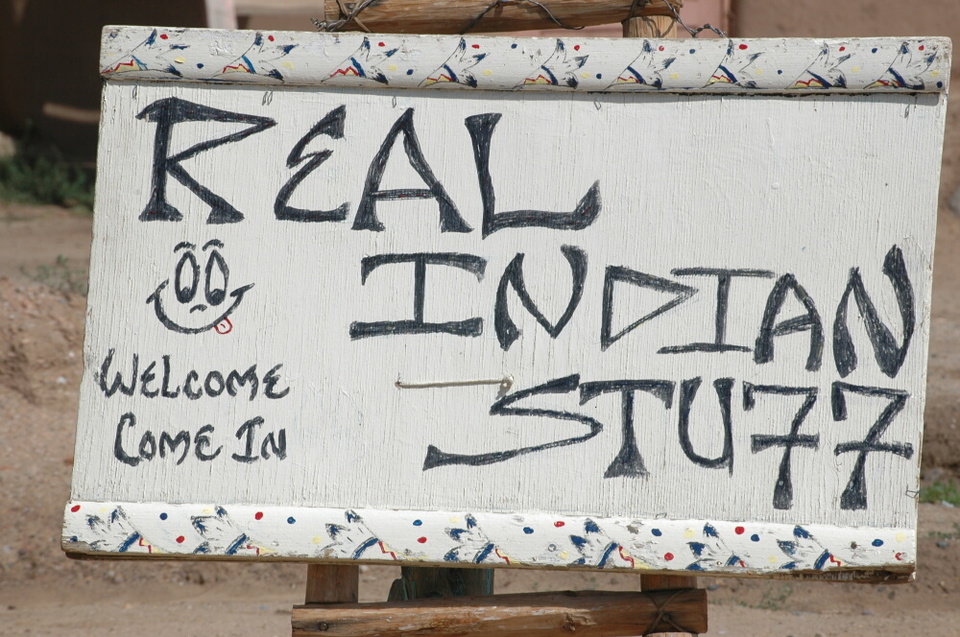
Figure [1]: Indian jewelry is sold here.

Angelika Anyone who has ever studied American history cannot avoid the tragic chapter of the extermination and oppression of the Native Americans. To this day, Native Americans fight for recognition, equality, and the return of their land. The hunger of white settlers for land and natural resources led in the 19th century to the systematic displacement and relocation of Native Americans to reservations, which were mostly established in completely remote, less fertile areas (in other words: in the desert).
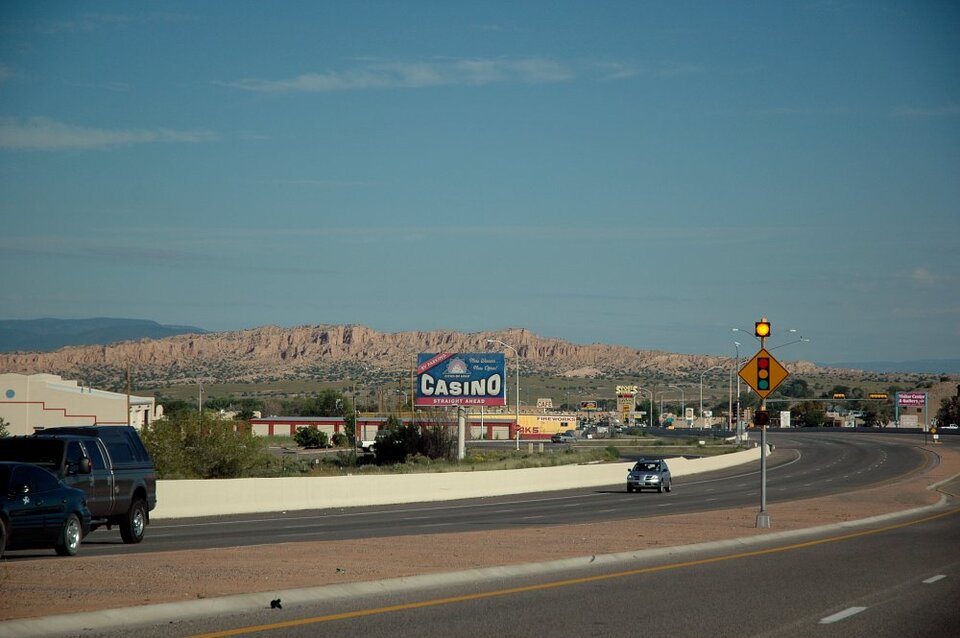
Figure [2]: Indian casinos along the main road

I will never forget how, in 1987, we drove for the first time through the vastness of the American Southwest, repeatedly passing Indian reservations: A road that cuts straight through the desert landscape to the horizon, with small, very basic huts scattered across the landscape on either side, which had seen better days. On the way to Monument Valley, we picked up a Native American hitchhiker who lived on the reservation. He wanted to go to the nearest supermarket, which was a few miles away in the middle of nowhere. Even back then, I wondered how the Native Americans could survive in such isolation without any significant infrastructure, and I was no longer surprised by the high percentage of unemployed, alcohol-dependent, and those living on the brink of existence in the reservations.

During our tours through New Mexico, we constantly drove through various Indian reservations. Road signs, similar to town signs, indicate when an Indian reservation begins and when you leave it. This is quite relevant because Indian reservations are self-governed, and the tribal government has limited legal authority. For example, a ban on alcohol within the reservation is not uncommon. We also frequently saw cars with the inscription "Tribal Police" speeding around on the roads.

As an observant tourist in America, you might have wondered why there is now a casino on almost every Indian reservation. The Native Americans take advantage of the special legal status on the reservation and operate casinos where everyone (including non-Native Americans) can play to their heart's content. This brings in good money and has become a stable source of income for the Native Americans living on the reservation. Often, the opening of a new casino is met with loud protests from the population. I find this quite hypocritical: First, the land is taken from the Native Americans, they are confined to a godforsaken reservation, and then people complain that the Native Americans don't make anything of their lives. But as soon as they manage to establish something themselves and succeed, it's not acceptable either.

In 1987, the United States Supreme Court confirmed that Native Americans are allowed to operate gambling activities on their reservations independently of state regulations. However, in 1988, Congress enacted the "Indian Gaming Regulatory Act," which specifies exactly how this should be conducted. It grants the states partial input. Generally, casinos on Native American reservations can only be opened if gambling is not fundamentally prohibited in the respective state.

Angelika In my youthful naivety, I probably watched too many "Winnetou and Old Shatterhand" shows on TV, because I used to think that most Native Americans roamed the vast land and set up their tents wherever there was enough to hunt. As is well known, one should not rely on Karl May's stories, which stem more from his imagination than historical facts, when it comes to Native Americans and North America.
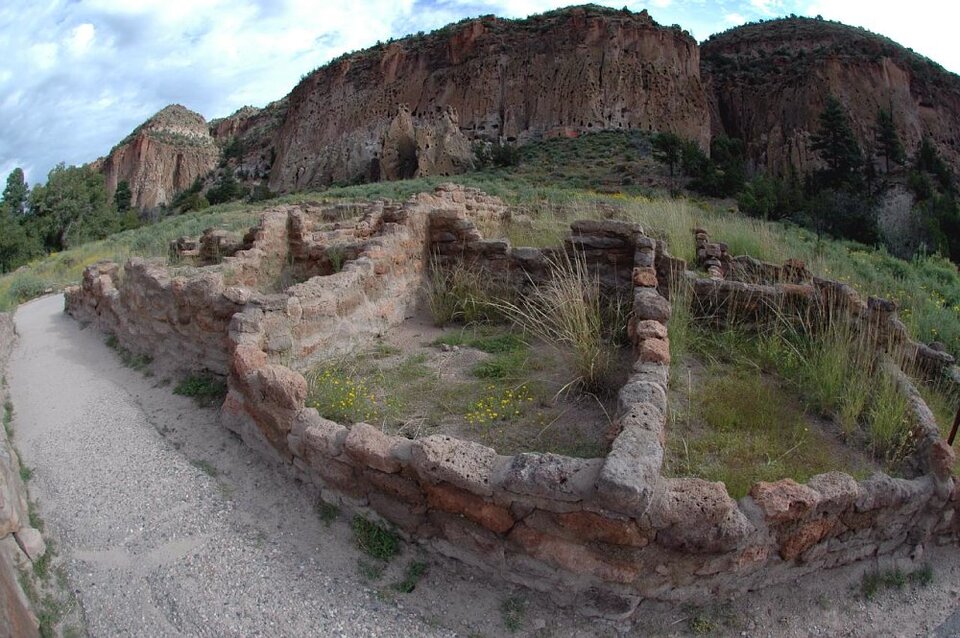
Figure [3]: Bandelier National Monument: Ruins of an
ancient pueblo>

Our trips in New Mexico also dispelled the romantic notion of the Indian riding through the prairie. In what is now the state of New Mexico, the so-called Pueblo Indians lived in villages and practiced agriculture since ancient times. Well-preserved ruins, such as those in Bandelier National Monument, prove this. We even climbed up various ladders to the Ceremonial Cave, a rock ledge high up in the mountain, where the Indians lived for reasons that are inexplicable to me--after all, the climb must not have been easy back then.
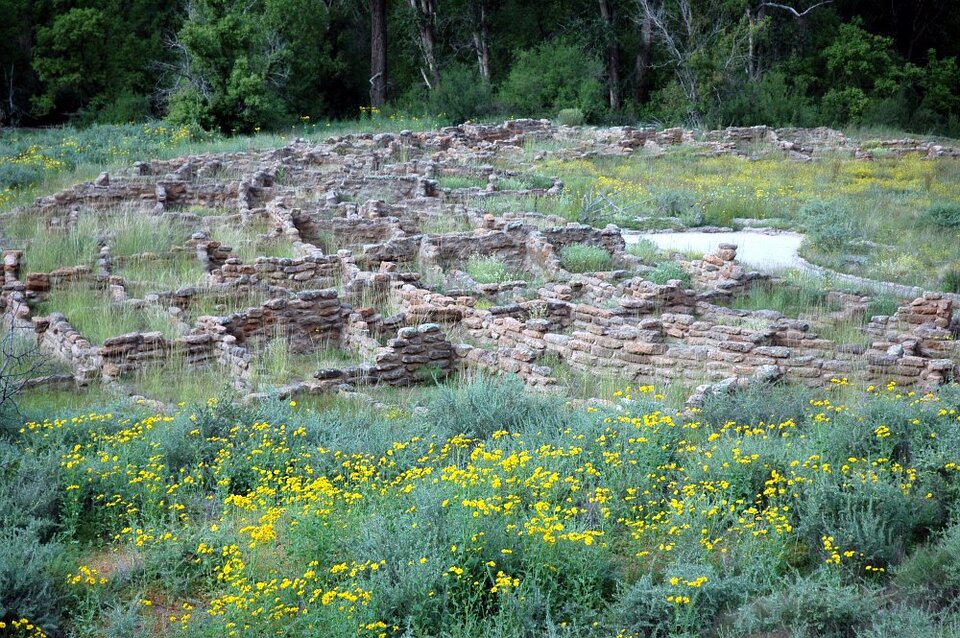
Figure [4]: The translation of "Noch mehr altes Gemäuer"
to English is "Even more old walls" or "Even more old masonry.>

But I digress, because I actually wanted to talk about the still-inhabited Native American village "Taos Pueblo." By the way, the term "Pueblo" comes from Spanish and means "village." The Spanish colonial rulers brought the term to New Mexico.

Figure [5]: The translation of "Indianerin auf dem Weg in
ihre Höhle" to English is "Native American woman on her way to her cave.>

In Taos Pueblo, about 2,000 Native Americans live, with approximately 50 families residing in the three-story, 1,000-year-old adobe houses. To this day, these houses have no running water or electricity. However, the rest of the village inhabitants live in modern houses. There is also a Catholic church in the village square, which might surprise you. The blame, of course, lies with the aforementioned Spanish conquerors who imposed their Catholic faith on the Native Americans. Even today, the Native Americans living in this area are generally Catholic.

Figure [6]: The translation of "Katholische Indianerkirche
in Taos Pueblo" to English is "Catholic Indian Church in Taos Pueblo.>

If by chance you ever find yourselves wandering around New Mexico, don't miss "Taos Pueblo." The architecture of the village is absolutely impressive, and a sense of tradition and history surrounds you at every turn. Incidentally, UNESCO agrees, as it added Taos Pueblo to the World Heritage List in 1992.

Figure [7]: Even for taking photos, you have to pay in the
village!>

A bit unusual, however, is the fact that tourists can only enter the village if they pay an entrance fee of 10 dollars. This is common practice in most Native American villages in New Mexico. Taos Pueblo is also officially a Native American reservation and therefore self-governed.

If you want to take photographs in Taos Pueblo, you pay an additional 5 dollars per camera. Of course, this is how the Native Americans make their living, and that's okay, but at first, we felt a bit inhibited and like intruders. However, the village residents were very friendly and open-minded. Not all areas are accessible to tourists. In the ancient adobe houses, many Native Americans have small shops where they sell their crafts, such as jewelry, wood carvings, and woven goods.

Figure [8]: An Indigenous woman is baking bread in the oven.

The highlight, however, was the delicious baked goods that were offered for sale, traditionally baked in an adobe oven, which is usually located outside the house and looks like a large anthill with a hole.

In Taos Pueblo, we also noticed that many businesses advertised using the term "Indian." Normally, in "politically correct" circles, the term "Native American" is used when referring to the indigenous peoples of America. Rundbrief 02/2002 The tour guide informed us: In the state of New Mexico, most Native Americans find it perfectly acceptable to use the term "Indian." Even museums that deal with the history or art of Native Americans are called, for example, "Museum of Indian Arts and Culture." Nevertheless, as a tourist, I would advise you to stick with "Native American," as you can't go wrong with that. By the way, in New Mexico, white people are often referred to as "Anglos," while in the rest of the country, "Caucasian" is considered correct.

RSS Feed
Mailing Liste
Impressum
Mike Schilli Monologues


Get announcements for new editions

New editions of this publication appear in somewhat random intervals. To receive a brief note when they're available in your mailbox (about once every two months on average), you can register your email on the 'usarundbrief' Google Groups list.

Your email address


All Editions:


Send us a comment
We'd like to hear from you, please send us feedback if you want to comment on the content or have suggestions for future topics.

Simply write your your message into the text box below. If you'd like a response from us, please also leave your email. If you want to stay anonymous, simply put 'anonymous' into the email field. This way we'll get the message, but we have no way to respond to you.

Your email address


Message

 
Contact the authors
Latest update: 27-Dec-2025