10/11/2006   English German

Previous
edition
  Edition # 63  
San Francisco, 10-11-2006
Next
edition


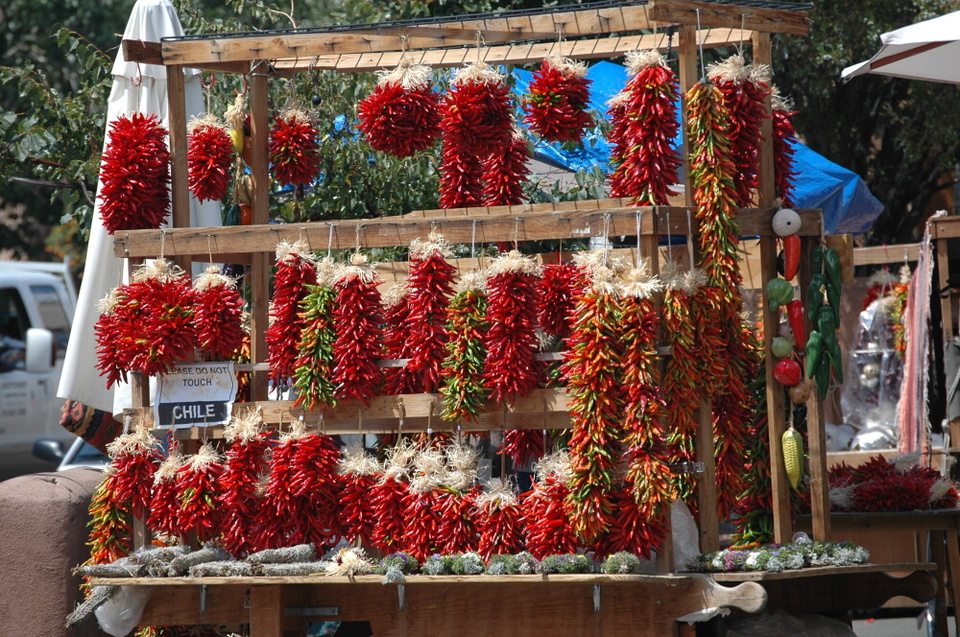
Figure [1]: Santa Fe: Chili peppers hung up to dry

Angelika We have, as is well known, set ourselves the goal of eventually visiting every state in the USA. We had so far neglected New Mexico, probably because it doesn't have the spectacular national parks that you usually find in the Southwest of the USA. But after several friends and acquaintances raved about New Mexico and especially Santa Fe, and immediately added that it was "completely different" to the rest of the USA was, there was no stopping us.

TODO

Santa Fe is not only the oldest state capital in the USA, but it is also situated a whopping 7,000 feet (approximately 2,100 meters) above sea level. The low air pressure there causes the chip bags in the supermarkets to amusingly expand. Despite having only 65,000 residents, it boasts not only surprisingly good restaurants and various museums but also a sea of galleries, especially on Canyon Road.

Figure [2]: One of the countless galleries in Santa Fe

Like San Francisco, the entire city is characterized by a liberal atmosphere. And since Santa Fe was originally ruled by the Spanish conquerors, it even has a real old marketplace (called a plaza) and many small, narrow streets.

Figure [3]: Adobe house in Santa Fe

Figure [4]: Typical round adobe structure

The best part, however, are the adobe houses that dominate the cityscape, as the city has a regulation that new houses must also be built in the old adobe style. Adobe means "clay," and the houses are made of clay bricks (made from clay, water, and straw), which are first stacked into a wall. Then the mason applies a reddish-brown plaster, spreading it generously and padding all the corners so that the whole thing looks like an upholstered sofa.

Figure [5]: By the fireplace in the hut

A great insulation is guaranteed with this type of construction. Our vacation cottage was also built in the adobe style and had the traditional fireplace, called a kiva.

Figure [6]: The brave newsletter reporter in the high desert
landscape>

The surrounding area of Santa Fe offers narrow canyons and vast high desert landscapes with gigantic views stretching to the horizon. There is even an alpine ski resort, the "Taos Ski Valley.

Figure [7]: Las Vegas has also seen better days.

Even a small town called "Las Vegas" can be found here, although it has nothing in common with the gambling paradise in Nevada. This small Las Vegas is famous for its many historic buildings. Unfortunately, the little town lacks money, and many buildings are in urgent need of renovation. However, Las Vegas exudes the old charm of the Wild West, and those who appreciate that will feel right at home there. Of course! Please provide the text you would like translated into English.

In the mentioned ski resort "Taos Ski Valley," there is another curiosity, namely a Bavarian restaurant high up on the mountain. In winter, guests reach it on skis, while in summer, one can drive up a long, steep, unpaved mountain road to the restaurant's parking lot. And since, as Germans in exile, we tend to adopt the most peculiar habits, we gladly admit that we did not shy away from this journey to enjoy a schnitzel and a good beer.

In general, we drove on many unpaved roads in New Mexico to reach remote parks for hiking. Anyone who likes bizarre rock formations and narrow canyons should visit the so-called Tent Rocks (officially... Kasha-Katuwe Tent Rocks National Monument" is already in English. Itis the name of a national monument located in New Mexico, USA, knownfor its unique rock formations. "Kasha-Katuwe" means "white cliffs"in the Keresan language, spoken by the Pueblo people. ...), don't miss it. The formations resemble tents, hence the name.

Indianerreservate

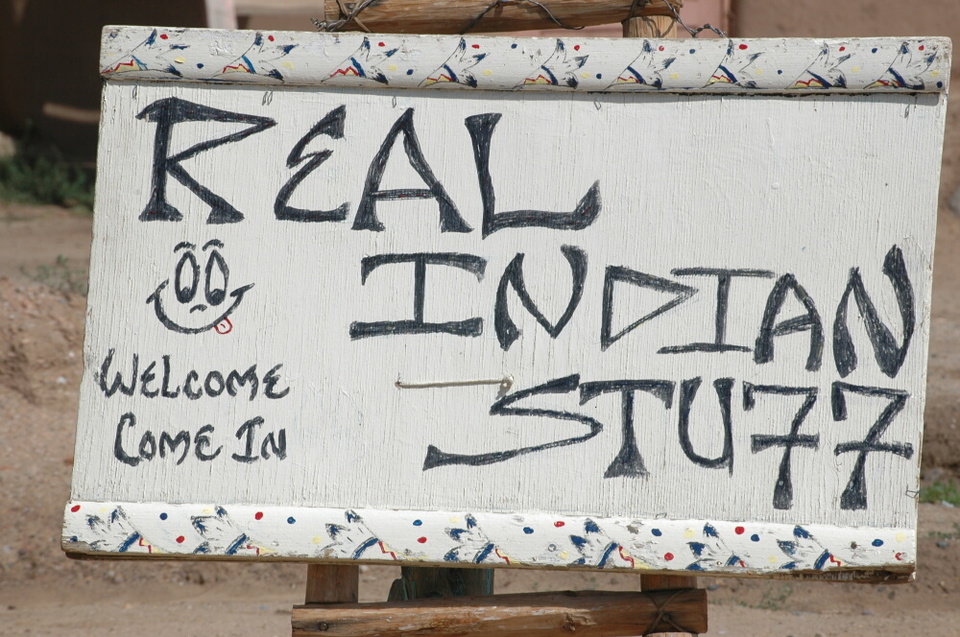
Figure [8]: Indian jewelry is sold here.

Angelika Anyone who has ever studied American history cannot avoid the tragic chapter of the extermination and oppression of the Native Americans. To this day, Native Americans fight for recognition, equality, and the return of their land. The hunger of white settlers for land and natural resources led in the 19th century to the systematic displacement and relocation of Native Americans to reservations, which were mostly established in completely remote, less fertile areas (in other words: in the desert).

Figure [9]: Indian casinos along the main road

I will never forget how, in 1987, we drove for the first time through the vastness of the American Southwest, repeatedly passing Indian reservations: A road that cuts straight through the desert landscape to the horizon, with small, very basic huts scattered across the landscape on either side, which had seen better days. On the way to Monument Valley, we picked up a Native American hitchhiker who lived on the reservation. He wanted to go to the nearest supermarket, which was a few miles away in the middle of nowhere. Even back then, I wondered how the Native Americans could survive in such isolation without any significant infrastructure, and I was no longer surprised by the high percentage of unemployed, alcohol-dependent, and those living on the brink of existence in the reservations.

During our tours through New Mexico, we constantly drove through various Indian reservations. Road signs, similar to town signs, indicate when an Indian reservation begins and when you leave it. This is quite relevant because Indian reservations are self-governed, and the tribal government has limited legal authority. For example, a ban on alcohol within the reservation is not uncommon. We also frequently saw cars with the inscription "Tribal Police" speeding around on the roads.

As an observant tourist in America, you might have wondered why there is now a casino on almost every Indian reservation. The Native Americans take advantage of the special legal status on the reservation and operate casinos where everyone (including non-Native Americans) can play to their heart's content. This brings in good money and has become a stable source of income for the Native Americans living on the reservation. Often, the opening of a new casino is met with loud protests from the population. I find this quite hypocritical: First, the land is taken from the Native Americans, they are confined to a godforsaken reservation, and then people complain that the Native Americans don't make anything of their lives. But as soon as they manage to establish something themselves and succeed, it's not acceptable either.

In 1987, the United States Supreme Court confirmed that Native Americans are allowed to operate gambling activities on their reservations independently of state regulations. However, in 1988, Congress enacted the "Indian Gaming Regulatory Act," which specifies exactly how this should be conducted. It grants the states partial input. Generally, casinos on Native American reservations can only be opened if gambling is not fundamentally prohibited in the respective state.

Angelika In my youthful naivety, I probably watched too many "Winnetou and Old Shatterhand" shows on TV, because I used to think that most Native Americans roamed the vast land and set up their tents wherever there was enough to hunt. As is well known, one should not rely on Karl May's stories, which stem more from his imagination than historical facts, when it comes to Native Americans and North America.

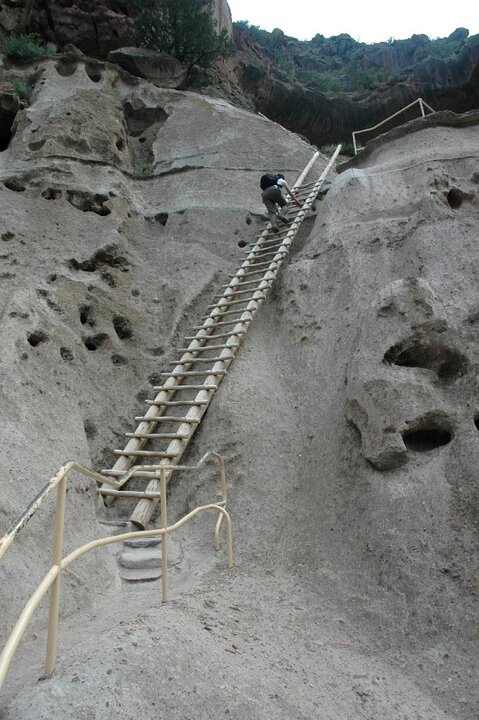
Figure [10]: Bandelier National Monument: Ruins of an
ancient pueblo>

Our trips in New Mexico also dispelled the romantic notion of the Indian riding through the prairie. In what is now the state of New Mexico, the so-called Pueblo Indians lived in villages and practiced agriculture since ancient times. Well-preserved ruins, such as those in Bandelier National Monument, prove this. We even climbed up various ladders to the Ceremonial Cave, a rock ledge high up in the mountain, where the Indians lived for reasons that are inexplicable to me--after all, the climb must not have been easy back then.

Figure [11]: The translation of "Noch mehr altes Gemäuer"
to English is "Even more old walls" or "Even more old masonry.>

But I digress, because I actually wanted to talk about the still-inhabited Native American village "Taos Pueblo." By the way, the term "Pueblo" comes from Spanish and means "village." The Spanish colonial rulers brought the term to New Mexico.

Figure [12]: The translation of "Indianerin auf dem Weg in
ihre Höhle" to English is "Native American woman on her way to her cave.>

In Taos Pueblo, about 2,000 Native Americans live, with approximately 50 families residing in the three-story, 1,000-year-old adobe houses. To this day, these houses have no running water or electricity. However, the rest of the village inhabitants live in modern houses. There is also a Catholic church in the village square, which might surprise you. The blame, of course, lies with the aforementioned Spanish conquerors who imposed their Catholic faith on the Native Americans. Even today, the Native Americans living in this area are generally Catholic.

Figure [13]: The translation of "Katholische Indianerkirche
in Taos Pueblo" to English is "Catholic Indian Church in Taos Pueblo.>

If by chance you ever find yourselves wandering around New Mexico, don't miss "Taos Pueblo." The architecture of the village is absolutely impressive, and a sense of tradition and history surrounds you at every turn. Incidentally, UNESCO agrees, as it added Taos Pueblo to the World Heritage List in 1992.

Figure [14]: Even for taking photos, you have to pay in the
village!>

A bit unusual, however, is the fact that tourists can only enter the village if they pay an entrance fee of 10 dollars. This is common practice in most Native American villages in New Mexico. Taos Pueblo is also officially a Native American reservation and therefore self-governed.

If you want to take photographs in Taos Pueblo, you pay an additional 5 dollars per camera. Of course, this is how the Native Americans make their living, and that's okay, but at first, we felt a bit inhibited and like intruders. However, the village residents were very friendly and open-minded. Not all areas are accessible to tourists. In the ancient adobe houses, many Native Americans have small shops where they sell their crafts, such as jewelry, wood carvings, and woven goods.

Figure [15]: An Indigenous woman is baking bread in the oven.

The highlight, however, was the delicious baked goods that were offered for sale, traditionally baked in an adobe oven, which is usually located outside the house and looks like a large anthill with a hole.

In Taos Pueblo, we also noticed that many businesses advertised using the term "Indian." Normally, in "politically correct" circles, the term "Native American" is used when referring to the indigenous peoples of America. Rundbrief 02/2002 The tour guide informed us: In the state of New Mexico, most Native Americans find it perfectly acceptable to use the term "Indian." Even museums that deal with the history or art of Native Americans are called, for example, "Museum of Indian Arts and Culture." Nevertheless, as a tourist, I would advise you to stick with "Native American," as you can't go wrong with that. By the way, in New Mexico, white people are often referred to as "Anglos," while in the rest of the country, "Caucasian" is considered correct.

Hetch Hetchy" is a proper noun and does not require translation.

It refers to a valley, reservoir, and water system in the Sierra Nevada of California, USA.

Of course! Please provide the text you would like translated into English. Of course! Please provide the text you would like translated into English. Of course! Please provide the text you would like translated into English.

Michael We have often mentioned that it doesn't rain a drop in San Francisco from March to October. This raises the question: Where do the city and the surrounding areas get enough fresh water to survive?

Figure [16]: ... and the meadows are also a lush green ...

Everything that is green in San Francisco is watered in the summer. The palm trees on Dolores Street and the many green parks would be unthinkable without sprinkler systems. Areas that are not artificially irrigated, such as Bernal Heights Hill or the expansive Marin Headlands north of the Golden Gate Bridge, completely dry out and turn brown.

Figure [17]: ... but in the summer, everything that is not
artificially irrigated withers.>

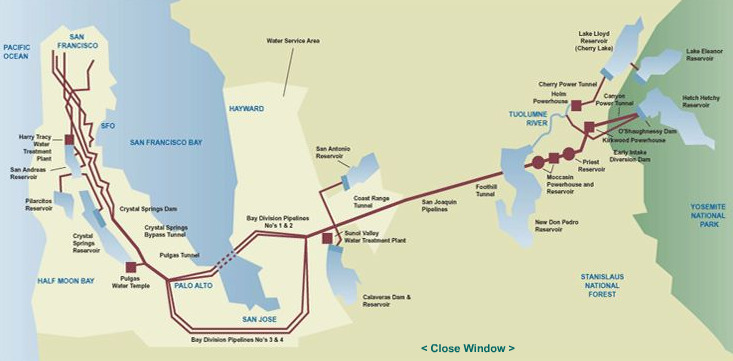
Approximately 200 km east of San Francisco lies Yosemite National Park, an alpine-like landscape with great climbing opportunities, where the two intrepid newsletter reporters have also roamed. At the western end is the so-called Hetch Hetchy Valley. "Hetch Hetchy" refers to a type of grass with edible seeds in the language of the Sierra Miwok Indians who once lived there. After the earthquake in 1906, the city of San Francisco demanded water rights in the park to build a dam, flood the Hetch Hetchy Valley, and create a water reservoir.

The conservationists, led by John Muir, were up in arms. A seven-year legal battle ensued, and in the end, a federal court issued a decisive ruling in the "Raker Act." The O'Shaughnessy Dam was constructed, and the Tuolumne River, flowing into the valley, filled it to the brim with water. This precious water is delivered to San Francisco and the surrounding Bay Area through a complex system of pipelines and tunnels. Website of theWaterworks The translation to English is: "you can see exactly how the whole thing works.

Figure [18]: Location of the
O'Shaughnessy Dam, which impounds water for San Francisco in Yosemite National Park.>

In the summer, the basin gradually empties, but the winter rain refills the reservoir. A few years ago, there wasn't much rain in the winter, and as a result, there was a water shortage in the summer. At that time, recommendations were issued to shower only once a day and to water the lawn only in the late evening.

Pick-Up-Fußball

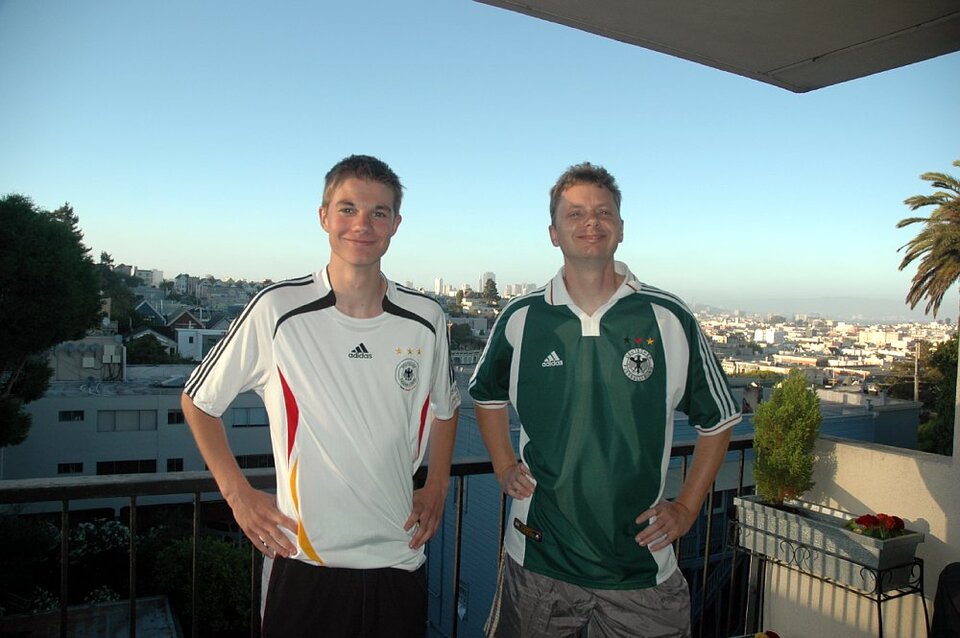
Figure [19]: The German national team in San Francisco

Michael During my youth, I famously spent countless hours playing soccer on the street. And during my studies in Munich, there was a soccer game every day at the so-called ZHS (Central University Sports), where you could just show up without registering.

The USA is indeed a diaspora of soccer, and it's not that easy to find people who can actually play soccer. But when our 17-year-old nephew recently came to visit, I remembered that there is often a so-called "pick-up game" happening in the nearby Dolores Park. So one evening after work, we ran down there and just joined in the game.

Initially, we noticed that an astonishing number of women were playing. And the skill level of the men is, um, not exactly world-class. But it was very fun, and I learned that nowadays people come together for casual soccer through the internet: on the site http://socster.com First, you select the region, then one of the registered locations, and you can already arrange in discussion forums when and how many people will come together.

Figure [20]: Organize pickup games over the Internet:
socster.com>

That works excellently, and last Tuesday I joined a little game, which was really great! The mix was typical too: noticeably many exiled Germans, Italians, and French. Of course, I play in the German national team jersey, which I bought many years ago during a visit to Germany, so people know where I stand.

Barber: Traditional Barbers

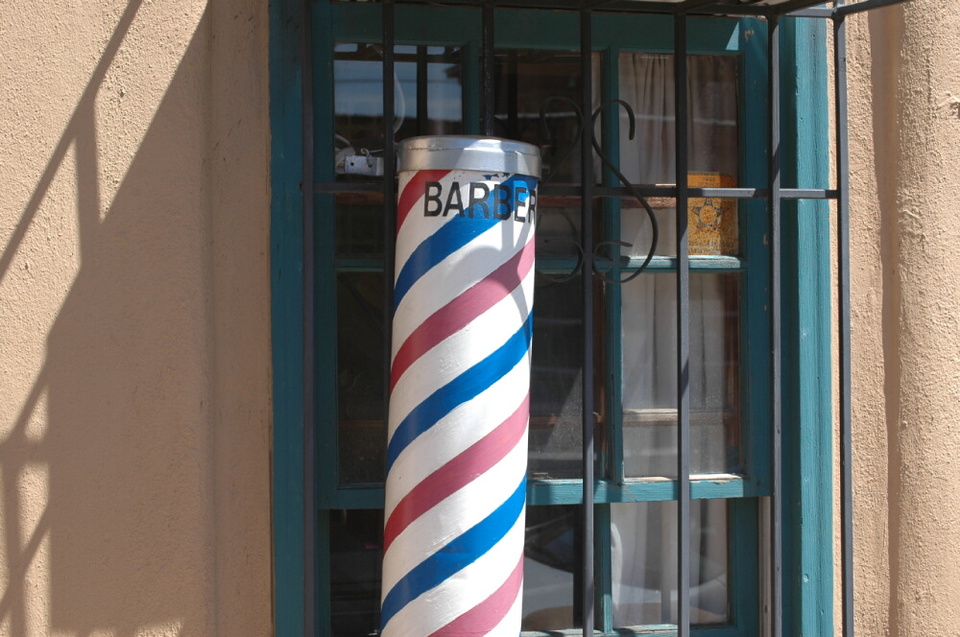
Figure [21]: The "Barber's Pole", the sign for a barbershop

Michael When an American man needs a haircut, he goes to what is called a "barber." These are usually tiny shops, and inside there is a red upholstered leather chair with a footrest. An ancient, life-worn man holds scissors and a razor in his hands. In San Francisco, there is one who even plays the saxophone when there are no customers. Of course, you don't make an appointment with the barber; you just drop by.

A barbershop can be recognized from the outside by the so-called Barber's Pole isalready in English. It refers to the traditional sign used bybarbers, typically a pole with red, white, and sometimes blue stripesthat spiral around it. A vertically standing cylinder with white-red-blue striped spirals. The history of this symbol can be traced back to the Middle Ages, when barbers performed bloodletting on their patients using leeches. And it wasn't that long ago that barbers also pulled teeth or performed minor surgeries with whiskey anesthesia.

The white stripes of the cylinder symbolize bandages, the red ones blood, and there are different interpretations for the blue ones: either venous blood (as opposed to red arterial blood) or simply to distinguish between surgeons (red) and barbers (blue). Or simply to complete the American national colors, as there is no certainty about this.

The difference between a barber and a hairdresser is that the barber also shaves beards, although this is rarely requested nowadays. Additionally, the barber is relatively inexpensive; sometimes a haircut costs less than 10 dollars! However, the barber does not wash hair, as that seems to be reserved for the fancy salons.

Figure [22]: A typical American barbershop.

By the way, there is this budget chain called "Supercuts," which are hairdressers that are also quite cheap and trim both men's and women's hair. However, Supercuts is the McDonald's of hairdressers, and I've heard that the training period for the staff is about a week. So, the quality of the haircut can vary.

My barber in the Italian neighborhood of North Beach is from Puerto Rico and lives in the South American neighborhood of Mission. He not only cuts my hair and shaves the sideburns with a real razor, but after the work is done, if he's in a good mood, he also straps a vibrating device to the back of his hand to massage the scalp with his now trembling hand. Very pleasant! However, if you talk during this, your voice vibrates amusingly.

Figure [23]: The barber gives the customer a
traditional men's haircut.>

A tip of about 20% is given at the hairdresser. In an expensive women's salon, that can quickly be $20-$30! And just before Christmas, as custom dictates, this amount is to be doubled. That makes the wallet groan!

Topprodukt

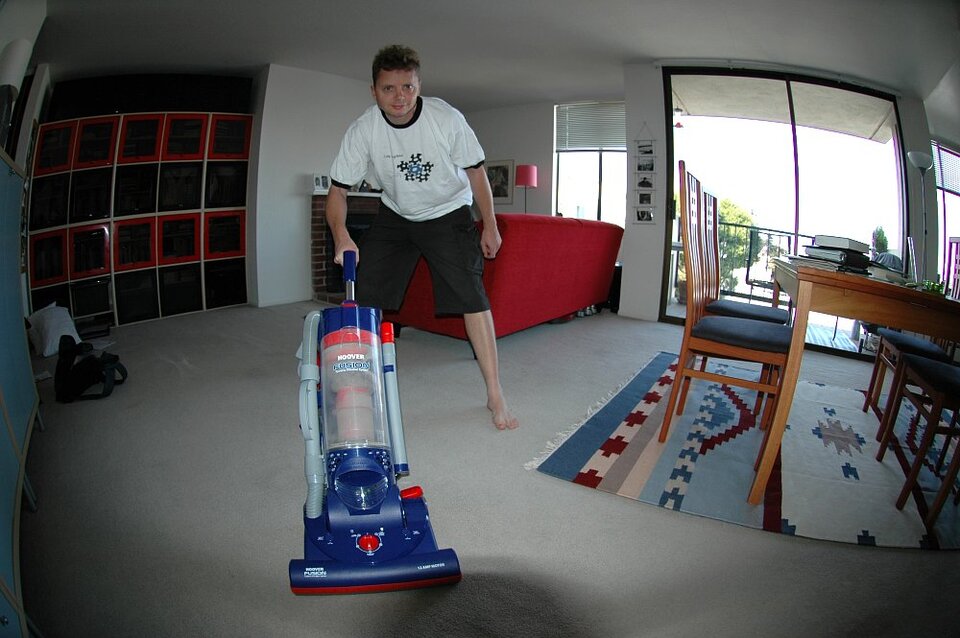
Figure [24]: The super vacuum cleaner "Hoover Fusion

Michael Recently, someone asked on an internal Yahoo mailing list what the best vacuum cleaner currently available might be. Don't laugh! This kind of question comes up often, and it's actually very helpful to get everyday tips from reasonably educated people. The popular answer: the Dyson. It's one of those modern, futuristic-looking vacuum cleaners that supposedly unleashes such an infernal suction power that it outshines every device that has come before it. One Dyson model even has the fitting name "Animal." However, it comes with a price: $400 and up.

We are, as you know, still letting our Roomba vacuum robot ( Rundbrief 02/2006 Here's the translation to English:

"... but sometimes you spill something or want a deep clean, and that's when you need a proper vacuum nozzle. Spending $400 on a device that you only use once a month is, of course, absurd. So when I found out that the well-established vacuum company Hoover produces a Dyson clone for $110, I quickly ordered it online and had it sent to my office.

And this thing is truly phenomenal! I have no idea if the Dyson is even better, but at a quarter of the price, I'm happy to accept that uncertainty. I vacuum a part of the apartment every day because it's so much fun!

PG&E

Figure [25]: PG&E gives a discount.

Angelika Last week, our electricity bill from PG&E (Pacific Gas and Electric Company) arrived, and I was surprised to see that it was significantly lower than usual. Then I noticed the attached note, which kindly explained that every customer would retroactively receive a 15% discount called the "Heat Storm Bill Credit" for their gas and electricity bill from July. It went on to say that an unusual heatwave had gripped California in July, leading to higher electricity consumption (keyword: air conditioning) and bills for many households. Huh? I had always thought that we live in an era of global warming and that saving electricity, not wasting it, should be rewarded. PG&E had generally adhered to this principle in the past. During previous heatwaves, consumers were encouraged to reduce their electricity usage, for example, by turning down the air conditioning, to receive a discount later for significant savings.

In San Francisco, by the way, we don't pay a monthly installment for our electricity; instead, we pay for the amount we actually consume. Every month, the PG&E man comes to read the meter. He carries a huge bunch of keys to open various garage doors or similar to access the meters. Often, the meters are also mounted on the exterior walls of houses. Just before the new year, a calendar is always included with the bill, indicating when the meter will be read. This system naturally leads to higher bills in months when heating is necessary or when the air conditioning (which is rare in private homes in San Francisco) is running at full capacity. PG&E does offer the option to pay an average amount each month to balance out the fluctuations, but I personally don't know anyone who does that.

The DVD film "Enron - The Smartest Guys in the Room" provides a good insight into the dark dealings of American energy executives.

Mexican Coke

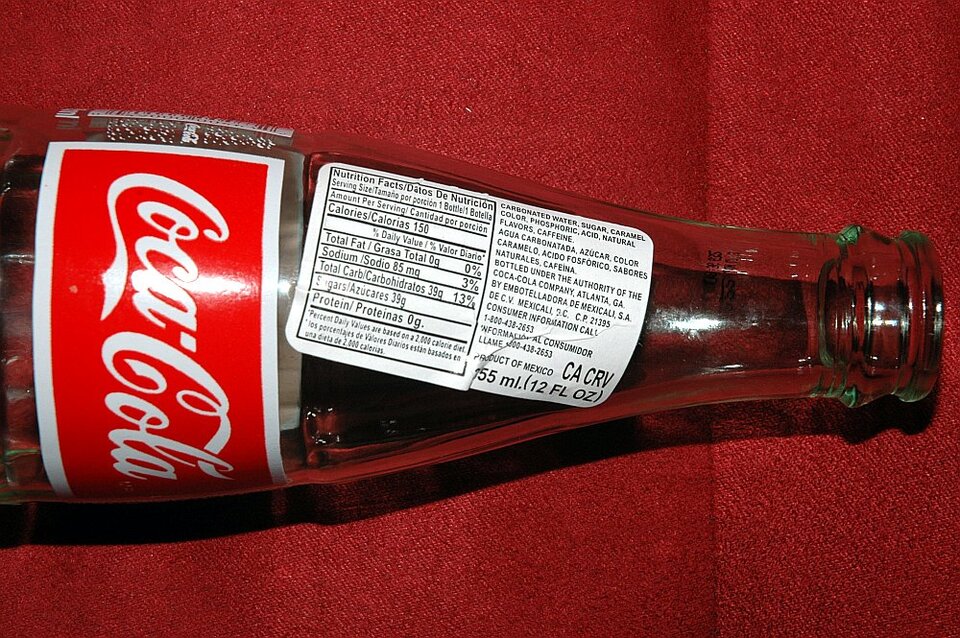
Figure [26]: The real Coca-Cola, still with sugar. Bought at
the Mexican taco truck.>

Michael When you buy a bottle or can of Coca-Cola in the USA, you get a different product than the Coca-Cola that was sold as such 20 years ago. This is because the powerful distributors of corn syrup (a sweet sludge made from corn) have ensured that their American product is used for sweetening in soda-like drinks instead of sugar across the board.

There are conspiracy theories suggesting that the substance is significantly responsible for the fattening of American society. Allegedly, the syrup is said to lead to excessive consumption of sticky soda.

Whether that's true, I dare to doubt, but connoisseurs nowadays don't buy their soft drinks in the supermarket anymore; instead, they buy them online or at Mexican taco trucks, where you can find re-imported Coca-Cola from Mexico at fantasy prices (I recently paid 2 dollars for a 0.33l bottle!). The Mexicans call it "Coca Mexicana." With sugar, like in the old days. Because the Mexicans won't be fooled. And the internet-savvy folks in Silicon Valley line up obediently behind the Mexicans at the taco truck during lunchtime.

See you later, Baby!

The translation of "Angelika und Michael" to English is "Angelika and Michael.

RSS Feed
Mailing Liste
Impressum
Mike Schilli Monologues


Get announcements for new editions

New editions of this publication appear in somewhat random intervals. To receive a brief note when they're available in your mailbox (about once every two months on average), you can register your email on the 'usarundbrief' Google Groups list.

Your email address


All Editions:


Send us a comment
We'd like to hear from you, please send us feedback if you want to comment on the content or have suggestions for future topics.

Simply write your your message into the text box below. If you'd like a response from us, please also leave your email. If you want to stay anonymous, simply put 'anonymous' into the email field. This way we'll get the message, but we have no way to respond to you.

Your email address


Message

 
Contact the authors
Latest update: 27-Dec-2025