02/15/2006   English German

Previous
edition
  Edition # 59  
San Francisco, 02-15-2006
Next
edition


Figure [1]: Chinese tombstone

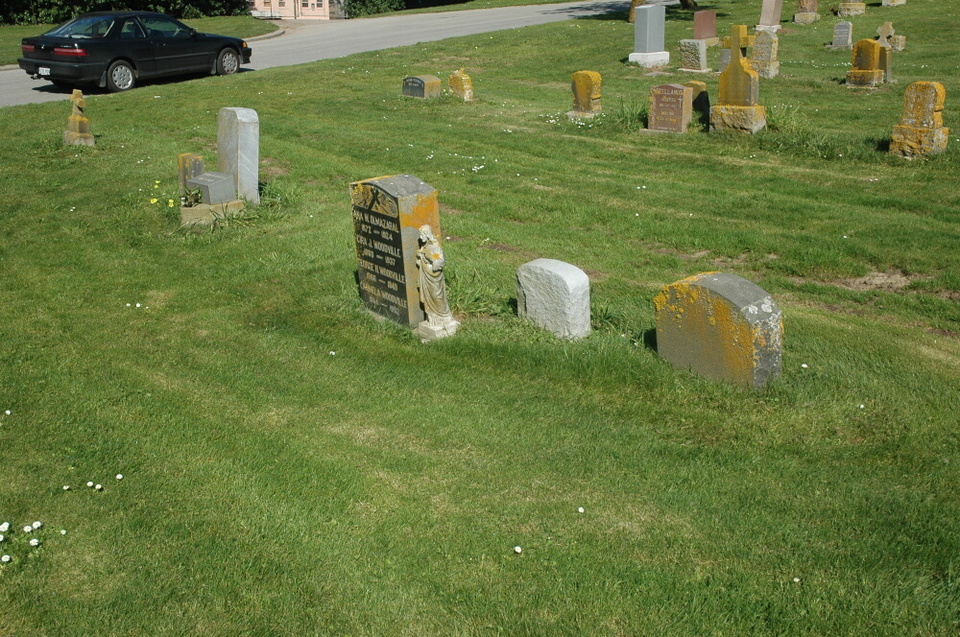
Figure [2]: Tombstones from way back when.

Hold on, that's not entirely correct. Three cemeteries remained in the city due to their historical significance. This includes the "San Francisco National Cemetery," reserved for war veterans, located on the grounds of the Presidio, the former military base near the Golden Gate Bridge. Today, burials in this location are only conducted in exceptional cases. The second is the cemetery belonging to the old Mission Dolores, where many Native Americans, who helped build the mission, found their final resting place. And then there is the "San Francisco Columbarium," a unique neoclassical building from 1897 that houses urns and was formerly part of a cemetery called "Odd Fellows."

Figure [3]: The columbarium in San Francisco

Today, only the Columbarium building remains at the end of a small cul-de-sac in the Richmond district. You can still reserve a spot for your ashes there. Although the Columbarium survived the severe earthquake of 1906 and the forced relocation of cemeteries, it gradually fell into disrepair from 1934 to 1979 until the Neptune Society (a cremation company) took it over and lovingly restored it. Each urn is placed in a cabinet about 15x15 inches in size, with either a glass door or a copper door. The cabinets look like shelves set into the walls of passageways. Many of the niches now contain not only the urn with the ashes but also small mementos reflecting the deceased's preferences. So, if you are one of those people fascinated by cemeteries and you find yourself in San Francisco again, be sure to visit the Columbarium.

If you don't want to be cremated after your death and haven't reserved a niche in the Columbarium, as a resident of San Francisco, your only option is one of the 17 cemeteries in Colma. Colma is surrounded by the San Bruno Mountain Range and the Freeway 280. Besides the cemeteries, Colma has a few typical American shopping centers and car dealerships. Colma has about 1,300 residents and is home to almost 2 million graves. For comparison: San Francisco today has about 750,000 residents.

Figure [4]: Front: Jewish Cemetery. Back: Italian Cemetery.

Figure [5]: Chinese Cemetery

The diverse cemeteries reflect the cultural diversity of San Francisco and its surroundings. Among the 17 cemeteries, there is an Italian, a Greek Orthodox, a Jewish, a Catholic, and a Chinese one, among others. When Michael and I visited the various locations on a beautiful Saturday, we were surprised by the park-like grounds. Signs indicated that sunbathing in the cemetery was not allowed, and the Jewish cemetery was completely closed due to the Sabbath.

Inside the cemeteries, we almost felt like we were in another world. Only the highways, as well as the Toys-R-Us and the Target supermarket in the background, taught us otherwise. We were also quite amazed by the pompous mausoleums. By the way, normal graves in America do not have a grave outline or planting. Only the headstone and a few flowers adorn the grave, which is otherwise surrounded by the cemetery lawn. Often, the stone is a small square plaque set into the ground, and the flowers are made of plastic. This, of course, makes maintenance easier and fits the pragmatic nature of Americans. And, typically for America, you can drive your car through the cemetery right up to the grave. English.

The latest trend, however, are so-called green burials, which are supposedly more environmentally friendly. The deceased are not embalmed and are buried either in a simple, biodegradable wooden box or just in a shroud, under the surface of a the green hill. The impact on the landscape is meant to be minimal, meaning there are no large headstones marking the grave or any traditional cemetery layout. Relatives who wish to visit the grave later can locate it using a GPS system provided by the cemetery company for this purpose.

Now, you might think this is an American invention, but supposedly the British are pioneers when it comes to green burials. Such burials naturally resonate with the esoterically inclined and environmentally friendly old hippies in California. So it doesn't surprise me that there is already such a cemetery in Marin County, which is located north of San Francisco. The Fernwood Cemetery, recently also called "Forever Fernwood" is not the first American cemetery to offer green burials. As early as 1998, Billy Campbell, a doctor, came up with the same idea in the city of Westminster in the state of South Carolina. However, the operators of Fernwood are not only striving for an alternative cemetery but also for a kind of nature reserve that can later be used by the general public for hiking and other activities. Therefore, only native plants are allowed to adorn the graves, which are invisible anyway. But now, back to life.

San Francisco Views: Bernal Heights

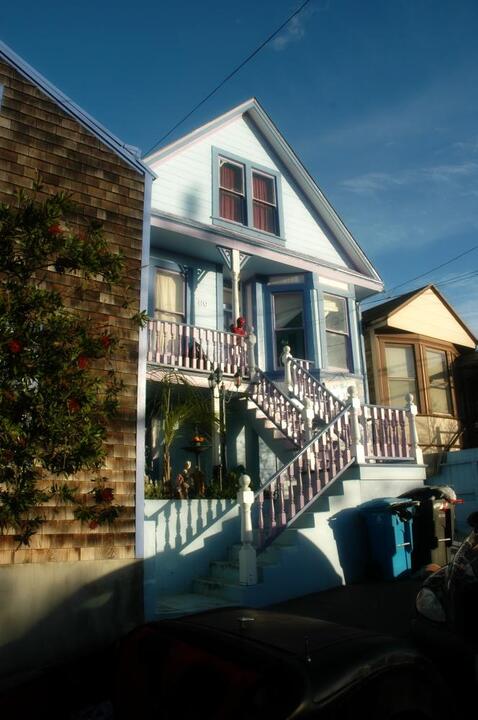
Figure [6]: Bernal Heights: Hippie House

Michael In our series "Views of San Francisco," today we focus on the old hippie stronghold "Bernal Heights." It is pronounced "Bernel Hites". The name comes from Don Jose Cornelio Bernal, a rancher who was granted the area of today's Bernal Heights in 1839 to let his cattle graze there. Later, as the city of San Francisco began to grow, Bernal Heights was initially sparsely populated but experienced significant growth when the area, founded on stable rock, was largely spared from the 1906 earthquake.

Figure [7]: Bernal Heights: Old Cars and Hippie Houses

Figure [8]: Bernal Heights: A modern-style house with a view of the Bay

Bernal Heights is home to hordes of super-rich old hippies. Day in and day out, they mock the neighboring district of Noe Valley, claiming that it became completely yuppified during the dot-com boom of the 90s. In their eyes, Bernal Heights is still home to true alternatives.

That is, of course, nonsense. The truth is that in Bernal Heights, while many people don't maintain their gardens and some park very old cars on the street, the house and rental prices have also reached dizzying heights. If you look closely at the photos, you'll notice that I've edited them all with a filter that makes them appear somewhat dreamy and blurred. This way, you see the area through the eyes of the old hippies who live there!

In Bernal Heights, it is noticeable that there are hardly any shops. Hardly anyone is on the street; everyone is sitting in their expensive hippie houses counting their money. To spend it, they would have to drive two kilometers to Noe Valley, as there is no good public transport, because that would be bourgeois. Yet the area is really beautiful, very hilly (the speedy newsletter reporter had to shift to the first gear on his mountain bike and even had to push once) and offers breathtaking views of the surrounding neighborhoods like Mission, Downtown, the San Francisco Bay, and various highway interchanges. On clear days, you can see all the way to Oakland and Berkeley on the other shore of the Bay.

Figure [9]: Bernal Heights: Victorian Houses

Figure [10]: Bernal Heights: View of the "Mission" neighborhood

The satellite image of Bernal Heights shows the easily locatable, light brown grass hill named "Bernal" in the summer, on top of which stands a radio tower. If you drive east from Bernal Heights, you will reach a neighborhood that we will probably never feature in the "San Francisco Views" series: Hunter's Point, one of the last truly violent neighborhoods that no hippie dares to enter.

Figure [11]: GPS navigation system on a bicycle in Bernal Heights

What stands out about Bernal Heights is its enormous density of dead-end streets. Roads either end abruptly on steep hills or at the adjacent 280 freeway. If there were a statistic on American neighborhoods with the most dead ends, I wouldn't be surprised to find Bernal Heights at the top of the list. Anyone who makes the mistake of entering the labyrinth without a navigation system will never find their way out. Of course, the speedy newsletter reporter had his new GPS system with him (see illustration 11) and escaped the old hippie fools after completing his work with just a few strong pedal strokes.

On the State of the Nation

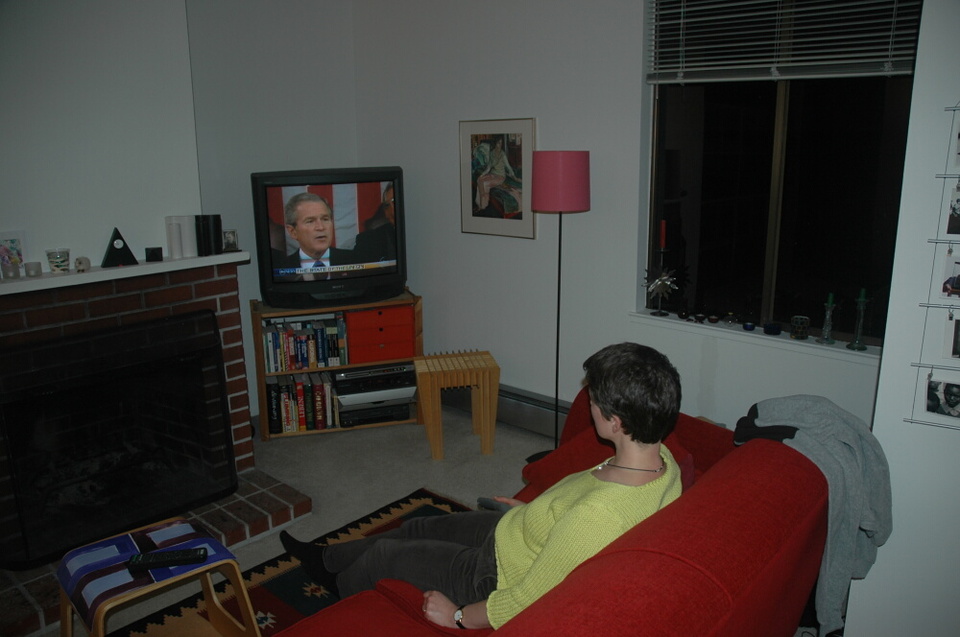
Figure [12]: Angelika with her favorite president

Angelika Once a year, usually in January, the sitting American President delivers a report on the state of the nation before the members of Congress, including representatives, senators, and some invited guests. This report is called the "State of the Union." I have experienced this once before during Clinton's time in office (Rundbrief 03/2000). The same applies, by the way, to the respective "Governors" (Heads of State) of the federal states and mayors of the cities, except that the speeches are then called "State of the State" or "State of the City".

The president's speech will be broadcast live on television. I had actually sworn to myself never to watch another speech by Bush, because it always ends with me yelling at the TV. I find Bush's grin and his basking in applause unbearable. But one has to be informed in order to participate in discussions. Of course, several speechwriters have been working on the State of the Union address for weeks, so it sounds great, but what is said has little to do with reality.

The speech, of course, serves the purpose of presenting Bush in the best possible light. He portrayed the scandal of Americans being wiretapped without court orders as a legal "terrorist-surveillance program." Otherwise, he bombarded us with the usual platitudes: fighting terrorism and radical Islam, tax cuts as a cure-all, reforming Social Security, combating skyrocketing healthcare costs, and America as the savior of the world. Yawn! But then the president, deeply connected to the oil industry, said: "America is addicted to oil, which is often imported from unstable parts of the world.

And he added another point, namely that 75% of American oil imports from the Middle East must be replaced by alternative energy sources by the year 2025. This alarmed the Saudi Arabian ambassador, who speculated in dismay after the speech about what Bush actually meant by that. Could it be that Bush is secretly an environmentalist and a Democrat? No, because he only spoke about replacing oil with alternative fuels like ethanol. He did not say that the dependency on oil imports should be reduced by limiting American gasoline consumption.

But the more liberal American press is increasingly picking up on this idea. Columnist and Middle East expert Thomas Friedman is tirelessly writing about it in the New York Times. His mantra is more fuel-efficient cars and a high gasoline tax. After the speech, the opposition is given the opportunity for a response, the so-called "Rebuttal." However, this no longer takes place in Congress with an audience. This year, Governor Tim Kaine from Virginia and Mayor Antonio Villaraigosa from Los Angeles spoke for the Democrats, with Villaraigosa delivering his response in Spanish, by the way. Surprised, aren't you?

Garbage Collection

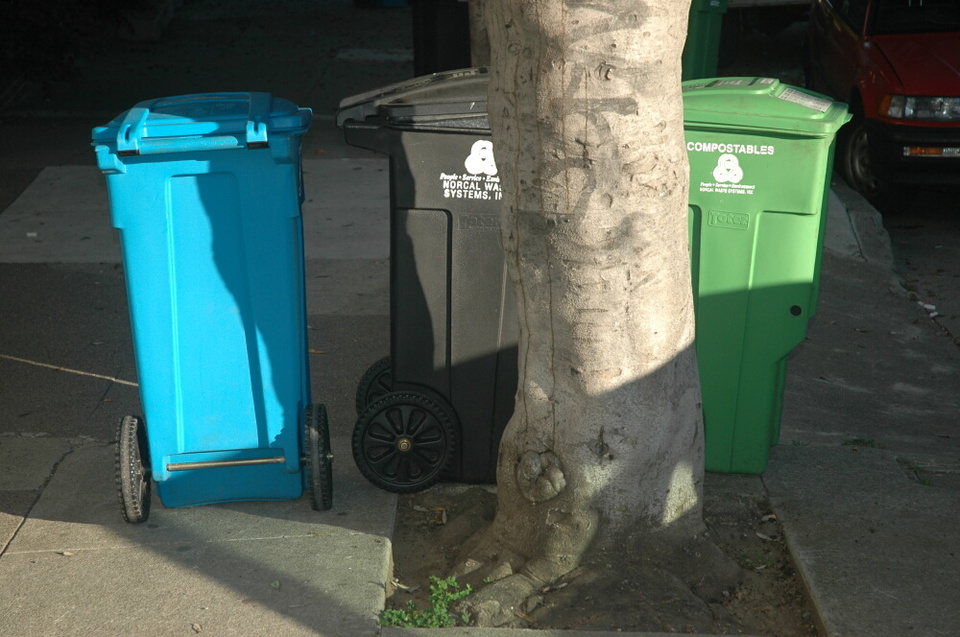
Figure [13]: Three bins for glass/paper/plastic, regular waste, and compost.

Angelika Our visitors from Germany are always surprised that recycling is also done in San Francisco. America simply has a reputation for packaging mania and a throwaway mindset. And for the most part, that's true; Americans are still far from recycling as progressively as the Germans do. For example, at larger private parties, most people still find it quite normal to eat from paper plates and use plastic cutlery. Or just think about how many paper coffee cups the coffeehouse chain Starbucks hands out daily.

However, there is waste separation in San Francisco, but it works differently here. Paper, cardboard, glass, aluminum, and plastic: everything goes together into a large blue trash bin or box, which is to be placed on the street on a specific day. The sorting is done by the waste facility. They want to make it as easy as possible for the customer. Only any compost that may be generated is placed separately in a green bin.

Figure [14]: This recyclable plastic bottle is type 1.

Things made of plastic, on the other hand, are also a science in themselves here. Only plastic bottles with the numbers 1 to 7 and plastic cups and lids with the numbers 2, 4, 5 go into the blue bin. The number is stamped on the bottom of the bottle or cup--similar to the German "green point" recycling symbol. The water bottle in illustration 14, for example, has the number 1 in the stamped recycling triangle at the bottom of the bottle. Into the bin it goes!

Lids for glass or plastic bottles, as well as metal bottle caps, are not being recycled, which Michael still hasn't understood, even though there's now a large poster on our fridge showing the items that can go into the blue bin. Recycling is becoming increasingly popular in America. Many cities have similar blue bin programs like San Francisco. In more remote areas, you often have to take matters into your own hands and bring paper, glass, and cans to designated containers. During our last vacation on Kauai, we drove around the island for miles with a pile of old glass bottles until we finally found the island's only glass recycling container.

Green bins, intended for compostable waste, are also appearing more frequently in front of houses in San Francisco. Many restaurants and hotels participate in the city's composting program. Organic waste is processed into compost by the company Jepson Prairie Organics. Wineries in Napa and Sonoma spread it between their vines so that the fine grapes for California wine can thrive. And speaking of greenery: even Christmas trees are recycled in San Francisco. We just have to place the undecorated tree outside our door at the beginning of January.

Even though recycling is no longer a foreign concept in America, California/San Francisco often takes a leading role when it comes to protecting the environment. For example, at the beginning of February, a law came into effect in California that prohibits the disposal of old batteries, neon tubes, mercury thermometers, and so-called electronic waste (cell phones, printers, computer monitors, televisions, VCRs) in household trash. This may not seem particularly groundbreaking to you, but the law is considered one of the most far-reaching in the USA. Additionally, starting in July, stores that sell cell phones will be required to take back old ones. For a change, we are aligning ourselves with European regulations.

Words that nobody knows

Michael In the series "Words Nobody Knows," we present English words that even the most seasoned English speakers don't know, but every child in America does. We guarantee that you can drive English teachers at German high schools crazy with them! So, use our words diligently in your school essays! Today: What is the name of the ice resurfacing machine for ice rinks? You know, those giant carts on four wheels with an ice scraper at the back that makes the ice surface in stadiums nice and smooth again between hockey games or ice skating events.

That is a 'Zamboni.' Named after its inventor Frank J. Zamboni, who lived from 1901 to 1988. As is often the case, this word is also described with extremely lovingly detailed explanations in Wikipedia, the encyclopedia of the future. Just look it up under Zamboni on Wikipedia.org. Afterwards, you will already know everything worth knowing.

Top product: Roomba

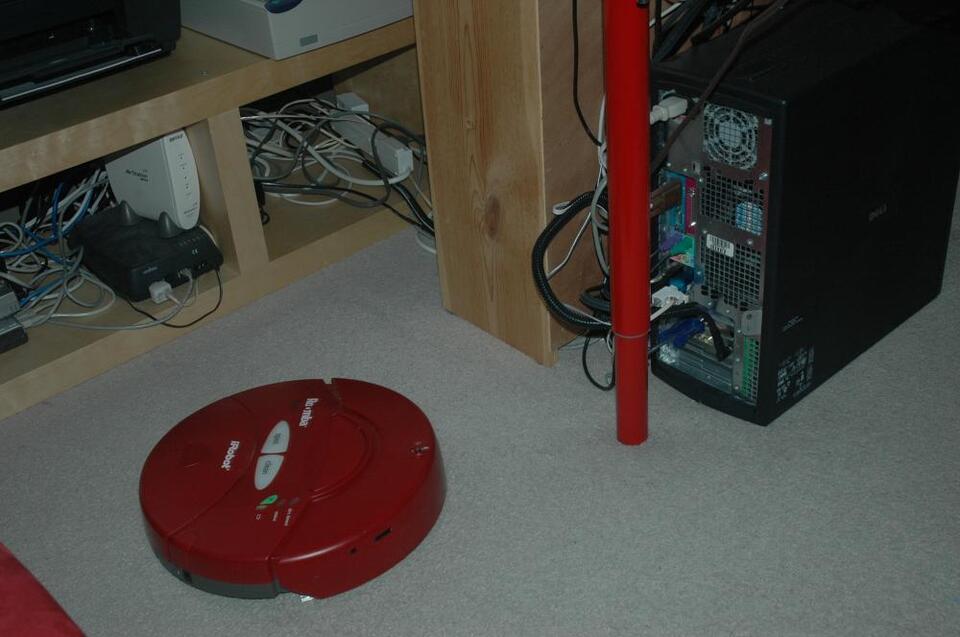
Figure [15]: The little Roomba is scurrying around on the carpet in my study.

Michael No one in our household likes to pick up the vacuum cleaner. Pushing that heavy thing around the apartment and then having to go back and forth over every piece of lint five times until it finally gets sucked up -- it's incredibly annoying.

Fortunately, for some time now, there have been small vacuum robots like the "Roomba" that you just turn on, and it independently explores the apartment. The saucer-shaped little guy remembers which obstacles it encounters and gradually builds an internal map of the area covered. Once it has covered all the corners, which takes about half an hour depending on the room size, it beeps a cheerful melody and turns itself off. The little fellow is surprisingly effective, as it also goes under the couch and the bed, where a regular vacuum cleaner would never reach.

However, the device is not yet perfect, so it can sometimes happen that it loses some dirt or gets stuck on carpet fringes. But most of the time, it manages to get itself out of the mess by trying different strategies (backwards, forwards, turning) until it can move freely again. It's a lot of fun to watch!

The Roomba runs on its rechargeable battery for about an hour, then it needs to return to its charging station. If you don't want it to roam through the entire apartment, you can limit its range with so-called "Virtual Walls." These battery-operated blocks emit a linear radio signal in one direction, creating something like a light barrier for the Roomba, causing it to turn around immediately.

I have a small video with the Roomba in action, as it just reaches under our bed, comes back out, and then tackles the dirt under the dresser. By the way, there is also a second video from another Roomba owner that is very funny, where a Roombascares a house cat.

I can recommend the Roomba; it's just incredibly cool to lock it into a room and let it work for half an hour while you turn on the TV or tinker on the computer.

The Best Toilets Downtown

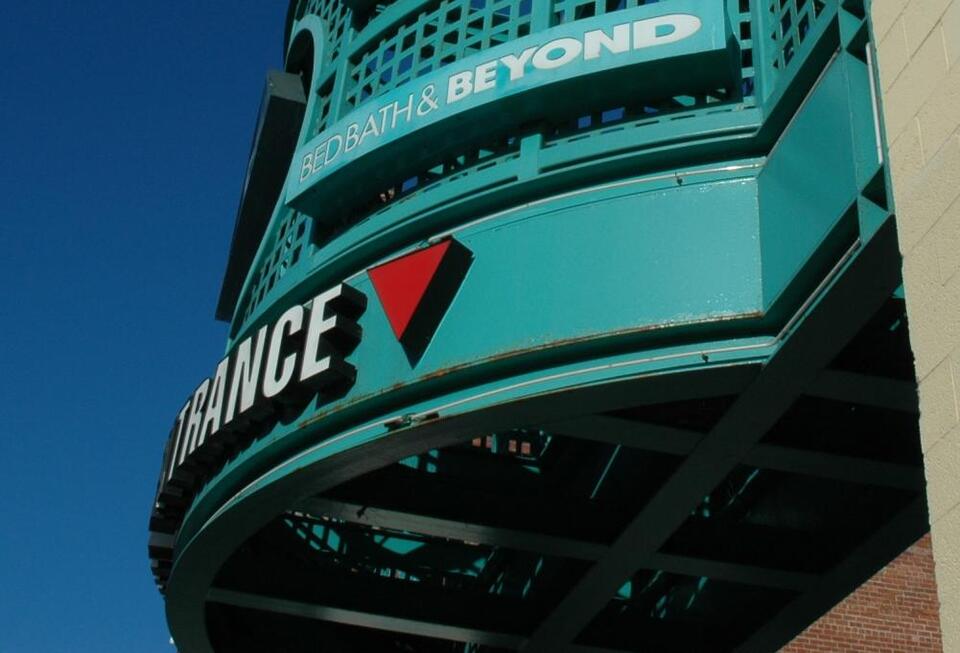
Figure [16]: Outstanding locations: Bed, Bath, and Beyond

Michael You know how it is: You're downtown and need to use the restroom. Restaurants and cafes don't like it when you just use their toilets and sometimes make it quite difficult if you're not a customer. But if you know your way around, it's relatively easy to find establishments that allow you to use the restroom without having to make any pseudo-purchases.

I must advise against using public toilets. Firstly, all subway toilets were promptly closed following the September 11, 2001 attacks. Apparently, no one misses them, as they have not been reopened to this day. Secondly, all public toilet facilities in San Francisco are inaccessible because they are used by drug addicts for low budget prostitution. So where does the average citizen go? Not to the shady establishments that display "No Public Bathroom" or "Bathrooms for Patrons only" signs. And not to the shady record-selling company "Virgin" on Powell, which offers a large selection of CDs but has a restroom that either doesn't exist or is constantly occupied--I spared myself the details of finding out. A disaster.

The best restrooms in downtown are at bookstores. The "Borders" on Powell Street (between Geary and Post) is not only located right on the cable car route, but also has decent toilets if you take two escalators all the way to the top.

On Market Street, at the corner of 2nd Street, is the independent bookstore "Stacey's," which also has excellent facilities on the upper floor (stairs up, then directly behind the information desk next to the magazine stands). By the way, Stacey's is an independent bookstore that needs support, otherwise it will soon go bankrupt, so feel free to buy your travel guides there.

Editor's note: In January 2009, Stacey's announced that it would close the store in March. The reason: declining sales caused by competition from book chains ("Barnes and Noble", "Borders") and online sellers ("Amazon").

If you are in SoMa (Rundbrief 05/2003), at the corner of 9th Street and Bryant, there is a store called "Bed, Bath, and Beyond" that not only offers excellent products at low prices but also has a spacious and exceptionally clean restroom on the 2nd floor (take the escalator up) in the far corner by the down comforters. I love going there; it's a real pleasure.

A similar situation applies to the area around Fisherman's Wharf, where there is a branch of the bookstore chain "Barnes & Noble" that even offers wonderful restrooms on the ground floor next to the children's book section. McDonald's and Burger King branches also usually have decent restrooms. However, like Starbucks branches and gas stations, they sometimes issue a key with an oversized tag at the counter, which you can use to unlock the restroom. This is petty and mean, and also shows poor business sense, which is why these chains should actually be boycotted.

You never have to walk around with a strained face in shopping centers either, as every Target, Walmart, Home Depot, Circuit City, and Costco all have decent restrooms.

Threatening To Cancel

Michael The USA is indeed a global leader in sales. Over here, they're selling like there's no tomorrow, using the best methods, some of which might even be considered somewhat questionable by European standards.

However, this often also has advantages for the consumer. When multiple providers offer the same service, such as an internet connection, it is a major disaster for the service provider to lose a customer. Firstly, it is extremely expensive to attract new customers through advertising, with costs amounting to about 10 months' worth of fees. And, almost as importantly, it is detrimental to the company's image if five million customers suddenly become four million. Then the stock price falls on the stock exchange, and no one jumps on a slowing train. That's why companies try everything, I emphasize: everything, to retain their customers.

No money to pay the bill? No problem, then the price will just be halved. Still too expensive? Then the service will be free for a while. You think I'm exaggerating? Just read how to cut your cable bill in half.

When you call a service and say you want to cancel, the representatives act understanding and immediately connect you to the so-called "Customer Retention" department. There, you get specialists on the phone who try everything to keep you as a customer. If you really want to cancel, it can be quite nerve-wracking because you have to explain a hundred times that you're really not interested in the extremely cheap alternative offer and actually want to leave the provider.

The result is that many people simply call, threaten to cancel, and then get the service for a completely ridiculous price for a usually limited time. DSL internet is currently available for $14.99 a month. However, Angelika has forbidden me from pushing for a lower price because she is afraid that they might see through my bluff and actually cut off our cable or phone.

In-N-Out Burger

Michael Fast food chains like McDonald's, Burger King, and Wendy's all have their roots in the USA. This naturally raises the question of where to find the best burgers. I should add that I might eat a burger once every three months. Unfortunately, there isn't a single burger chain in our neighborhood. A few months ago, there was a major construction site across from us, and I was hoping that we would finally get one. Instead, a bank and a fitness center moved in. My goodness! And since I rarely drive anymore, I hardly ever pass by any burger chains.

Call me a snob, but instead of paying 50 cents for a trash burger, I'd rather spend $2.50 for a decent one from "In 'N Out." And I would even pay $5 for one if the quality of the meat were guaranteed. But "In 'N Out" is already pretty good. They have the Double-Double, a burger with two layers of meat and two layers of cheese.

A little-known fact about this chain is that you can choose the number of meat and cheese layers yourself. For example, if you were to order a Triple-Triple, you would get a burger with three layers of meat and three layers of cheese. Of course, this can easily be increased to the point of absurdity: Quadruple-Quadruple, Quintuple-Quintuple, and so on. So a group of people in Silicon Valley thought, let's drive to Las Vegas and order a 100x100 burger. That means a bottom bun, then 100 layers of meat and cheese each, and then the top bun. The result can be admired on the Internet.

That reminds me of the documentary "Supersize Me" by Morgan Spurlock. The main actor, under medical supervision, eats only McDonald's fast food for a month. The rule: Every time the McDonald's employees ask, "Do you want to supersize it?" he must agree and consume the entire meal. McDonald's has since discontinued this practice, but back then, for a few extra cents, you could get enormous portions, a whole box of fries, and half a barrel of cola. The calories contained in these meals naturally caused the test eater to gain a dangerous amount of weight within the test period, prompting the supervising doctor to throw up his hands in despair. A noteworthy documentary, available on DVD.

Do-Not-Call-List

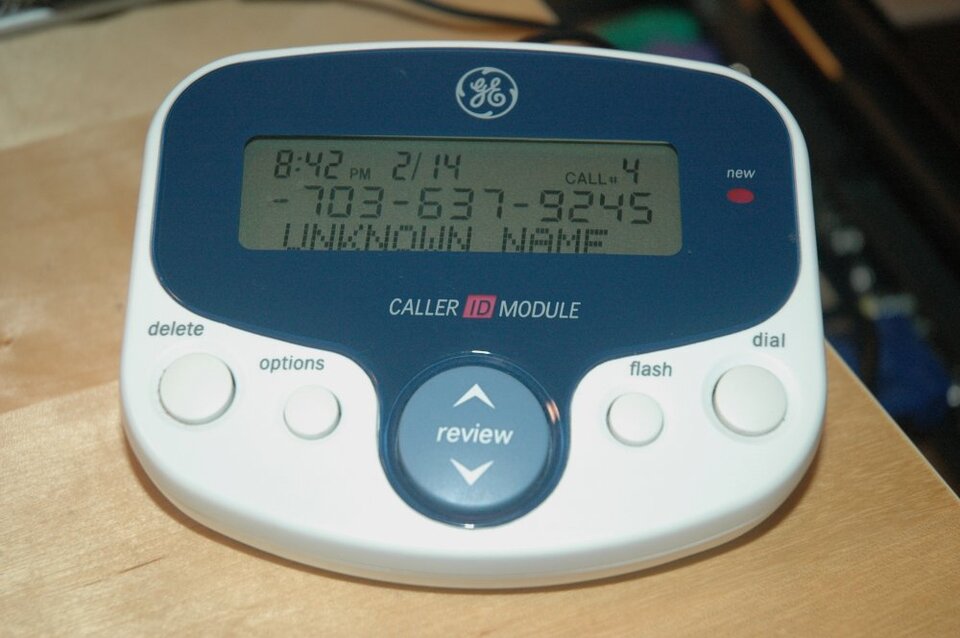
Figure [17]: The small caller ID box that displays the caller's phone number.

Michael In the USA, it is indeed allowed for companies to call you at home to sell you all sorts of nonsense. While this might sound amusing at first, it becomes nerve-wracking over time. Of course, we have what is called "Caller ID" at home (which outrageously costs 6 dollars a month) so that the phone company can pass through the caller's number. When the phone rings, I can read the caller's number on a display. And our answering machine even announces the number while it's ringing, so we don't even have to get up from the sofa when another telemarketer calls.

If you happen to pick up when a telemarketing call comes in, you typically hear nothing for about 5 seconds. You shout "Hello? Hello??" into the phone until the automatic telemarketer dialer connects you to the next available agent. They usually ask, "How are you doing today?" and then you often hang up, already annoyed. One of my colleagues uses the following strategy: When a telemarketer calls, he says, "One moment please," as he supposedly has something on the stove. After 60 seconds, he comes back and says it will take a little longer. This way, the telemarketer has to stay on the line and wait, unable to bother other people. It's a clever idea, but there's an easier way.

For there is the Do-Not-Call-List. Anyone whose phone number is on this nationwide USA list cannot be called by telemarketers. If they do call, they face such high fines that they actually refrain from doing so. I was initially a bit skeptical, but I have to say that we hardly receive any telemarketing calls anymore since our number has been on this list. Exceptions are companies with which you already have relationships (for example, the phone company) or non-profit organizations seeking donations. Adding your own phone number to the list takes about 30 seconds. You simply go to www.donotcall.gov, enter the number, and that's it. After about two weeks, almost no telemarketing calls come through. If they do, I usually say, "You realize that what you're doing is illegal?" and most telemarketers are shocked.

Baby Bullet

Figure [18]: A gift for the people who rode the first "Baby Bullet.

Michael One would be amazed to hear that public transportation has been improved here in Silicon Valley, can you believe it, in the land of car enthusiasts! I've already written about the ancient Caltrain trains in a previous issue. For years, I used to ride them daily for about an hour from San Francisco to Mountain View, which is located 35 miles to the south, and back. For some time now, there have been trains that no longer stop at every small station but only at three major ones. This shortens the travel time to 45 minutes. The service is so good and gas prices are so high that now crowds of people are taking the train to Silicon Valley. The train sometimes runs with new, quieter cars and is called the "Baby Bullet," likely in reference to the Japanese bullet high-speed trains. The comparison is, of course, laughable, because the Silicon Valley Rumble Train only reaches about 80mph, but we are in a developing country, so one can't complain.

On the first day the new Baby Bullet train ran, the conductors handed out coffee mugs with the "Baby Bullet" logo to the loyal passengers, and of course, I secured one for myself. In ten years, it will be worth a fortune on eBay, bahahaha!

Greetings from the land of future environmental angels:

Angelika & Michael

RSS Feed
Mailing Liste
Impressum
Mike Schilli Monologues


Get announcements for new editions

New editions of this publication appear in somewhat random intervals. To receive a brief note when they're available in your mailbox (about once every two months on average), you can register your email on the 'usarundbrief' Google Groups list.

Your email address


All Editions:


Send us a comment
We'd like to hear from you, please send us feedback if you want to comment on the content or have suggestions for future topics.

Simply write your your message into the text box below. If you'd like a response from us, please also leave your email. If you want to stay anonymous, simply put 'anonymous' into the email field. This way we'll get the message, but we have no way to respond to you.

Your email address


Message

 
Contact the authors
Latest update: 15-Dec-2025