![]() |
| Angelika/Mike Schilli |
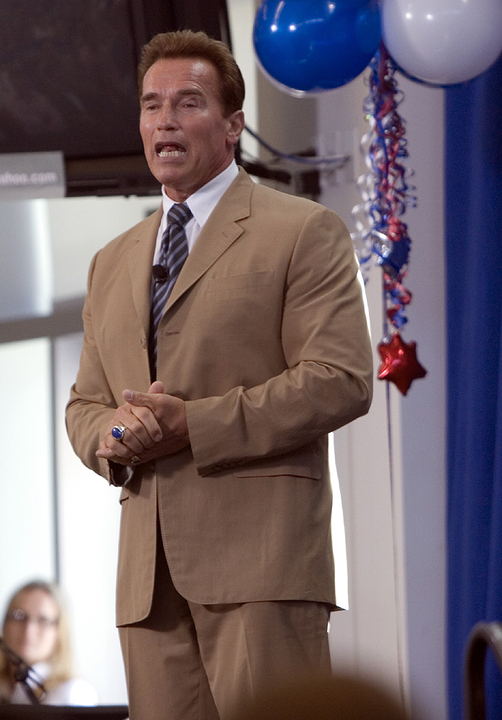
Michael In mid-August, our (ahem!) beloved "Gouvernator" Arnold Schwarzenegger stopped by for a visit at the Yahoo! cafeteria. I had already been wondering in the morning when I came in why part of the parking garage was cordoned off, but it was probably so that the famous gentleman could enter the cafeteria through the back entrance, where a bunch of Yahoo! employees were already waiting for him.
He once again told the same old story about how he came to the USA as a poor lad back in the day, armed only with his bodybuilding knowledge, and the American Dream and blah blah blah. Only the pleasant political topics were touched upon, but it was a fun visit, and indeed, it was amusing.
My cubicle neighbor had an expensive DSLR camera with him and left it with me in the cafeteria when he had to go back to the office. Later, due to security regulations (overcrowding in the cafeteria), he couldn't return, such bad luck! So, I just grabbed his camera, struggled a bit with the ISO settings and focus, but some of the pictures actually turned out quite well.
Michael It has already been mentioned that you can no longer watch TV news in the USA. The channel "Fox" is the mouthpiece of George W. Bush's Ministry of Propaganda. And he is increasingly embarrassing to most Americans I regularly interact with. The previously quite objective channel CNN has recently been reporting in a strangely one-sided manner. And the local stations don't cover world news, but rather local nonsense, weather, and sports. The Iraq war only seems to interest these editorial teams if there is news about a soldier from the local county who died.
Since most Americans do not get their political information from newspapers but instead keep the TV on, the most well-known networks determine the political stance in the country. In the medium of television, a picture often says more than a thousand words. As a result, hardly anyone internalizes political content. However, as soon as Bush appears in rolled-up shirt sleeves, like after the disaster in New Orleans, everyone knows: The man is doing something.
There are indeed radio stations like NPR that broadcast profound political analyses and TV programs like "News Hour with Jim Lehrer" on KQED that delve into political topics. However, since only a small minority in America stays engaged with more complex stories for longer than 30 seconds, these political programs are limited to a niche market.
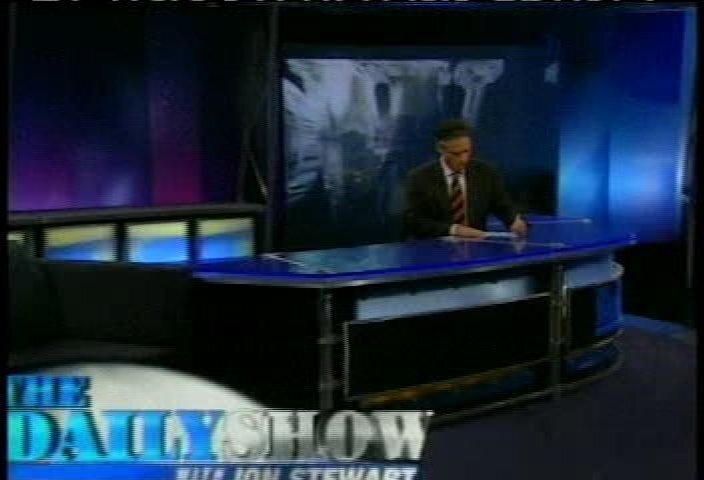
But something has changed: Instead of seriously delivered news (which is actually ridiculous), there is now a funny show on the channel "Comedy Central" that people with sense actually watch instead: "The Daily Show" with Jon Stewart.
In the first few seconds of the show, a kind of news studio appears, but when the host starts to scribble on his pad during the pounding intro music, seemingly diligently but like a three-year-old, it quickly becomes clear that it's a parody. And yet, this is currently almost the only show on American television that clearly states that American foreign policy is not very well received at the moment and that Bush is not the smartest. High-ranking guests from politics appear and give interesting interviews.
When a strongly religious, ultra-conservative figure in the Senate spouts nonsense and the house goes wild, it rarely makes it to the TV news. But if it's funny, it is guaranteed to be featured on the Daily Show, and thus at least a humor-interested minority learns about the clown show, despite the censorship attempts by the established broadcasters.
Almost all of my colleagues are also avid fans of the show, which is eagerly discussed at the lunch table. Interestingly, it had looked like the late-night programming scene was set in stone for years: It was clear that David Letterman would continue indefinitely, and Jay Leno would work on the competing channel for another five years before being replaced by Conan O'Brien. But suddenly, on the little-known channel "Comedy Central" (which also launched the series "South Park"), the unknown Jon Stewart appeared and shook up the entire scene. The show cannot be compared to sluggish offerings like Letterman or Leno; Jon Stewart is incredibly sharp and clever. Everyone is talking about the show, and it receives tremendous support, especially among circles that have become disillusioned with the government. You learn what's happening in the world, and you can laugh at the same time. Perfect.
And when a reporter in New York tries to see if someone in a Nazi uniform can hail a taxi with the Hitler salute, it's super funny! By the way, it didn't work; no taxi stopped, and passersby gave the masked reporter the middle finger. All legal, as the First Amendment of the Constitution in America still guarantees the right to free speech.
Angelika In Germany, by now, every store has its own bonus program. When a customer buys something, bonus points are credited to chip cards, which shoppers can redeem later. When I recently bought something at a pharmacy during a visit to Germany, I was handed different colored plastic tokens along with a brochure explaining how many tokens I needed to get a pack of tissues for free. Almost like in Americ!
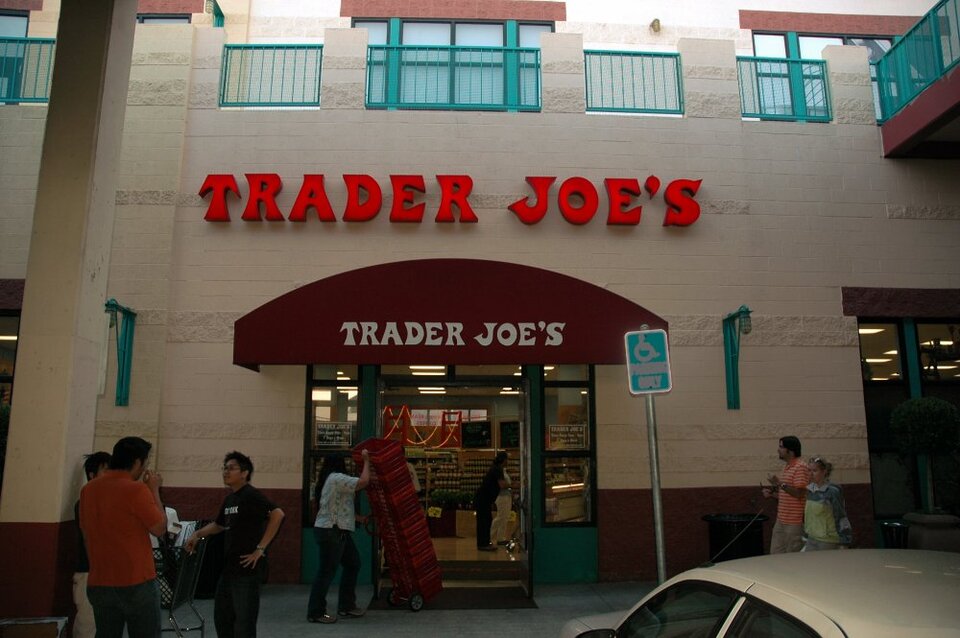
Here in the USA, you practically need a separate wallet to keep track of everything. Not only does every supermarket hand out club cards for future special offers, but the coffee shop around the corner also entices customers with punch cards. After ten punches, meaning ten paid coffee drinks, you get the next one for free. The intention, of course, is to keep the customer loyal to their store. Additionally, supermarket cards allow them to study customer purchasing behavior or target them with advertisements later. Privacy is taken less seriously in America than in Europe. These cards have become a nuisance to me because I constantly forget them, as I don't want to carry around a super-heavy wallet all the time. That's why I love stores like "Trader Joe's" even more. This unusual supermarket chain neither hands out club cards nor offers a single special deal in the store.
This is a nearly revolutionary and at the same time un-American concept. The company's motto is: "Trader Joe's" always offers everything at the lowest prices. German tourists are always amazed in American supermarket chains like "Safeway" at how wide the aisles are and the overabundance of goods (e.g., in the aisle with the various types of cornflakes) available there.
"Trader Joe's" can be found with smaller stores often located in more remote areas, with narrow aisles and a limited selection. Products often do not carry brand names but instead bear the "Trader Joe's" label. Customers will also search in vain for the typical American bulk packages. A bottle of beer costs exactly one-sixth of a six-pack.
The selection makes European hearts beat faster: European cheeses at reasonable prices, exclusive wines, good olive oil, great chocolate, e.g., from Droste, fruit juices without added sugar, chips without colorings and artificial flavor enhancers, eggs from happy hens, unsulfured dried fruits, as well as various organic products that delight the eco-heart.
At the register, the merchandize is only packed in paper bags. You will wait in vain for the question "Paper or plastic?" at the "Trader." And no one wrinkles their nose at our huge blue plastic tub that we always bring and use to pack our goods for transport. Most customers pack their purchased items themselves. This seems to be an unwritten rule in American alternative stores. But don't try this in a regular supermarket, as it might earn you dirty looks from the cashiers, who might think they aren't fast enough for you.
Full-time employees at "Trader Joe's" receive health insurance, and the company contributes to a company pension plan, even though the employees are not unionized. Interestingly, in America, many employees in supermarket chains like Safeway are union members and work under negotiated union contracts. This usually leads to better hourly wages and social security (namely health insurance). So, when you hear about striking Safeway employees, it's about renegotiating contracts, often sparking fierce battles over benefits like health insurance. Incidentally, the hourly wages at "Trader Joe's" are said to be higher than those at supermarkets that pay under union contracts.
"Trader Joe's" was founded by a certain Joe Coulombe in Southern California. He was the proud owner of a small grocery store chain, "Pronto Markets," and in the late 1960s, he had to find a way to compete against the growing competition from 7-Eleven stores. So, he decided to enhance his stores with gourmet items and good wines at affordable prices -- that was the birth of "Trader Joe's." In the late seventies, he sold everything, and you can guess to whom: Theo Albrecht, one of the German Aldi brothers. While there are already Aldi stores on the East Coast of the United States, they are unknown in California. From the outside, you can't see Trader Joe's affiliation with Aldi at all, as that probably wouldn't go over well with the rather alternative clientele.
Any politically over-correct eco-friendly person in San Francisco, however, goes to the "Rainbow Grocery," because after all, "Trader Joe's" is a chain with now over 200 stores in the USA. Michael always claims that you can only shop at the Rainbow if you have at least one piercing or tattoo and are a vegetarian or vegan, or an old hippie.
Rainbow is owned by its employees, who not only run the store but also collectively decide which products are sold. You won't find any meat at "Rainbow." In the early seventies, during San Francisco's hippie era, an ashram in the city, which is a spiritual community--you know, with a guru and all--started the Rainbow movement. The idea was to offer vegetarian, "pure" foods. The first store was run by volunteer staff--meaning unpaid. After a few relocations, the store is now on Folsom Street and is quite large. Initially, I always thought you had to be a member to shop at "Rainbow." Far from it: Rainbow is essentially an eco-supermarket for everyone, with the unique feature that the employees are also the owners.
Michael Sure, in America, ruthless capitalism prevails. But precisely because everyone knows that people without money have nothing to laugh about, and also receive nothing or very little from the state, many high earners feel obliged to donate something to the not-so-well-off. Germans would be more likely to say, "I already pay so much in taxes, the state should take care of the bums, right!" But here, many publicly and proudly show that they also care for the disadvantaged.
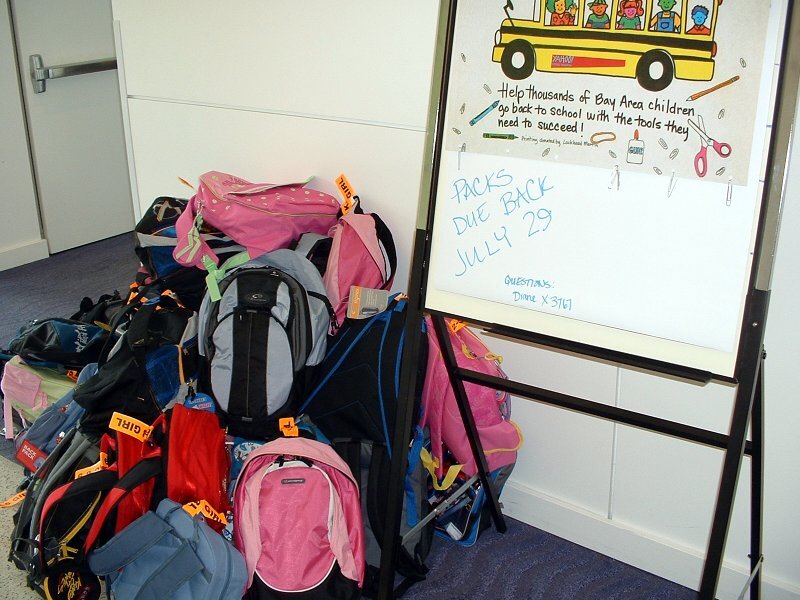
Recently, Yahoo! organized an initiative to give underprivileged children a backpack filled with supplies for a good start to the school year. Participating employees could choose a sticker for "Boy" or "Girl," purchase a backpack designed accordingly, fill it with various school supplies, and drop it off. By the end of the week, there was an entire tower of backpacks in the entrance hall!
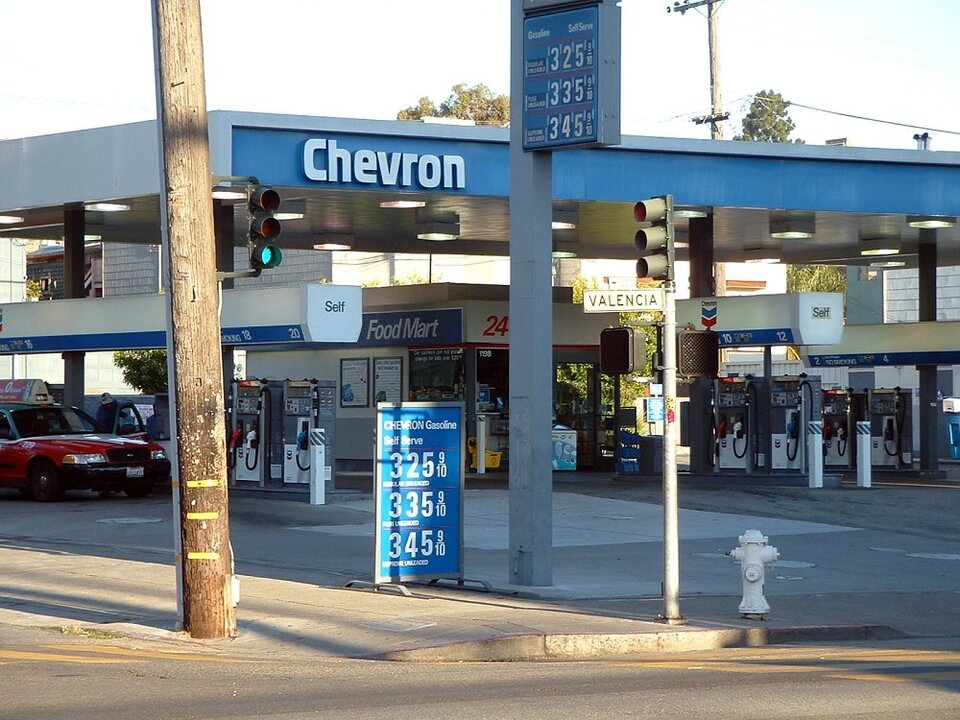
I don't really need to tell you in Germany about expensive gasoline. But lately, here in our cheap-gasoline country, prices have been skyrocketing to the point where it makes you dizzy. Especially the owners of gas guzzlers are groaning when the gas station attendant laughs in his booth because the fools are already paying with a $50 bill for the third time in a week.
"Right on!" I say, nothing better could have happened. This way, people at least learn that taking the train and riding a bike aren't so foolish. Or the purchase of a "hybrid" vehicle like the Toyota Prius, which runs partly on electricity and partly on gasoline. By the way, a new law has just passed in California, allowing drivers of these environmentally friendly vehicles to pick up a sticker from the DMV in California, which then allows them to use the carpool lane during peak hours (even without a passenger!) for a speedy commute (Rundbrief 07/2001).
In figure 8, you can see that the cheapest type of gasoline currently costs $3.25 per gallon (0.71 euros/liter). For comparison: In Rundbrief 03/2003 you can see that the most expensive back then cost $2.03 (0.44 Euros/liter) and that even then it seemed outrageous to me?
And figure 9 is a short excerpt from the film "Crimes and Misdemeanors" by Woody Allen from 1989, where the price of gasoline was $1 per gallon. Within 15 years, the price of gasoline has tripled. And as far as I'm concerned, it can keep going. I fill up maybe once a month for $20, even though I commute 30 miles each way every day.
I'm not exactly Heinz Sielmann, but in sunny California, there are some curiosities in the animal kingdom that even fascinate me as a techie. Recently, we were in Point Reyes, and during a hike, I almost stepped on a snake that slithered lightning-fast across the path. Phew, that was a close call.
We had rented a cottage, and the owner had set up two sugar water containers to attract the local hummingbirds. I had seen these fascinating birds before, but I had never noticed the racket their wings make when you're standing 6 feet away. And the creatures zoom around each other so quickly that it makes you dizzy.
A hummingbird is only about two inches in size, but as is well known, they do not glide through the air like normal birds; instead, they hover in place like an insect. To remain stationary in the air despite their not insignificant weight, they must move their wings so quickly that you can only see blurred outlines, similar to a helicopter rotor. Because of the humming sound they make, those creatures whose German name is "Kolibris" are called "Hummingbirds" in English.
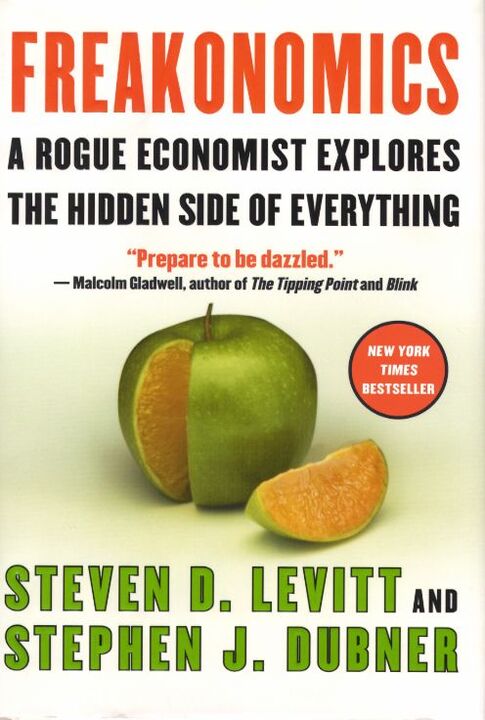
Recently, I devoured a book that I absolutely must recommend. The intellectual father of "Freakonomics" is Steven D. Levitt, an economist, but not of the ordinary kind. Unlike millions of business students who mindlessly parrot the principles of Adam Smith, Levitt approaches questions with an open mind and scientific rigor. The book is not about macro- or microeconomics. It is about human, all-too-human reactions to economic stimuli.
For example, in Japanese sumo wrestling: During the annual championships, wrestlers must win eight or more out of 15 matches to remain in the league. This raises the question of how two wrestlers typically fare when one is already on the safe side (with eight or more wins), while the other (with seven or fewer wins) still desperately needs points. Is it conceivable that in such situations, the better wrestler might take it easy and let the weaker one win? Indeed, the analysis of the data confirms this hypothesis.
Or what was the reason for the unexpected decline in crime in the USA in the 1990s? Was it the drastic increase in prison sentences for even minor offenses? Surprisingly, much suggests that it was actually the legalization of abortion (a Supreme Court decision called "Roe vs. Wade") that made a significant contribution to reducing crime.
Such explosive conclusions naturally encounter tumultuous resistance, especially in the ultra-conservative USA. However, Levitt is not politically interested at all; he merely draws conclusions that can be proven with reliable data.
A brilliantly written book by someone who is committed only to the truth, no matter how uncomfortable it may be. Hats off.
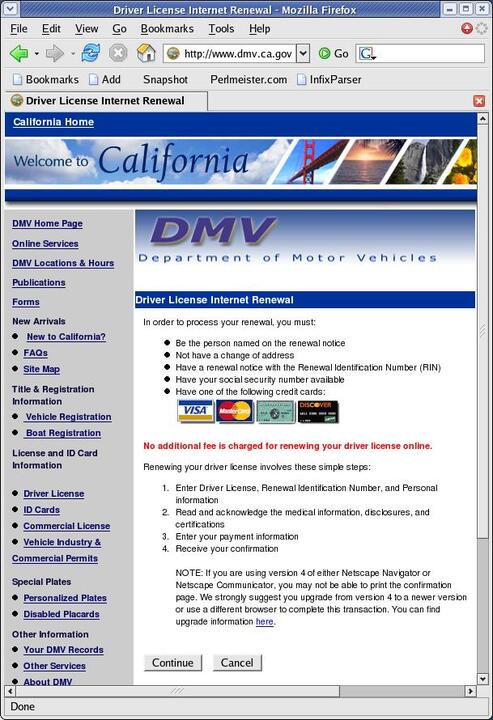
Angelika After five years, a California driver's license expires and you have to apply for a new one. It's a mere formality. The responsible authority, the DMV (Department of Motor Vehicles), has quite a bad reputation, but recently it hasn't been as slow and disorganized as generally assumed. I received a letter by mail stating that a new driver's license needed to be applied for, and this could be done either by sending a form to the DMV by mail or, brand new, via the internet. I'm always up for modern conveniences, so I went to http://www.dmv.ca.gov , where I not only found a button for "Online Driver License Renewal" but also could immediately enter the number included with the letter, quickly confirmed that my eyesight is still reasonably good, paid $25 by credit card through a secure browser connection, and that was it. To my great surprise, the new driver's license arrived by mail just three days later. That's how I like dealing with bureaucracy!
Bureaucracy in the Space Age
With the request to renew the driver's license, a form was included to register as a voter. In America, there is no mandatory registration, and when someone moves to another state, they first apply for a new driver's license there. To be eligible to vote in the next election, one must register as a voter in that state, and conveniently, the motor vehicle registration authority handles this.
However, you are only allowed to do that if you are an American citizen. We, on the other hand, are still German citizens, even though the immigration authority has recognized us as "Permanent Resident Aliens." The form in Figure 14 also states that there are severe penalties for providing false information.
Angelika I had a feeling: If an earthquake comes, we have to help ourselves. The images and reports about the failure of the American government and also of local politicians on the American Gulf Coast to quickly implement relief efforts after Hurricane Katrina prove me right. Not to mention the lack of extensive preventive measures for a foreseeable disaster. Even Michael no longer mocks my earthquake emergency kits, which are stored under our bed and can provide us with essentials like water, food, a battery-operated radio, a first aid kit, and warm clothes in the event of a severe earthquake (Rundbrief 04/1999).
He no longer makes fun of the little notecards that we both carry in our wallets, which list, in addition to phone numbers outside of California (the likelihood of these working is greater), the place where we will meet if there has been an earthquake and our house is no longer habitable. He just mentioned recently that we would also need a weapon to defend our supplies (haha!). If you think San Francisco is prepared for a major earthquake, I have my doubts. The wrangling over the Bay Bridge in San Francisco, which was damaged by the Loma Prieta earthquake in 1989 and was only temporarily patched up afterward, is ominous. It took more than 12 years (spring 2002) before construction work to earthquake-proof the Bay Bridge finally began.
The completion of the new bridge arch, which connects Oakland halfway to San Francisco, via Treasure Island and Yerba Buena Island, will still take years. Driving over the Bay Bridge remains a risky endeavor. At least our mayor, Gavin Newsom, launched the 72-hour campaign. Posters and advertisements on city buses are meant to remind us, the residents of San Francisco, to prepare ourselves to be self-sufficient for 72 hours in case of an emergency (see my earthquake emergency kits in Figure 15). The website www.72hours.org provides further assistance with preparations. And if all else fails, we hope for your care packages from Germany.
Were we suprised about the chaos in New Orleans and similar places after the hurricane? Not really! Michael cynically remarked right away, what do you expect from a nation that fixes many things only temporarily with thick, strong tape ("Duct Tape", Rundbrief 03/2003) and also generally displays a certain carelessness when it comes to construction? All that matters is that it goes quickly and somehow works. Americans' boundless optimism that things won't turn out so badly certainly play a role as well. Not to mention the environmental sins committed in New Orleans.
In a city that lies below sea level and is regularly threatened by hurricanes, the wetlands serve as an important buffer for wind and water. Unfortunately, these areas have increasingly disappeared to create land for housing developments. Renowned experts therefore believe that in the rebuilding of New Orleans, it is not only necessary to raise the levees but also to restore the wetlands. Unfortunately, we hear little about this from those in charge, especially President Bush. He also denies the existence of global warming, which can lead to stronger hurricanes. The enlightening articles in the New York Times and the New Yorker are of little help, as Bush is known not to read newspapers but instead relies on reports from his advisors.
The increased gasoline prices as a result of the storm, because, among other things, oil production in the affected areas has come to a halt, are already causing him concern. And, of course, his dwindling popularity ratings. We never thought we would live to see this day, but the press--even Bush's right-wing "propaganda organs"--came down on him hard. Suddenly, there was a strong wave of discontent among the population: the richest country in the world failed to rescue its own people (real Americans, so to speak) from the floods in time, and New Orleans descended into anarchy. This did not sit well even with conservatives, leading Bush to grudgingly admit for the first time in his presidency that he had messed up.
In front of the illuminated St. Louis Cathedral in the French Quarter of New Orleans, he gave a speech to the people, also to improve his image. Before the live broadcast, the commentator amusingly mentioned that the White House pointed out that the cathedral was brightly lit by specially flown-in generators, as many neighborhoods in New Orleans were still without power. They likely wanted to preempt criticism that the President was wasting resources on-site while the population sat in the dark. The speech included the usual promises of aid for reconstruction, primarily financial in nature. It was interesting that Bush addressed the issue of poverty, which is rooted in racial discrimination. You saw the television images: mainly the poor, the elderly, and black people remained in New Orleans, those who did not have the means to leave the city, meaning they neither owned a car nor a credit card.
This is naturally also due to the fact that black people make up almost 70% of the population in New Orleans. Unfortunately, black people are disproportionately part of the group of American poor. However, the mention of being black and being poor seems more like lip service from Bush, as the proportion of the poor increased during his presidency. The tax cuts for the wealthy in the country, along with the refusal to raise the minimum wage, also contradict his words. And although Americans donate enormous sums (as they are doing now in the case of the hurricane), many still hold the view that poverty is self-inflicted and that government programs are the wrong way out of the misery.
The slow response of the Bush administration in sending aid to the disaster area is also rooted in the Republican belief, Bush's party, that the state should play as small a role as possible in the lives of Americans. President Reagan already coined the phrase that the state is not the solution, but the problem ("Government is the problem, not the solution."). The struggling Federal Emergency Management Agency (FEMA), which thrived under Clinton and withered under Bush, is the best example. Compounding the issue is Bush's tendency towards cronyism, meaning he appoints people to positions who are connected to him but not necessarily qualified for the job. The FEMA chief Michael Brown, who has since resigned, had no experience in disaster management. They might as well have hired me with my one earthquake training.
We will see if lessons have already been learned from the mistakes, as the next hurricane, "Rita," is at the doorstep. In any case, the residents of Houston did not need to be asked twice to leave the city, which, however, led to total chaos on the highways. Nothing was moving anymore. It might be smarter and more efficient if people didn't all flee in their own cars, but instead, for example, if shuttle buses were provided to take them to shelters, as there are no more hotel rooms available. But no one is asking me.
Angelika This week, our "Gouvernator" Arnold Schwarzenegger revealed to us that he will run for election again in California in November 2006. The man is showing courage, as according to newspaper reports, he currently has the approval of only 34 percent of the population.
In August 2004, it was still a proud 65 percent. Schwarzenegger fell out of favor with the unions of California's teachers and nurses, and his initiative to hold a special referendum this November is also causing Californians to grumble. Many believe it is a waste of money.
Arnold remains on the hit list of homosexuals and supporters of same-sex marriage. This is because the California legislature passed a law ("gay marriage bill") in early September to legalize same-sex marriages in California. It was a historic moment, as California is the first state where the decision was made by the state legislature, rather than a court (as in Massachusetts, Rundbrief 05/2004).
The joy was short-lived, however, because Arnie immediately announced that he would use his veto power, meaning he would not sign the law: In his opinion, only the voters or the Californian courts have the mandate to legalize same-sex marriage. So the dispute continues.Arnie again
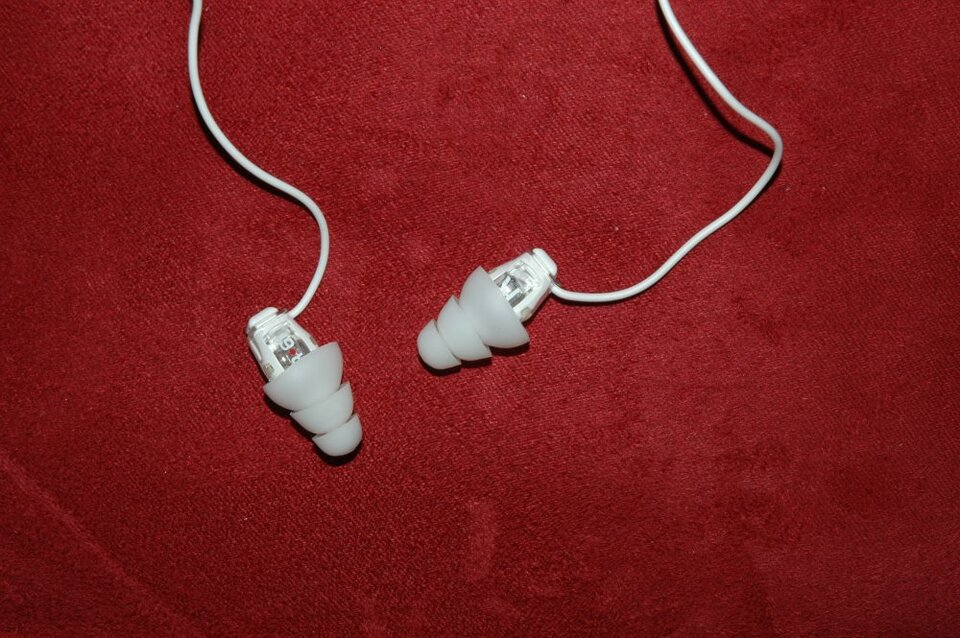
Michael I have tried many headphones in my life. When you're on the go, however, there's always the problem of ambient noise spoiling the listening experience. The airplane roars or the train rattles, and you have to turn up the portable music player quite a bit just to hear anything at all. This is not only unenjoyable but also extremely harmful to the ears, which can become irreparably dulled. That's why there are so-called "noise-cancelling" headphones, which electronically create a counter-noise to the external sound, effectively filtering out static noises like humming or droning. However, if some idiot three seats away starts talking on their phone during a train ride, even noise-cancelling won't help anymore.
That's why the company Etymotic offers small earphones that are not just placed in the ear, but are inserted directly into the ear canal. Soft sealing rings hermetically seal the ear canal from the outside world.
Forcing a plastic piece into the ear canal is, of course, unusual. However, it is surprisingly comfortable and, in the long run, much more pleasant to wear than even a regular headphone, whose foam pads rest on the earlobes.
The insulation is so good that no sound from outside reaches your ears. Even if the conductor asks for your ticket for the third time -- not a chance, someone has to tap you on the shoulder, otherwise you won't notice. And because no disturbing outside noise overlaps the music, you don't need to turn up the volume much. Deepest bass and highest treble -- everything is crystal clear. Of course, the whole thing isn't exactly cheap; I have the Etymotic 6i, which costs about $100. But they are truly worth every cent. And there are even more expensive ones!
Michael And yet another top product: In the USA, there is this hysteria about colds. Everyone avoids anyone who sneezes or blows their nose, and anyone who has a cold naturally cancels all appointments immediately.
In the meantime, the hysteria has also caught up with me, and ever since I read somewhere that you usually catch colds by touching something bacteria-laden and then rubbing your eyes, I am always extremely careful about where my hands are.
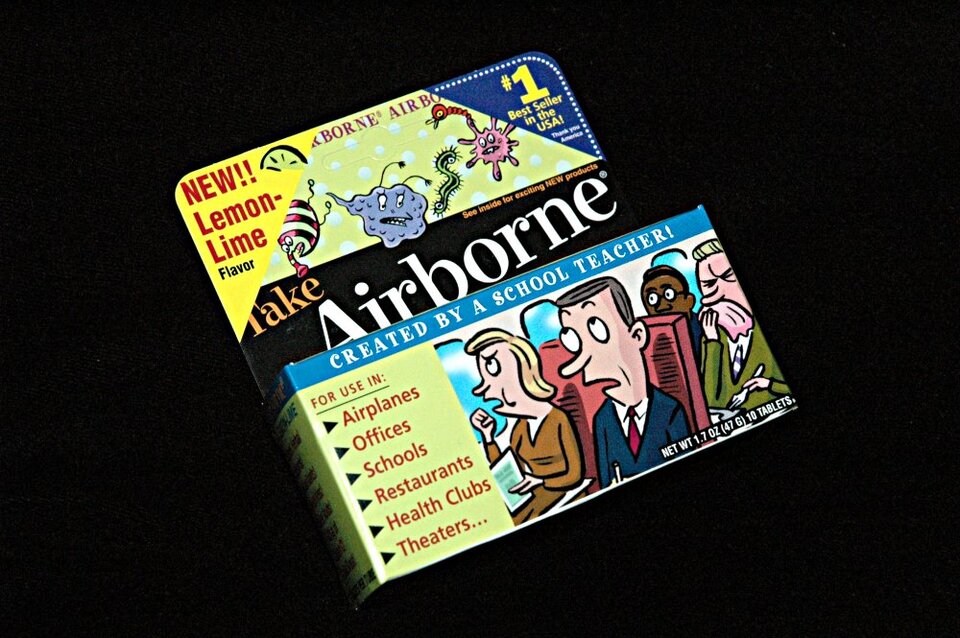
But sometimes you just have to sit next to a sniffling passenger on a plane, or the air conditioning in the office distributes bacteria evenly across all the cubicles. For these situations, there is a new herbal medicine called "Airborne," which you take when you enter one of these contaminated areas or already feel the first signs of a cold in your throat.
"Airborne" was developed as a home remedy by a teacher who eventually got tired of constantly catching colds because there were always one or more sick students in class. And, the remedy works surprisingly well. Recently, I felt a terrible scratch in my throat, and the next day the cold broke out. But thanks to promptly taking "Airborne," it was quickly alleviated and was over after just two days. Great product! Available for about five dollars at Trader Joe's.
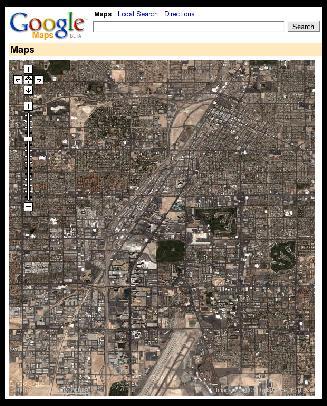
Recently, something came out that made me think: It's amazing what an exciting time we live in. The internet company Google released an innovative map service that allows you to see both street maps and the corresponding satellite images. Curious?
Then have a look at the Yahoo! buildings from a height of 90,000 feet. Amazing, right? There is even a website where people publish links to Google's satellite images that show special sightings. From Michael Jackson's 'Neverland Ranch', to the White House, to the large rock in Arches National Park, everything is included.
You can even see our house. The brilliant thing about it, of course, is that you can directly switch to the road map in the same location. If you zoom out further, you see which region of San Francisco we live in. Even further out and you can see where we are located on the North American continent. The absolute best part is that you can move the map with the mouse and travel around the world. Those Googlers are really clever foxes.
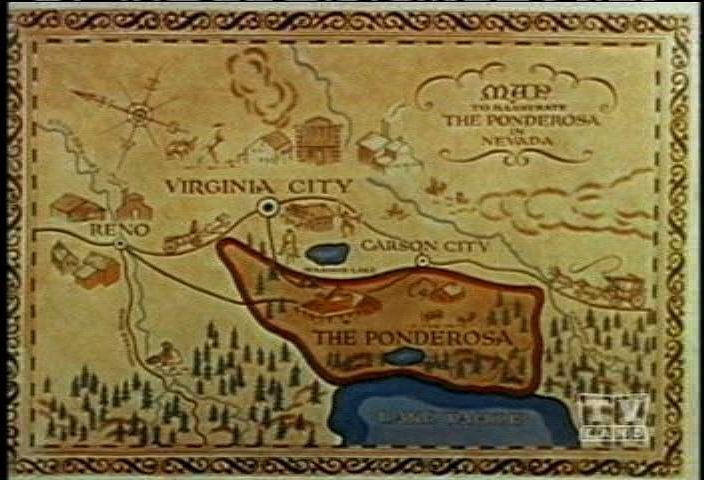
Michael When our TiVo recently picked up a rerun of the Western series "Bonanza," which I used to greatly enjoy as a young lad, I noticed a map at the beginning of the show that displayed the location of the Ponderosa Ranch. Ha! It's right near Reno and Carson City in the state of Nevada, a bit north of Las Vegas! We must have unknowingly driven by there on one of our road trips.
Oh, memory! The main characters Ben Cartwright (Lorne Greene, died 1987), Little Joe (Michael Landon, died 1991), and Hoss (Dan Blocker, died 1972) have been dead for a long time. The Bonanza entry on Wikipedia.org brings everything back to life for a moment. How time flies.
Angelika Around here, hurricanes are raging, and in yours, it's election chaos. However, it's not my fault because, even though I wanted to dutifully exercise my right to vote in the federal election, I was unable to cast my vote. I already mentioned in the newsletter that you have to apply to be entered into the electoral register of the municipality (in my case, Munich) where you were last registered in Germany (Rundbrief 09/2002), seperately for each election.
The department responsible then sends the postal voting documents to you. Due to the early election, the schedule was particularly tight this time, as the postal voting documents were only sent out at the end of August. A letter to San Francisco takes a good five to seven days, and then everything has to be sent back after marking the ballot, as the completed voting documents must be received by 6 p.m. on election day, which in Germany is a Sunday, a day when the mail carrier is known not to work.
The election was approaching, but our mailbox remained completely empty. So I decided to call the election office at the district administration department in Munich and prepared myself for a conversation with a grumpy Bavarian official. However, the woman on the phone was extremely nice and informed me that my application had been received properly and that they had sent the election documents to 3370 in San Francisco. Unfortunately, our house number is 3770.
In America, however, mail is delivered strictly according to the address and not the name of the recipient. This means that the letter did not reach me because the tiny error, which caused astonishment at the election office. The friendly lady promised to take care of it and call me back. The next day, our answering machine was indeed blinking, and when I listened to it, a shrill melody first played, probably the same one that everyone hears when they are on hold with the district administration office.
I was supposed to provide my fax number via telephone, after which the election office would fax a template of an affidavit. I would then sign it, and the election documents would be sent out again. However, I was unable to give the election office my fax number: after two hours of trying to get through, I gave up in frustration and went to bed, because due to the time difference, you can only call German authorities at night our time.
The whole thing probably wouldn't have worked out anyway because of the long postal delivery times. I even called the responsible post office in San Francisco in search of my absentee voting materials. But they couldn't help me either and just said that the letter would be returned to the sender (hmm!). Or my documents are floating around in the Mexican neighborhood "Mission," because house number 3370 is there.
Greetings from the house with the number 3770:
Angelika und Michael
Missing election documents