
Taxis
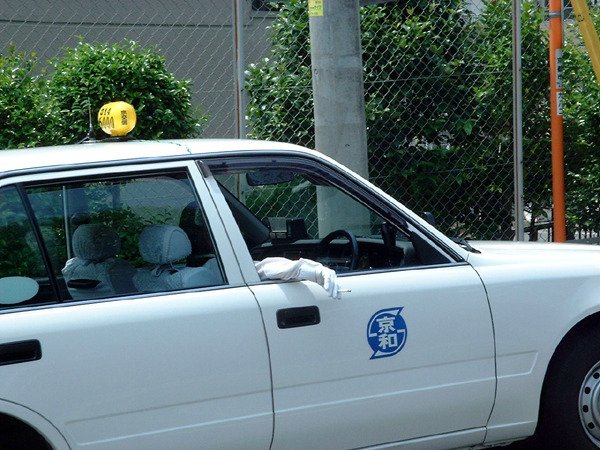
Angelika Taking a taxi in Japan is a special experience. First of all, there are no foreign taxi drivers in Japan. If you're used to American conditions like we are, you'll be quite surprised, because in San Francisco, you almost never encounter an American taxi driver. We also didn't see any female taxi drivers in Japan. Taxi drivers usually wear suit and tie and a hat that resembles that of a train conductor from my old picture book. But the absolute highlight is the white gloves. Every taxi we rode in was spotlessly clean, and the seats were adorned with white lace covers. Taxi drivers don't speak any English at all, and I was glad that we had learned from our Japanese teacher how to say where we wanted to go. The problem is that it's not enough to show the taxi driver an address (preferably written in Japanese characters). He usually needs a very precise route description. This is due to the chaotic system in which addresses are written in Japan: it goes hierarchically by areas (first the district, then the city, followed by the neighborhood, individual streets, and buildings) and not by street names. House numbers do not necessarily increase or decrease sequentially; it can very well be that building number 20 is next to building number 1.
Of course, taxi drivers know where the train station, major hotels, or other attractions are located. Unfortunately, tourists often don't know which famous landmark the restaurant they want to visit is nearby. However, Japanese taxi drivers are fundamentally honest and won't rip you off. If they can't find the address, they will drive to the nearest Koban in the desired district and ask for directions. A "Koban" is a small police station. These can be found in every district, often no larger than a kiosk. Here, there is a detailed map of the district where the police box is located.
In Tokyo (and in our experience, also in other Japanese cities), it is additionally challenging that only the larger streets have names. Finding something is a challenge even for a pathfinder with a compass, because there are thousands of tiny alleys in Tokyo, none of which are marked with names on street maps. We often searched for a restaurant described in the travel guide and gave up in frustration despite having a map. Additionally, restaurant names typically include Kanji characters, which are wonderfully decipherable in the printed travel guide, but have little to do with the signs in the real world, as they have been "enhanced" for design purposes.