

Angelika The so-called midterms, which will take place this November, are already on everyone's lips. These are the important midterm elections in which many seats in the House of Representatives and the Senate are up for election. Traditionally, the party of the incumbent president loses a number of seats in such elections. This time, 35 of the 100 Senate seats are up for election, as are all 435 seats in the House of Representatives.
Who will enter the race in November is determined by the primary elections. Every state holds these so-called primaries. However, the primaries do not take place on the same day in every state; instead, each state has its own schedule. In California, the primaries already took place in June. For most major offices, California uses a system known as a "Top-Two Open Primary," which, amusingly, is also often referred to as a "jungle primary." California uses a different system only for presidential elections.
So what exactly is behind this "top-two system"? The name gives some of it away. For the gubernatorial election, seats in the US Congress, and elections to the California State Legislature, all candidates appear on a single ballot, regardless of their party affiliation. Every registered voter can vote for any candidate on that ballot, regardless of the party preference they stated when registering to vote. The two candidates who receive the most votes then advance to the general election in November, again regardless of which party they belong to.
Things are often different in other states. In so-called closed primaries, voters can generally vote only for candidates from the party whose preference they stated when registering. Someone registered as a Democrat, for example, can then participate only in the Democratic primary. The rules do vary from state to state, however. Voters can generally change their party preference again as well. I know people who deliberately register with the opposing party in such states because they want to influence that party's choice of candidates.
In principle, this primary system seems very democratic, since it is ultimately the voters who decide which candidates will run in the actual election. In reality, however, turnout in primaries is usually significantly lower than in general elections. As a result, it is often only the party base that goes to the polls, and the candidates selected are more extreme than those the average member of the population actually wants. Well, elections have consequences, and not showing up is a very bad idea. Sure enough, voter turnout in California was below 35% of eligible voters this time. That was already higher than usual, and voters selected not only the candidates for the US Congress but also those for the office of governor of California. More on that in a moment.
But back to California's primary system. Only the two candidates with the most votes advance. A candidate therefore does not need a majority, but merely has to finish in the top two. This can result in two candidates from the same party winning and advancing to the general election. That very nearly happened in California's primaries this time. Another curiosity of this system, incidentally, is that even if a candidate receives more than 50 percent of the vote in the primary, the top two finishers still face each other, regardless of how large the winner's lead was in the primary.
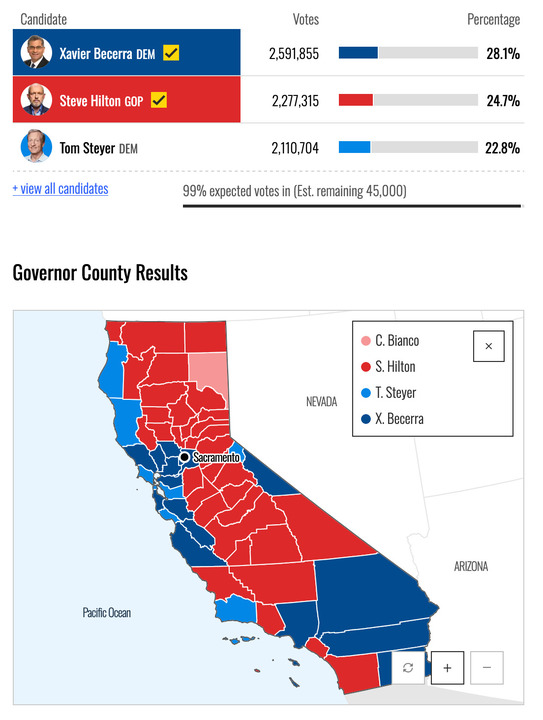
Our governor, Gavin Newsom, cannot run again after two terms, so Californians had to decide whom to send into the race to succeed him. California, of course, is known as a very progressive state in which the Democratic Party is strongly dominant. It would therefore seem logical to assume that two Democrats would advance to the final round. Far from it. This year, a whole host of Democratic candidates had entered the race. As a result, Democratic votes were split among many candidates. For a time, it actually appeared that two Republicans might make it into the "top two." After all, when votes are spread among many candidates, the percentage received by each individual candidate naturally falls.
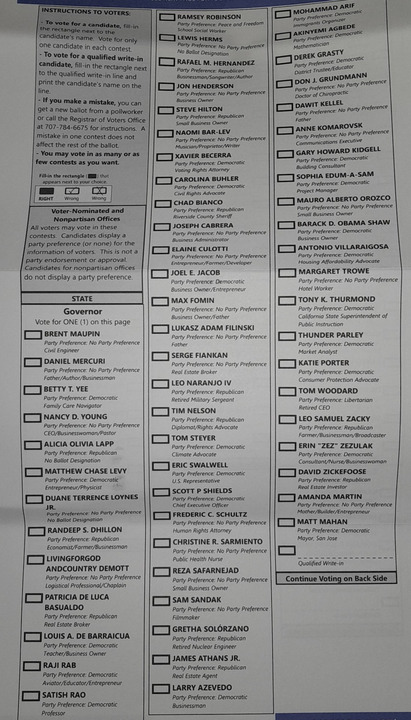
In the end, however, things turned out differently. A Democrat and a Republican are now facing each other: Xavier Becerra versus Steve Hilton. Becerra is an experienced career politician who has served, among other roles, as California attorney general and US secretary of health and human services. Hilton, by contrast, has never held political office. He did, however, work as a political adviser in the United Kingdom and later became known as a television host.
Despite the sheer abundance of 50 candidates (figure 6), voters somehow still faced a rather limited choice. There was no truly charismatic standard- bearer for California—someone who might arrive with fresh ideas for this highly complex and complicated state.
It remains to be seen what will actually happen in California in November. As already mentioned, California is considered one of the safest Democratic strongholds in the United States, and a Republican governor would be quite a surprise at present. Nevertheless, many Californians are decidedly dissatisfied with the policies of recent years, particularly because of the high cost of living, the housing shortage, homelessness, high energy prices, and the still- unresolved infrastructure problems. Although the latest polls show Becerra well ahead, November is still a long way off in political terms.
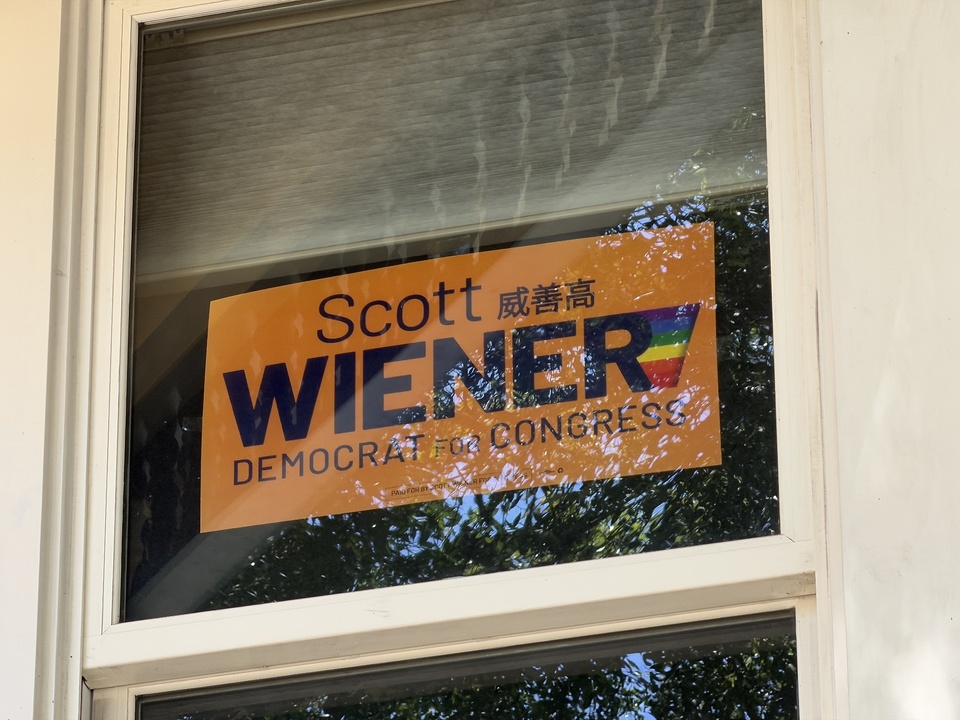
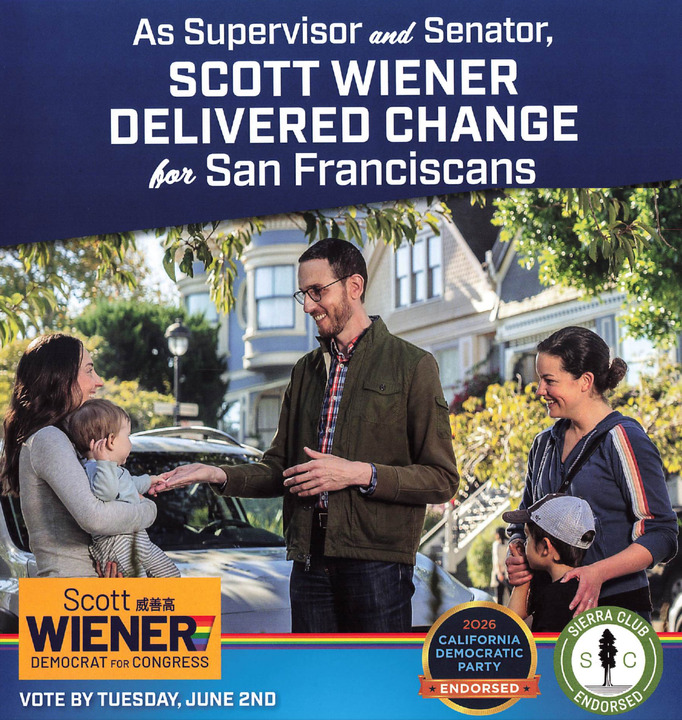
In the simultaneously held primary for the House seat being vacated by the prominent representative Nancy Pelosi, local politicians Scott Wiener and Connie Chan qualified for the general election. Scott Wiener currently serves in the California State Senate, while Connie Chan serves as a supervisor on the San Francisco Board of Supervisors. The two candidates are currently engaged in a media mudslinging match, and a few days ago, following complaints from within his own party, Scott Wiener had to take down the AI website conniechan.ai. The site portrayed the candidate giving fictional and supposedly funny answers to current political questions in a Chinese accent. As always, the campaign is merciless, while discussion of substantive issues is more the exception than the rule.