

Angelika Michael did not miss the opportunity to participate again this year in one of the oldest and most famous street races in San Francisco. The yearly Bay-to-Breakers took place on the third Sunday in May, and this year marked its hundredth occurrence. We have reported on it several times before (Rundbrief 06/1999, Rundbrief 08/2000). The famous footrace received its venerable name due to the race course, which has changed only slightly over the years. The run starts at the San Francisco Bay near the Embarcadero, and continues across the city to the Pacific Ocean. The second part of the name, "Breakers," refers to the well-known breaking waves there.
The race is not only famous and notorious because the runners have to climb the so-called Hayes Street Hill, a street with a significant incline that leaves many would-be athletes out of breath, but also because of the costumed participants who view the race more as a mix of a carnival parade and a large outdoor party. No one knows exactly why the trend of wearing costumes began, but supposedly the first runner was dressed as "Captain Kidd" as early as 1940. Since the race was originally created to forget the devastating effects of the 1906 earthquake, the exuberant atmosphere fits well with the Bay-to-Breakers idea.
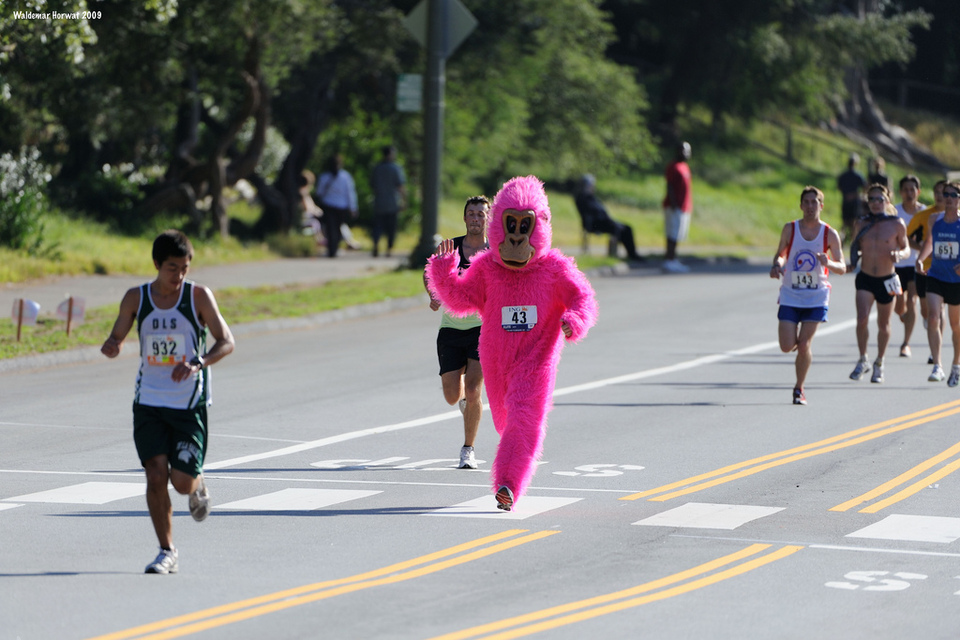
By the way, there are indeed serious athletes in this race. They are allowed to run in front so that the party-loving runners won't disturb them. This year, a Moroccan named Ridouane Harroufi won the race. He took a mere 34 minutes and 26 seconds for the 12 kilometers. An incredible time, considering it usually takes longer to cover the distance by car. The first race, held on January 1, 1912, was won by the American Bobby Vlught in 44 minutes and 10 seconds. Until 1965, the race was called the "Cross-City Race," then someone came up with the brilliant name "Bay-to-Breakers." In 1949, the organizers moved the race to the month of May, and it wasn't until 1971 that women officially participated, although a woman named Barbara Burke took part in the race as early as 1940. She simply registered as "Bobby."
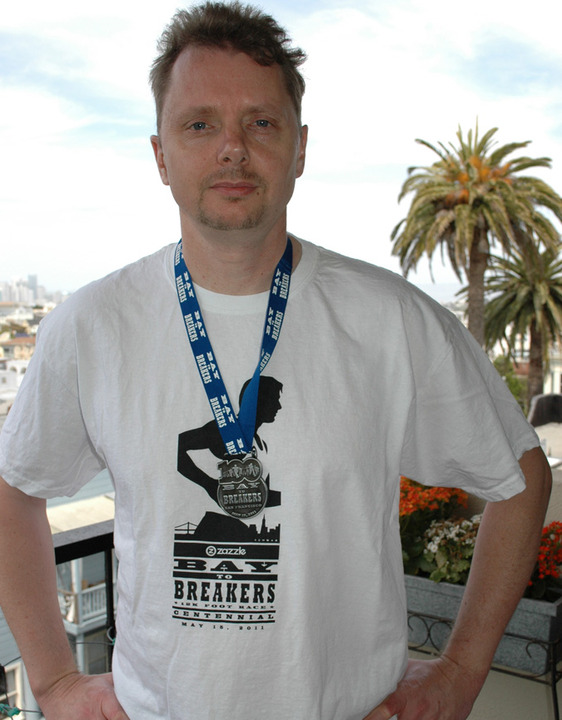
On average, 60,000 to 80,000 people now participate in the city run each year, with about half of them not registered, meaning they're not paying the entry fee, simply blending in with the crowd of runners. In 1986, there were over 110,000 participants, which earned the Bay-to-Breakers a spot in the Guinness Book of Records. Unfortunately, Michael did not fulfill his dream of running in under an hour this year, but he came close, as he completed the course in 1 hour and 4 minutes.

In addition to the costumed participants and those who run the race wearing nothing but sneakers, the participants maintain several other crazy traditions. At the start, participants throw tortillas, the Mexican flatbread variant, into the air to pass the time. Since 1978, there's a subcategory of participants called "Centipede". Dwayne Harms came up with this glorious idea. At least 13 runners form a unit and run together. A substitute runner is allowed in case someone from the group has to drop out, for example, if their shoelaces comes undone. The "Centipedes" are usually serious runners and aim to break all possible records. For instance, the "Reebok Aggies" set the men's Centipede record in 1990, completing the course as a group in just 37 minutes and 39 seconds. Then there is a group of runners called Salmons, disguised as swimming upstream or against the current, i.e., starting the course at the ocean.

You can already see that Bay-to-Breakers cannot be compared to any other race in the world. Unfortunately, there are now a few spoilsports living in San Francisco who have been trying for several years to turn the race into a run-of-the-mill event for Mr. and Mrs. Clean. As always with large gatherings of people, a few go overboard and drink too much alcohol or behave inappropriately. A particular annoyance for many residents living in houses along the route is that drunk participants sometimes misuse their front yards as urinals. Now, while I can understand that this is annoying, the Bay-to-Breakers only takes place once a year, and perhaps one should turn a blind eye or go on a trip if one is a party pooper.
Since 2009, the organizers have been trying to enforce stricter regulations, with more or less success. Carrying and drinking alcohol during the race has been officially banned for two years now, but no one has adhered to it so far. Initially, the organizer introduced a fee for the so-called "floats," small decorated handcarts that usually contained a keg of beer. This year, they were completely banned, and alcohol was confiscated in general. The sponsor had even hired private security forces in addition to the usually present police for this purpose. There were also sobering-up tents along the route. Additionally, the race did not start at 8 a.m. as usual, but at 7 a.m. The underlying strategy was probably that party lovers do not like to get up early. It was indeed more orderly this year, but at the expense of the event's special flair.