![]() |
| Angelika/Mike Schilli |
|
|
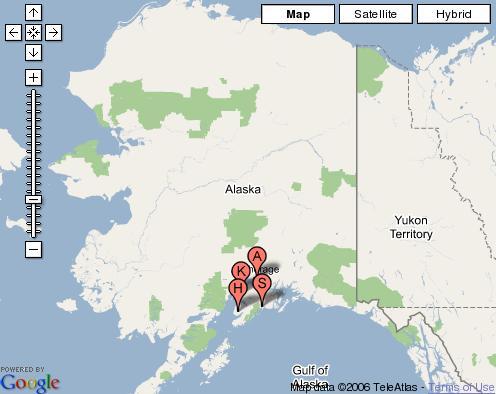
Angelika Already during the approach to Anchorage, we realized how sparsely populated Alaska is. Looking out the window, we saw nothing but endless expanse to the right: no houses or roads in sight. To the left was Anchorage with its 260,000 inhabitants. It is the largest city in Alaska, home to a whopping 40 percent of the total population.
All of Alaska has a mere 660,000 inhabitants and--by my calculation--at least as many bears. Since Alaska is separated from the other U.S. states by Canada, true locals refer to the "Lower 48" when they talk about the continental USA. Hawaii, the 50th state located far out in the ocean, is also left out by this reference.
Alaska, unlike California, for example, did not come to the USA as a conquest prize, but was sold by the Russians in 1867 to the Americans like a piece of real estate for 7.2 million dollars. The poor American Secretary of State, William Seward, who sealed the deal, received harsh criticism at the time. It must have been a lot of money back then, which people would have preferred to spend on "more sensible" things. From today's perspective, the amount is, of course, ridiculous; there are houses in San Francisco that cost that much. The purchase was, as Michael noted several times during our vacation, worth every cent.
Large parts of the country are only accessible by plane. That's why Anchorage has the largest seaplane base in the world. You can book fishing tours to areas where you fly in by seaplane, fish for a few hours, and then hopefully fly back with a big catch.
In a country where winter temperatures prevail for an average of 7 months a year, combined with only a few hours of daylight, tourism is concentrated during the summer months of June to August. This leads to a flood of tourists in the more easily accessible areas of Alaska, which as a tourist you generally want to avoid.
The Kenai Peninsula we visited is said to be totally overwhelmed by RVs in the summer. However, since the area is already accessible in May, we decided to brave the perhaps slightly more unpredictable weather. A golden decision. There were hardly any tourists around, and everyone was delighted to see us, engaging in many a long chat with us. The weather initially showed its cooler side, which actually led Michael to buy a hat, probably his first since childhood. But then the sun even shone from the sky. Hooray!
Michael Due to the long and harsh winter, Alaskans are overjoyed in the spring and run around in T-shirts and shorts at the first ray of sunshine (even though it's still 40 degrees Fahrenheit). The best time to travel in many areas is in May or September. During these months, it might still be (or already be) a bit cold, but there are neither swarms of mosquitoes nor tourists.
In May, the sun rises in Alaska at 5:30 AM and doesn't set until 10:30 PM. And after that, it stays light for at least another hour. This is great for tourists because you can hike until late in the evening without the fear of not being able to finish the trail due to encroaching darkness. People in Alaska also tend to eat dinner very late. It's not uncommon to see full restaurants in Anchorage at ten o'clock in the evening, whereas this is more of an exception in San Francisco.
Angelika Anchorage is a typical American city that sprang up from the ground. In addition to its beautiful location and some really good restaurants, the city boasts a great bike path, named the "Tony Knowles Coastal Trail." It is 11 miles long (about 17 kilometers), runs along the water, and is well shielded from any car traffic. Tony Knowles is, by the way, not, as Michael had assumed, a famous skateboarder (compare Tony Hawk), but a former governor of Alaska.
Michael and I rented two bicycles and pedaled away. The bike shop guy also described a route to us, which made it a longer loop, and on the way back, we passed by a huge airfield for small planes. Hats off to this surprisingly good network of bike paths, which we found not only in Anchorage but also later in the much smaller town of Homer. Who would have expected that of Alaska?
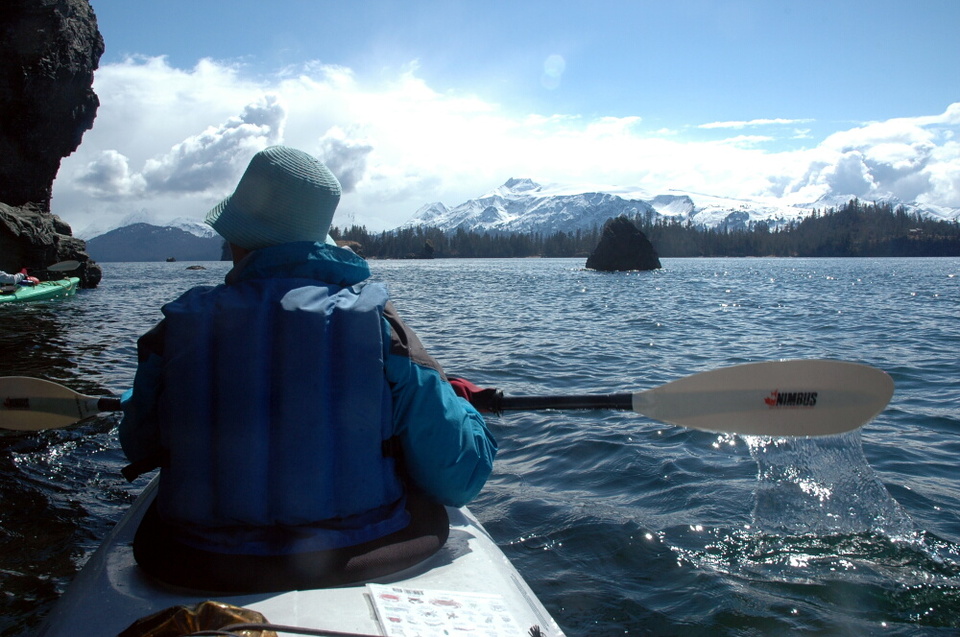
Michael To experience the Arctic Ocean up close, we booked a kayak tour in Homer, which was also attended by another vacationing couple from the state of Arizona. Angelika and I got a double kayak with two entry holes. Angelika sat in the front and I was in the back at the rudder, each of us received a double paddle. Everyone had to put on a piece of clothing that looked like a ballerina's tutu. This skirt is made of waterproof neoprene is stretched over the entry hole after (carefully) stepping into the floating kayak, so that no water splashes into the interior of the kayak from above while paddling.
If a kayak capsizes in the ice-cold water and both rowers suddenly find themselves upside down, you need to exit as quickly as possible by pulling a loop that detaches the plastic cover from the entry hole. Then the kayak guide quickly paddles over to help you turn and stabilize the boat so you can carefully get back into the now water-filled kayak. You then have to pump out the water on the spot using a hand pump. This is, of course, a bit annoying in 40 degree cold water. Then you paddle to shore and have to change out of your wet clothes and into a ridiculously patterned dry overall that the kayak guide keeps ready for such emergencies. Allegedly, you even have to wear it to the pub where a tour that ended so abruptly will be celebrated! According to our guide, who has been leading tours for many years, this has happened exactly seven times under her supervision, mostly with overconfident teenagers. Fortunately, we were spared such emergency maneuvers, as the sea was in a good mood and calm that day.
This naturally raises the question: How did the kayak pictures come about? Or: How cool does someone have to be to put a Nikon D-70 in a plastic bag, strap it to a kayak, and then take it out on the sea to photograph with it on the shaky little boat? Answer: Pretty cool, the vacation could have quickly become a lot more expensive.
Michael The part of the Pacific Ocean located between Alaska and Russia, known as the Bering Sea, is home to gigantic fish populations. According to the SeaLife Center in Seward (a kind of politically correct aquarium and research center), the most commonly caught fish is the Pollock, an inconspicuous, relatively small marine creature from which fish sticks and McDonald's Filet-O-Fish are made.
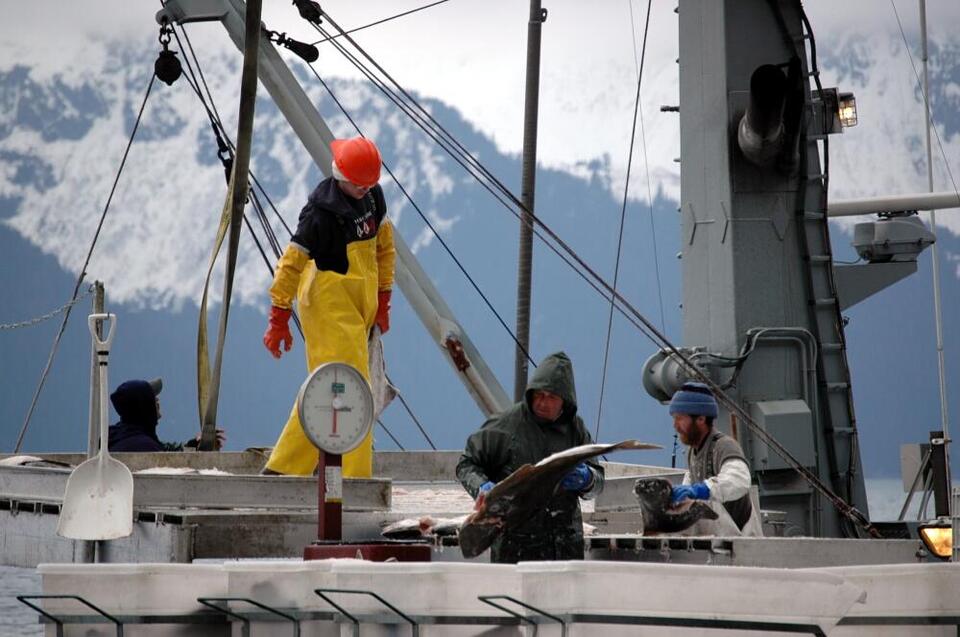
The town of Seward is one of the largest hubs for fresh fish; this is where the fishing boats arrive with their catch. Dockworkers pack the sometimes astonishingly large fish into boxes, quickly load them onto trucks that are already waiting, and off they go. Curiously, hardly any goods remain in town. Only a tiny shop sold fresh fish, and we had to ask around for a long time before we found it. When we accidentally entered through the back door, I saw a box of herrings and was already cheering because herrings are quite hard to come by in the USA (except at Ikea). However, a grumpy fisherman pointed out to me that the herrings in the trough were not suitable for human consumption but were used as "bait" to catch larger fish! We bought halibut cheeks (the fatty cheeks of flatfish) and a few "King Crab Legs," 15 inch long meaty crab legs. The cabin we stayed at had a gas grill, on which I didn't let the delicacies overcook (as unfortunately happens in many American restaurants) but prepared them masterfully. The whole thing was quite expensive ($50 for the fish) but very delicious.
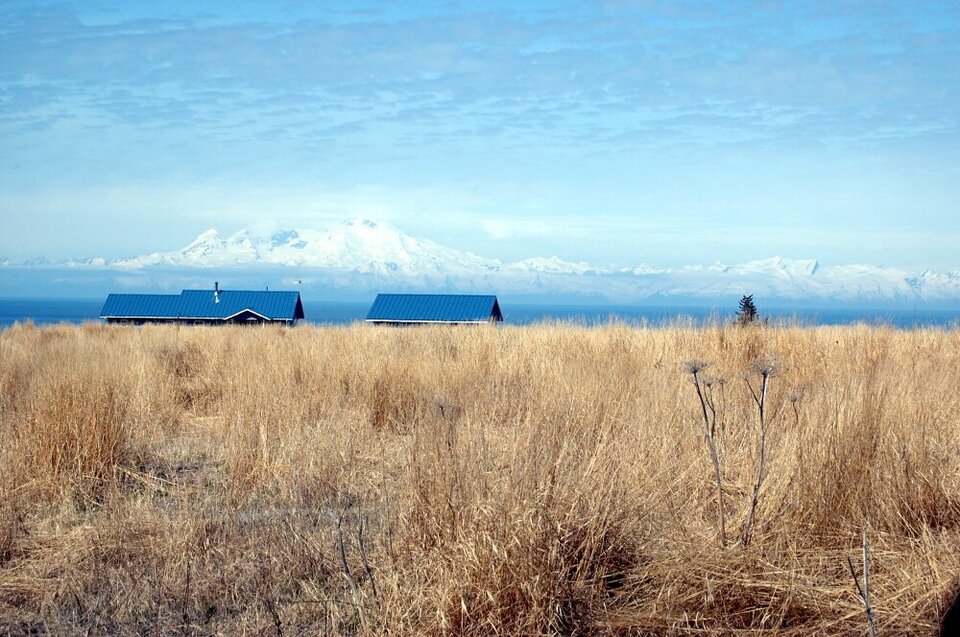
Angelika As we paddled around in our kayaks in the waters of Kachemak Bay, we noticed that here and there small, quite rustic cabins appeared behind the treeline. Naturally, we immediately thought of summer cottages, but we learned from our kayak guide Alison that some of them were originally built as part of what is known as "homesteading."
To settle the western United States, Congress under President Abraham Lincoln decided in 1862 that every American who was at least 21 years old could claim 160 acres of land for a fee of 18 dollars. The goal was to make the land usable. After five years, the settler could call the land their own. They only had to prove that they lived on the land, had built a cabin, and cultivated the land.
The program was finally discontinued in 1976, with only Alaska receiving an extension until 1986. Despite this generous land allocation, only 1% of the land in Alaska is privately owned. 60% belongs to the federal government (e.g., the national parks), 20% to the state of Alaska, and the rest was returned to the indigenous people in 1971.
We noticed that the scattered little houses along the country roads all have one thing in common: The property around the house looks like a mess. Scrapped cars, old refrigerators, and washing machines. One gets the impression that it is customary to set up a spare parts depot in the garden when acquiring a new device or vehicle.
Unfortunately, even in the more populated areas of Alaska, there is no escape from the obligatory "McDonald's," "Safeway," and "Starbucks." Apparently, no one can resist the relentless American desire to place an unsightly shopping center in even the most breathtaking landscapes.
On the other hand, you encounter individualists in Alaska like in no other American state, who want to fulfill their dream of living in the last remaining wilderness. That's why Alaska is also known as the "Last Frontier." Our kayak guide Alison, for example, was originally from New York City and now lives somewhat off the beaten path from Homer in a house without running water, which can only be reached on foot by a half-hour walk. During our kayak tour, we asked her what vacation means to her, since she already does for a living what others seek as an adventure during their time off. She replied that she likes to rent a room in a good hotel in Anchorage to take a full bath.
Another interesting story we heard from the landlady of our little house in Seward: Many years ago, she worked in a candy store in New York City and came across a postcard that showed Alaska. She said that from that moment on, she knew she would live there one day. After separating from her first husband, she packed her things and, with her dog in tow, drove endless roads all the way to Alaska. She immediately liked the area around Seward, so she decided to use her private retirement savings (the so-called 401k, Rundbrief 08/2003) to start investing before retirement, buying land and setting up log cabins on it, which she now rents out to tourists. The man who built the cabins for her also became her new love. By the way, when she moved to Alaska with all her belongings, she was already over 40! Only in America.
However, romantic notions about the wilderness of Alaska can certainly also lead to disaster. There are always people who are afflicted by the Robinson Crusoe syndrome and believe that a hermit's life beyond any civilization in the wilderness would be easy to manage.
The majority of locals in Alaska consider these guys to be rather crazy and don't speak well of them. If you want to read a very interesting book on this topic, you should check out 'Into the Wild' by Jon Krakauer. Krakauer tells the true story of Christopher McCandless, who hiked alone into the Alaskan wilderness in 1992 and whose body was found by hunters after several months.
Michael Many households in Alaska which are somewhat remote, still do not have a telephone. To deliver messages to these people, there are the so-called "Bushlines," lines of text that the radio host of a local AM station broadcasts into the "bush" (the wilderness) a few times a day, each time on the hour.
So that personal messages and passionate declarations of love can be sent through the airwaves without the whole world knowing, many recipients use code names. It is reportedly a popular pastime to listen to the Bushlines and guess who is flirting with whom. Exclusively in the newsletter, we present to you a current Radio recording of the Bushlines. As you can see, some people use the service probably for nostalgic reasons -- if someone gives out an internet URL, it's quite obvious that the recipient also has a phone, right?Bushlines
Angelika Anyone who has lived in Alaska for at least one year receives money for doing so. The "Alaska Permanent Fund" makes it possible. It pays an annual dividend to the residents of Alaska, regardless of their age.
The background: In 1976, a referendum led to an amendment of Alaska's constitution, requiring that 25% of the state's revenue from the extraction of natural resources (mainly oil in Alaska) be deposited into a fund and invested. This fund now holds 33 billion dollars. The amount of the annual dividend payout is determined by the return on investment. On average, it ranges from 600 to 1500 dollars per person. However, the year 2000 was exceptional, with nearly 2000 dollars per person! Politicians repeatedly attempt to change the use of the fund, suggesting that instead of distributing the money to everyone, it should be used for community purposes such as funding schools and hospitals. However, the population strongly opposes this. Locals told us that if a politician campaigns with this unpopular idea, they pay dearly at the polls.
However, nowadays big money is no longer to be made from oil in Alaska, as the oil fields at Prudhoe Bay are drying up. Bush and his associates, as well as some politicians in Alaska, want to open up the unique "Arctic National Wildlife Refuge" in the far north of Alaska for oil drilling. Fortunately, these efforts have so far been thwarted by various political maneuvers.
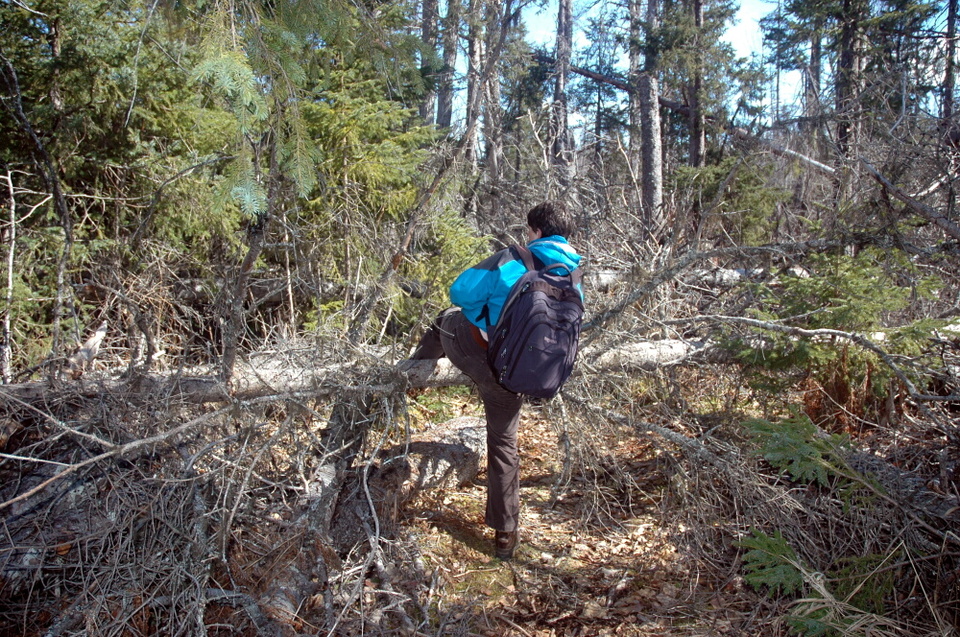
Angelika In Alaska, the journey is truly the destination, as often the real challenge is simply getting somewhere in the first place. There are only few roads in Alaska, but small aircraft, such as the charming seaplanes, as well as boats and ferries, prove to be the preferred means of transportation. I also read in the travel guide that only a few areas in Alaska have well-marked hiking trails. However, in the area we visited, the signage was exemplary. Hmm! It only becomes problematic when the winter snow knocks down the signs and trees, and the team of volunteers hasn't yet set out before the summer season to clear the hiking trail. It also seems that people in Alaska have a different way of assessing obstacles.
We wanted to hike the "Glacier Lake Trail" in Kachemak Bay State Park near Homer. To do this, we first had to take a water taxi (i.e., a boat) to take us from Homer to the other side of the bay, where it would drop us off at the start of the trail and pick us up five hours later at the end of the trail at another small bay.
The water taxis are really convenient, but not exactly cheap. We paid 65 dollars per person to get to our hiking trail. The owner (a man named Mako) of "Mako's Water Taxi" kindly informed us that although the hiking trail had not been officially cleared this year, a sign had dropped to the ground at a junction, and we would have to climb over some fallen trees. Oh, and there was still a bit of snow here and there. But no problem at all.
And I tell you, we climbed and climbed. Since the sun was shining wonderfully warm, the hard snow on the path had partly turned into a small stream, but our waterproof turbo hiking boots held up. The reward was the beautiful, partially still frozen glacial lake with the Grewingk Glacier in the background, which we didn't have to share with anyone.
The day before, Michael had obtained the rough coordinates of the individual waypoints from the internet and saved them on his portable GPS system after some wild coordinate transformations. This way, we always knew how far it was to the next junction, which was very reassuring.
As we were almost at our agreed meeting point with the water taxi, we once again climbed over a huge conifer tree and suddenly, the path was no longer visible. Michael walked a few steps ahead and stood in the dense undergrowth. No path in sight. After a few uncomfortable minutes, I decided to simply climb back over the tree, because we had seen the path before the tree. And indeed, the second attempt was successful. Shortly afterward, the water taxi picked us up at the agreed destination. During the hike, Michael had already devised a scenario of what we would do if the taxi didn't come. I, on the other hand, preferred to focus on the danger of bears.
Michael As mentioned, it is quite normal to encounter bears in Alaska. They are not to be trifled with. Usually, they will immediately run away if they see humans, especially if the humans are tall and/or in groups. However, this assumes that you don't startle the bear, as they don't like that and will become grumpy. For example, if you turn a blind corner and suddenly, a bear is standing in front of you. That's why you should constantly be making noise, and if that gets on your nerves, you can wear a small bell ("Bear Bell") that constantly jingles softly, informing bears in the vicinity of the hiker's position and preventing any surprises. The bear usually avoids confrontations widely if it can do so without effort. However, bears hibernate during the winter months and are quite groggy in the head for some time after waking up in the spring.
Anyone who has seen the excellent film "Grizzly Man" (directed by Werner Herzog) knows that bears, if things go really wrong, can indeed kill and eat humans. There are two different types of bears: the black "Black Bear" and the brown "Grizzly." They can weigh up to half a ton and reach up to 10 feet in height when they stand upright. The brown Grizzly is more predictable; if it does attack, you should play dead, and it will usually leave you alone. The "Black Bear," however, is more aggressive and may pursue hikers, who then have to use all sorts of tricks (make themselves look tall, put a backpack on their head, scream, wave their arms) to scare it off. If the "Black Bear" attacks, you should never play dead but instead punch it in the snout. Or, as a local explained to us: "A Grizzly will kill you. A Black Bear will kill you and then eat you.
For self-defense in the extremely rare case of an emergency, one can either carry along a double-barreled shotgun with a giant caliber ("bear slug," see Karl May) or a pepper spray specifically made for bear defense with the martial name "Counter Assault." However, the spray is insanely expensive ($37.95), but fortunately, the mountaineering supermarket REI in Anchorage had it on special offer ($24.95). Allegedly, it works up to 30 feet away. But if the wind blows in the wrong direction, the spray can turn into a boomerang.
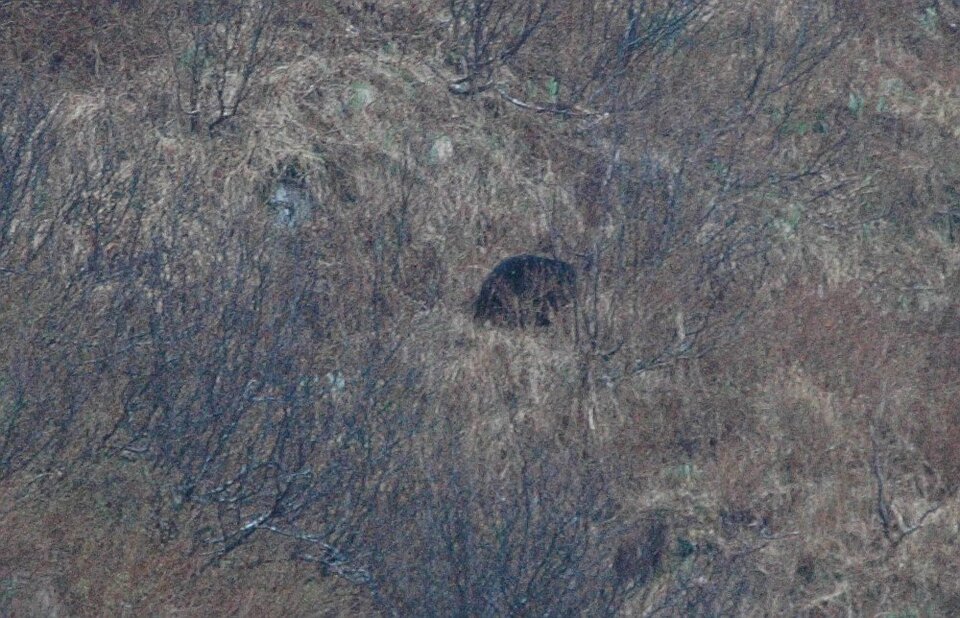
We had the canister unlocked and always ready during our hikes, but fortunately, we never had to use it, as no bear surprised us on our paths. However, during a boat tour, we saw an estimated ten (!) different black bears in various locations, some even on quite steep mountain slopes. These slopes are also frequented by mountain goats, the bears' favorite food. At least until the salmon start jumping. Even experienced hikers confirmed to us that it frequently happens that bears cross the path, and the lady who rented us a cottage included a bear booklet and wrote in large letters that we should read it before undertaking any hikes.
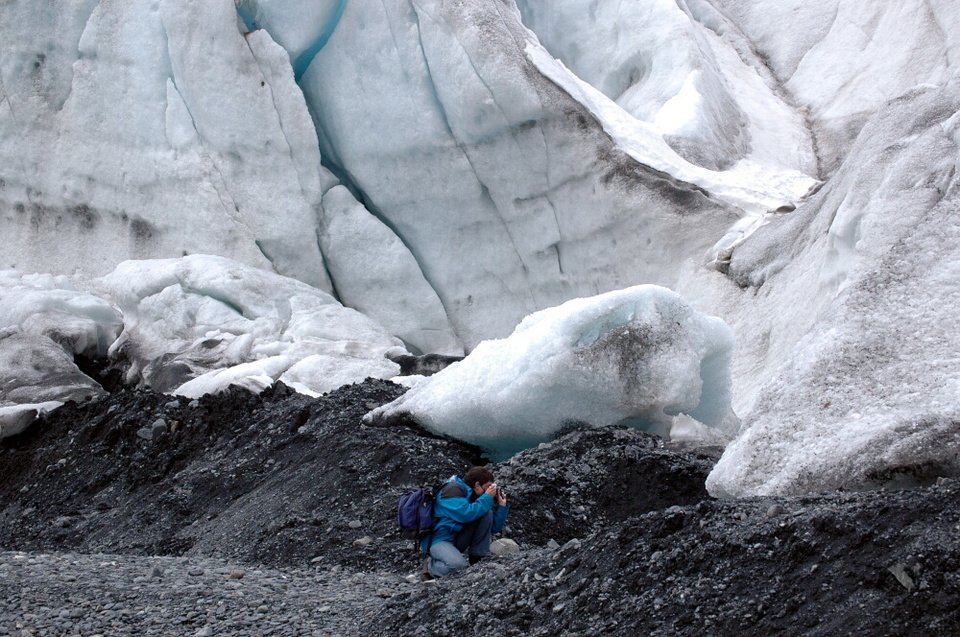
Angelika In the city of Seward, we were surprised to find that visitors to the "Kenai Fjords National Park" can reach the so-called "Exit" Glacier with minimal effort. The glacier is truly within reach, less than a mile from the parking lot. But Alaska remains Alaska. As we stood in front of the glacier, there were a few threatening rumbles from within, as a small warning that we were standing before an active glacier that should not be underestimated.
Global warming is quite clearly visible there, by the way. The glacier has been retreating further and faster in recent years; in 1970, it was almost at the parking lot, about half a mile from the point where it ends today. In fifty years, it probably won't exist anymore.
We could also clearly see that glaciers are actually blue in some places. According to a sign posted at the national park, this is because the snow masses from which they are formed are compressed over the years into a dense ice mass that absorbs all light except for the high-energy blue light, so that glacier ice looks like the candy of the same name!
The so-called moraines, which are rocks that have been ground up and pushed forward by the glacier, were also clearly visible, and you could even walk around on them. My old geography teacher would have been thrilled!
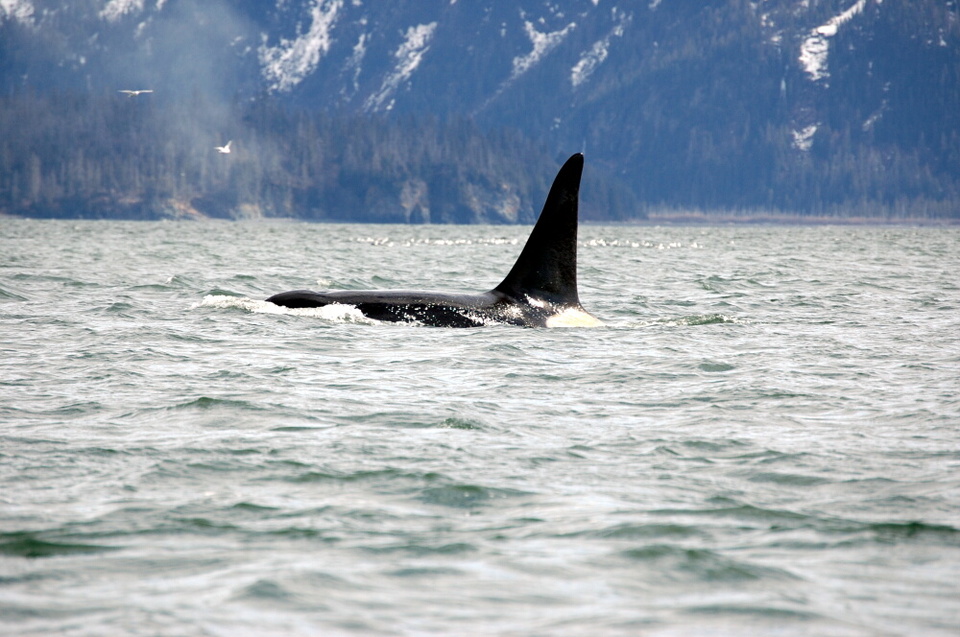
Michael Of course, you shouldn't think that you can just sail around on a boat and spot a whale. That's very rare, even in Alaska. Sometimes, on a full-day tour, you might only see a few miserable sea otters. However, we were lucky twice: once on the way back with the water taxi from the kayaking tour and another time on a full-day boat tour. There were about a dozen people on a medium-sized ship, and I was staring at the water's surface when I suddenly noticed a few huge tail fins in the distance, which quickly disappeared again. Since I was already familiar with whales from California, I shouted, "Whales, 10 o'clock!!" (for non-nautical folks: "Whales, 60 degrees to the left!").
The skipper slowed the engine and steered the boat in the indicated direction, and after 30 seconds, about 7 killer whales (also known as orcas) appeared, each at least 15 to 25 feet long. They swam towards the boat, dove underneath it, and then slapped their tail fins on the water. People were thrilled, and a gentleman from Texas patted me on the shoulder at least five times in a row, and everyone praised the "Good eye, good eye" of the young man from San Francisco.
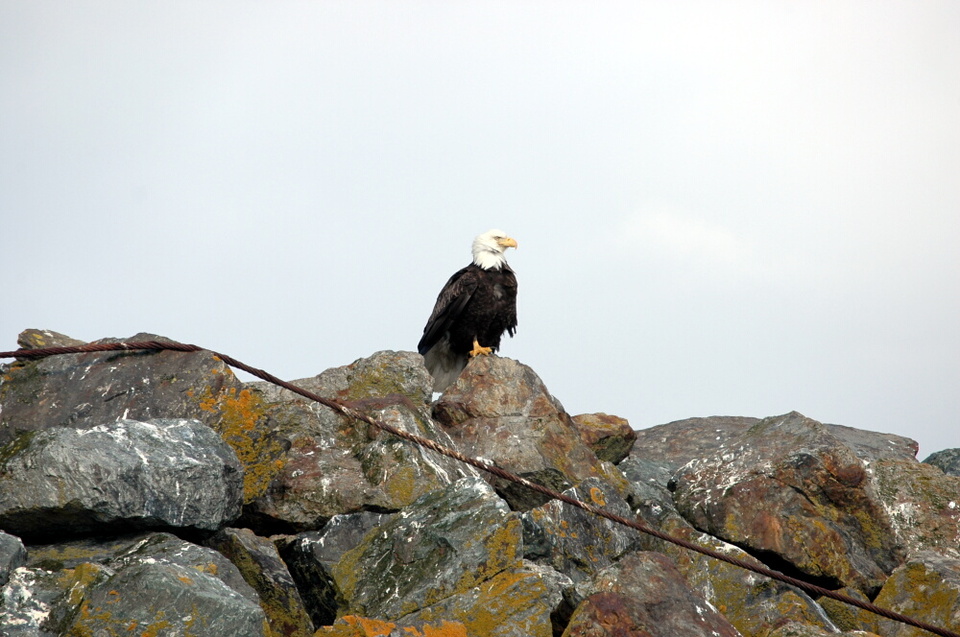
Angelika In Alaska, there are now not only bears and lots of bald eagles (the national emblem of the USA) to admire, but also moose that are happily hopping through the landscape.
Especially when there is still snow in the higher elevations, they come close to human dwellings in the lower regions. However, moose are difficult to spot in a landscape that has not yet turned green, as their brown fur blends perfectly with the surroundings. But since I had often visited Finland in my early youth, I knew what we needed to look out for.
On the very first day, as we rode along the Coastal Trail in Anchorage with our rented bicycles, I spotted a huge moose leisurely nibbling on some branches at the edge of the forest. However, we were just speeding downhill, and I braked a bit abruptly, which not only forced Michael to make a sudden braking maneuver himself but also led to a few comments about my reckless riding style.
Moose do look somewhat innocently silly, which probably tempts some Alaska tourists to get too close to them, but we kept a respectful distance when we saw the animal's long legs. A six-year-old could have easily walked underneath them. While Michael was photographing the moose, some cyclists pedaled past us, and Michael gestured wildly to them that there was a moose in the forest. But they didn't even stop; they were probably locals. After two weeks of vacation and several more moose sightings, we also understood: spotting a moose is quite normal in Alaska.
Ice-cold greetings!
Angelika & Michael