04/21/2006   English German

Previous
edition
  Edition # 60  
San Francisco, 04-21-2006
Next
edition


Figure [1]: The Fastrak transponder for the car

Michael San Francisco is known to be located at the northern tip of a peninsula. If you want to go north, you take the Golden Gate Bridge to Marin. If you want to go east, you drive over the gray Bay Bridge to Oakland. To the west lies the Pacific Ocean, and only to the south can you leave San Francisco without using a bridge.

Figure [2]: San Francisco is located at the northern end of a peninsula.

If you drive out of the city over a bridge, there is no charge. However, if you drive into the city, it not only costs exorbitant amounts of money ($5 on the Golden Gate, $3 on the Bay Bridge), but the traffic also backs up because everyone has to stop and pay the fee in cash at a small toll booth. The worst part: The average American doesn't hurry, of course, creeping up to the toll booth at a snail's pace, then awkwardly rummaging through their wallet for a few bills, and perhaps even stalling their SUV in the process.

That drives me crazy. That's why I recently ordered Fastrak, the American answer to "Toll Collect" and the Euro Vignette. You get a small transponder box for your car, which picks up signals from the toll station and automatically deducts the due amount from your credit card-fed account.

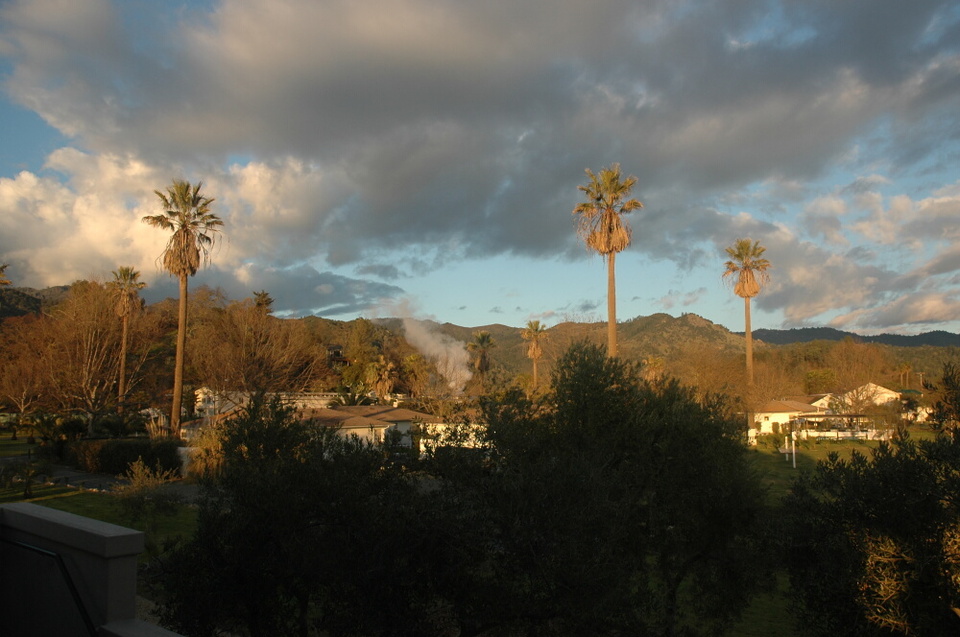
Typically American, the device doesn't always work, of course. For example, recently, we drove back to the city in the evening from a day trip to Napa Valley. Casually, I chose one of the two "Fastrak Only" lanes, overtaking all the slowpokes who had to line up, and we excitedly approached the toll booth. Because of a sign that read "Max 5 mph," I slowed down to 5 miles per hour. Okay, it might have been a few miles more, but in any case, the little device in the car was supposed to beep and the toll booth should display "Fastrak valid." Instead, there was no beep, and the display lit up with "Call Fastrak." Well, great.

Figure [3]: Top left and center: The two sections of the Bay Bridge, photographed from our window.

Once I got home, I called the toll-free 1-800 number, but an automated message informed me that calls are only accepted from Monday to Friday. Seriously, where are we? On Monday, I called again, and a friendly lady told me that this happens sometimes and that I should just "try a few more times." If the transponder doesn't work, a camera captures the license plate, and the charge is processed using the license plate registered with Fastrak.

This actually happened; a few weeks later, I was able to see on the website at http://www.bayareafastrak.org that the amount of $4 (Fastrak users get a one-dollar discount on the Golden Gate Bridge compared to cash payers) was deducted. When Angelika drove over the Bay Bridge some time later, the device beeped properly, and it also worked flawlessly when returning from another trip to Marin. Things aren't always precise in America, but in the end, they manage to get it right.

Figure [4]: On the Fastrak website, you can see how often you have driven over which bridges.

Angelika Several American friends have asked us about the German spa system, both fascinated and bewildered. Paid spa treatments are seen by Americans as the icing on the cake of the German welfare state. However, disappointment quickly followed when I explained that paid spa treatments, in the traditional sense, have been dying out in Germany for a long time.

Nevertheless, there are also places like health resorts in America. These are usually characterized by special water. In California, you can find several such places, as California's volcanic history means that pleasantly warm water still bubbles up here and there from geysers and the like. Calistoga, for example, is one such place; and it has the nice advantage of being located right in the middle of the wine region "Napa Valley." Calistoga is located about 80 miles north of San Francisco. The small town has retained its Californian charm and boasts some good restaurants and many so-called spas (singular: "spa"). I believe you guys are actually now referring to these in modern German as wellness centers. In these, people burdened by everyday life can relax with a massage or a mud bath. Calistoga is famous for its mud baths.

Michael has so far been reluctant to bury himself up to his neck in the mud made of volcanic ash because the mud is not changed from one spa guest to the next. A bit sensitive, the man! I, on the other hand, have already enjoyed such a bath, for which I bravely laid down in something like a bathtub and let myself be covered with mud. The mud is quite hot, and after a short time, sweat runs down your forehead like nobody's business. But that's probably the point: to detoxify the body and absorb the minerals from the mud.

Samuel Brannan opened the first hotel with a spa in Calistoga around 1860 because he dreamed of creating a second Saratoga Springs (a famous resort in the state of New York). Allegedly, the name Calistoga comes from a combination of the words California and Saratoga. The idea of a hotel/motel with a spa is, of course, brilliant and is still widespread in Calistoga today. Guests can settle into the hotel and don't even need to leave for a few relaxing treatments.

Our favorite accommodation in Calistoga is the "Indian Springs Resort," which is located on the property originally acquired by Sam Brannan. However, it's not the massages or mud baths that attract us there, but the swimming pool fed by a natural hot spring. The pool is Olympic-sized, and its water temperature varies between 90 to 102 degrees Fahrenheit depending on the season.

Figure [6]: The beautiful big hot pool at night

The insider tip is to book a stay at Indian Springs during the Californian winter months (November to February), as Calistoga typically has quite cool nights during this time. There's nothing better than scurrying through the cold night to the swimming pool and then slipping into the warm water, making your legs tingle from the temperature difference. As a hotel guest, you can use the pool until midnight. Every time we're there, I feel like I'm in a Hitchcock movie. The pool is dimly lit, and the water is steaming. Occasionally, you can see the outline of a person through the mist. Eerily beautiful!

Figure [7]: Angelika at the health resort

However, the fun isn't exactly cheap. To rent one of the small cottages, you need to have some money to spare, especially during the summer and fall months. The relatively new so-called "Lodge" on the premises is a bit easier on the wallet, but the tastefully decorated rooms there don't have a refrigerator or even a kitchen like the rentable cottages do. By the way, Calistoga can even boast its own mineral water, which is sourced from natural spring water. The bottled water company is also called Calistoga and unfortunately now belongs to the large Nestle group. If you're traveling in Northern California and order a mineral water, you might be asked if a Calistoga is okay. Now you know what that means.

Bureaucracy in Road Traffic Regulations

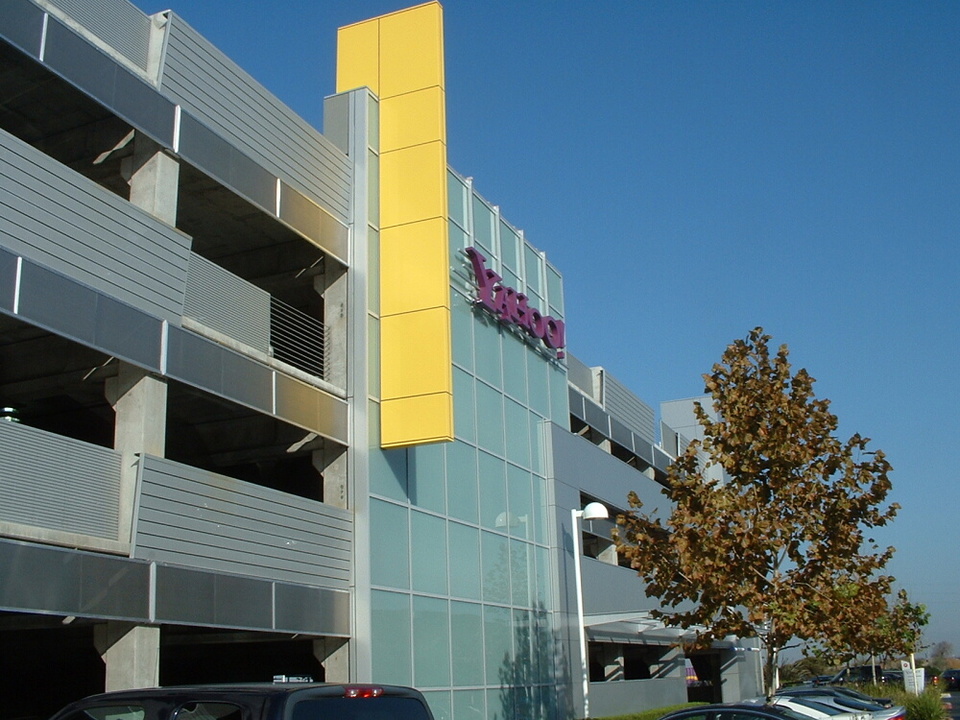
Figure [8]: The Yahoo parking garage

Michael One of the biggest stereotypes about America is that there is no bureaucracy. However, as soon as you have dealings with authorities here, you'll find that exactly the opposite is true; red tape is even worse here than in Germany. This certainly applies to the insanely complicated tax return, but there are even more interesting examples.

Did you know, for example, that in California there are special regulations for mobile ice cream vendors? Background: In 1999, a 4-year-old girl in San Bernardino (near Los Angeles) ran towards a parked ice cream truck and was struck and killed by a passing car. Two years later, the then-Governor of California, Gray Davis (later replaced by Arnold Schwarzenegger), signed the "Destiny Nicole Stout Memorial Act," named after the deceased girl. This law introduced specific regulations for mobile ice cream vendors. According to traffic regulations, an ice cream vendor is not allowed to stop on roads where cars travel faster than 25 miles per hour.

Additionally, vendors must display large signs with the words "WARNING" and "CHILDREN CROSSING" on both the front and back of the ice cream truck. These signs must be at least 12 by 48 inches (30 cm x 123 cm) in size to ensure they can be read from a distance. If you want to know further details about this regulation, here's a newspaper story.

Another special feature is the application of traffic regulations to private parking lots. For example, if someone shamelessly parks their car in a disabled parking space at the supermarket, the police can issue a ticket. However, this is only possible if there is a sign at the entrance of the premises stating that traffic regulations also apply on this private property. This serves as an invitation from the supermarket to passing traffic wardens (who are often male in the USA), who otherwise have no business on private property.

Ycantpark

Michael I dug up these regulations because recently a police car drove up to the Yahoo parking lot and issued hefty fines to all the cars parked in disabled parking spaces without a disabled permit. They're not cheap; each one cost about 300 dollars! I can, of course, only laugh about these problems because I almost always ride my bike or take the shuttle bus provided by Yahoo! to work.

Yahoo! has hired so many people in recent years that the parking situation is sometimes a bit tense. If you arrive at the parking lot after 10 a.m., you often can't find a parking space anymore and have to either go to the valet parker (Rundbrief 06/1999) or to a slightly more distant alternative parking lot. Naturally, it annoys us Yahoos when some people take up two parking spaces by parking carelessly, thereby worsening the situation through their negligence.

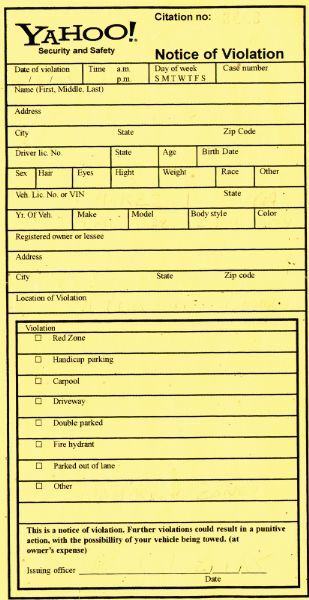
Figure [9]: Yahoo! Ticket for Illegal Parking

In the age of ever-present cell phone cameras, the culprits are therefore immediately photographed and uploaded to the image service Flickr, which was purchased by Yahoo!, under the tag "ycantpark" and relentlessly exposed on the internet. A hell of a fun! These issues are then often extensively discussed on the company's internal mailing lists. For example, some parking spaces are marked as "Compact," and only small cars should be parked there, not monster SUVs. If someone does park an SUV there, people get really upset! Normally, for parking violations at Yahoo!, you receive an internal ticket (illustration 9) that doesn't cost anything. However, as mentioned, recently the police showed up, and there was a rude awakening for many who parked incorrectly.

San Francisco in my Passport

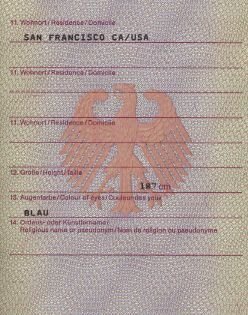
Figure [10]: Finally, San Francisco is listed as my place of residence in my passport.

Michael When I visited Germany a few years ago and wanted to jet back to the USA after a week of vacation, the German border officer asked me if I lived in San Francisco. This was quite logical, as Angelika had just passed through the border exit control, and her German passport listed San Francisco as her place of residence.

I, on the other hand, had not applied for a new German passport at that time yet, because my old one was still valid, and accordingly, it listed 'Munich' as my place of residence. 'Yes,' I said, 'I live in San Francisco.' Suddenly, the customs officer became agitated and exclaimed, 'That's not allowed!' and 'No one knows where you live!'

Figure [11]: The German Consulate in San Francisco

These two sentences are the hits at every American party where I tell this story. Americans often can't stop laughing! In any case, I solemnly promised the officer to apply for a new passport with the correct entry at the next opportunity.

And that's what I did. If you live outside of Germany, the German consulate in the country where you reside is responsible for issuing new passports. Conveniently, San Francisco has a consulate (incidentally, along with Los Angeles, the only one on the entire West Coast of the USA) in the beautiful villa district of "Russian Hill." I went there, paid 50 dollars in cash (checks or credit cards were not accepted), presented my deregistration certificate from the Munich registration office (required if you leave Germany), as well as a birth certificate, a marriage certificate, and my green card, filled out a form, and was assured by the German-speaking employee that I would be called at home when the passport was ready in about four weeks. I didn't even get a receipt, but you can rely on German authorities, and indeed, I was called after the waiting period had passed and was able to pick up my new passport. And it correctly stated "San Francisco CA/USA" as my place of residence. By the way, this entry is important if you want to shop tax-free in Germany, as we have mentioned before (Rundbrief 03/2001).

A few years ago, I used to play Schafkopf with an employee of the consulate in San Francisco, and that's why I know that there is an answering machine on the premises that the officials have to check every few hours, even on weekends. If a German is in trouble in America, the consulate must help immediately. The German consulate in San Francisco deserves five stars, I can only recommend it.

Angelika Recently, German passports started carrying biometric features, which makes the document now cost 88 dollars, as I found out when I applied for my new passport at the consulate. Of course, Americans are to blame for the fuss with the biometric data, because German passports issued after October 25, 2006, must have biometric data if one wants to continue entering the USA as a German without a tourist visa.

For Germans who possess the American Green Card, this rule does not apply, but for new passport applications, biometric features are already generally stored in chip form. Since these features mainly involve facial recognition, passport photos are now subject to very strict guidelines. The consulate provides an information sheet with examples of how the photo should look. For example, the face in the passport photo must not be smaller than 32 mm, but also not larger than 36 mm. Ah!!! The photo looks so ridiculous now because nothing but the head is in it. The friendly consulate employee was a bit concerned because both my eyes are not exactly on the same level, but she said that the Federal Printing Office in Berlin would accept it. By the way, I read that facial recognition has a fairly high error rate. Well, cheers to that.

By the way, you don't necessarily need to apply for a new passport if your place of residence in the passport is no longer correct due to a move. The consulate will update the place of residence in the passport for free if you provide the previously mentioned deregistration confirmation from the German registration office, as well as a phone or electricity bill showing your current US address, and the Green Card or American residence permit. Naturally, a small "Change of Residence" form also needs to be filled out.

Your old passport is then simply clamped into an old-fashioned typewriter, and the place of residence is corrected. My passport has had San Francisco listed as my place of residence for quite some time now. Since I often travel to Germany and take advantage of tax-free shopping, I eventually got tired of arguing with the customs officers in Germany. Despite my Green Card and my California driver's license with an American address, they would get upset about the still-German place of residence in my passport. An officer at the airport in Bremen was particularly stubborn once and said that anyone could make up a story.

Mandatory Health Insurance In Massachusetts

Figure [12]: The book "Critical Condition" by Donald Bartlett and James Steele

Angelika Sometimes things actually happen in this country that I never would have thought possible in my life. At the beginning of April, politicians (both Democrats and Republicans) decided to introduce a health insurance mandate for their citizens in the state of Massachusetts starting in July 2007.

A historic moment, as this has not existed in any American state until now. As the health insurance debacle in the USA worsens, the number of uninsured people keeps rising, and costs explode under poor conditions, Massachusetts decided to take matters into its own hands. The idea is: states require their drivers to have liability insurance if they own a car. Why should it be different when it comes to one's own health? Hats off, Massachusetts! First same-sex marriage (Rundbrief 03/2004) and now mandatory health insurance!

The details regarding mandatory insurance are not yet fully developed, but in principle, everyone who can afford health insurance must obtain it. Citizens who belong to the poorer segments of the population can access government-subsidized models, along with an expansion of Medicaid (a healthcare program for low-income groups, Rundbrief 03/2005).

Many are now hoping that other states will follow the good example set by Massachusetts. Will I still live to see the day when health insurance becomes mandatory across all of America? By the way, if any of you want to read a good book about the dire state of the American healthcare system, you should check out "Critical Condition" by the two journalists Donald Bartlett and James Steele. However, the book has only been published in English so far. In the prologue, the authors describe, for example, that the pricing policy of health insurance companies in America is akin to a supermarket charging each customer a different price for a box of cornflakes. You can guess that the authors lean more towards the liberal side and advocate for a national mandatory insurance in America.

Five-Second-Rule

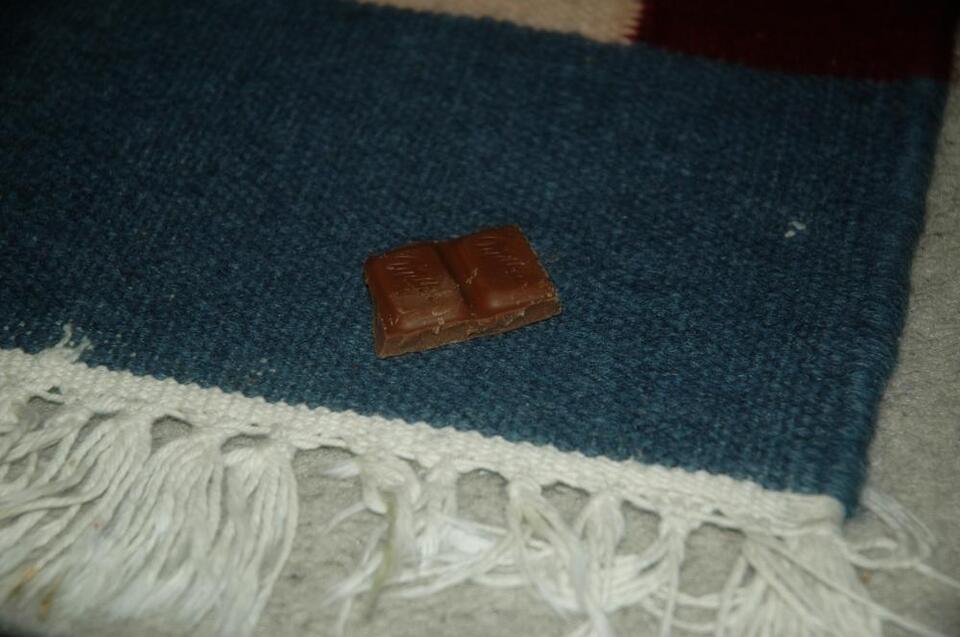
Figure [13]: Chocolate that has fallen on the carpet - to eat or not?

Michael In our series "well-known American rules for children that no one knows in Germany," today: the Five-Second Rule. If something edible, like a piece of chocolate, falls on the floor, the clock starts ticking: If you manage to retrieve the fallen piece within five seconds, it can be eaten without worry. If more than five seconds pass, it must go in the trash. The idea behind this is obvious: the good piece allegedly cannot accumulate enough bacteria within five seconds to be harmful to your health.

In the TV show Mythbusters (Rundbrief 03/2004), which we have already discussed in a previous newsletter edition and which is now even featured on German television on RTL2, this rule was once scientifically examined. However, Adam Savage and Jamie Hyneman found with bacterial cultures in test tubes that it makes no difference whether an item lies on the ground for five seconds or longer. The number of accumulated bacteria is approximately the same in both cases. Nevertheless, the five-second rule is used by many children and even some adults. Bon appetit! And even Wikipedia knows about the five-second rule. It even says there that there is a German proverb 'Dreck macht Speck!' which they claim means something similar. Ridiculous! And also according to Wikipedia, in the dormitories of American universities, the '10-Second Rule' applies to the constantly drunk and therefore slower-reacting students -- you guessed it.

Good Manners

Michael Some things in America haven't changed since the days of the Wild West: the gentleman still holds the door open for the lady. This is not only the case at highly formal events but is also common practice in everyday life. It is also quite common for the first person in a group to, for example, pull open a restaurant door and hold it open while the rest of the group walks in.

When a gentleman and a lady enter a restaurant, the gentleman holds the door open for the lady and lets her enter the establishment first(!). This rule served, during the times of the Wild West, to allow the gentleman to quickly count behind her back whether he had enough money to take the lady out while she was walking through the door. Because even in the very modern San Francisco, it is considered completely unacceptable if the gentleman does not cover the entire bill for a romantic table for two.

Or when, coming from the restaurant, two people get back into the car: The gentleman first unlocks the passenger door for the lady from the outside (!), holds it open, lets the lady get in, and then closes the door before finally walking around the car to the driver's side to get in himself. According to friends who are still active in the dating scene, the lady's behavior in this situation can predict the further course of the evening. If she unlocks the driver's door for the gentleman from the passenger seat, "something more" might happen that evening. However, if she waits for the gentleman to unlock his door from the outside with the key, then nothing more than expenses will come of it.

If you want to seriously start a relationship with someone, you go out to dinner with them at most three times. "Lunch" is more of a friendly affair and doesn't imply any romantic intentions, at most vague exploratory attempts. "Dinner and a Movie" is a common dating combination, and as a lady, you should be aware of the signals. Like in baseball, these three evenings are referred to as "First Base," "Second Base," and "Third Base." At the latest on second base, a little cuddling is required. If nothing happens after the third time, the process will be abruptly terminated. Actually, it is already considered an imposition if a lady allows herself to be invited three times and then acts aloof. How complicated it all is! It's a wonder that these people even manage to reproduce.

Narnia Rap and West Coast Rebuttal

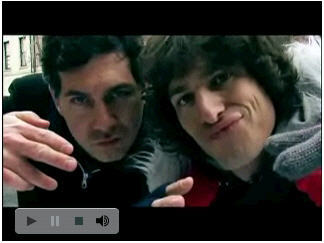
Figure [14]: Chris Parnell and Andy Samberg in the video "Lazy Sunday"

Michael Here in the U.S., there is this TV show called "Saturday Night Live," which, as the name suggests, is broadcast on Saturday evenings and is supposed to be quite funny. At least it used to be, back in the days when "Wayne's World" started on this very show and eventually became a huge hit.

In a recently aired episode, a first-rate comedic moment shook the nation: Two white comedians performed a rap piece in the style of black gangsta rappers, but instead of drugs and gang shootings, it was about a Sunday afternoon trip to see the children's movie "Chronicles of Narnia." However, it was done with the slang, hand gestures, and gangsta music typical of black gang circles. I've watched the video "Lazy Sunday" at least a hundred times and I could still crack up laughing every time, lyrics are here.

It's not easy for inexperienced English speakers to understand, which is why diligent people on the internet have transcribed it. And probably because of the part 'Let's hit up Yahoo Maps to find the dopest route' and 'Google Maps is the best! True that! Double true!' I saw the video played over and over internally at work at Yahoo (and probably at Google as well), we laughed and laughed!

The news about the video spread like wildfire on the internet, and even people who hadn't watched the "Saturday Night Live" show got to enjoy it through video-sharing sites like youtube.com. That was until the lawyers from the TV network NBC intervened and prohibited its distribution. Now, the video is available again on nbc.com, but it doesn't work properly on many computers. Apparently, only slowpokes work at NBC!

Anyway, the video triggered a so-called West Coast rebuttal. The East and West Coasts of the USA don't see eye to eye, much like East Frisians and Bavarians. And 'rebuttal' means something like 'counter-argument.' Two guys from Los Angeles made a "Lazy Monday" video, which is even funnier! Two Jewish Californians from next door who add a gangsta tone to the most mundane things. I could laugh myself silly every time at the scene where Adam Stein casually tosses aside the book "A Brief History of Time." And the coffeehouse chain discount card "To get our 1% in!" is as typical Californian as the banana bikes or the "Color me mine" store, where you can paint your own clay creations. One laugh riot follows the next! And: Aren't we living in a great time, where a few clever people can shoot a rap video over the weekend without too much cash and spread it all over the world? Who would want to live in another time!

Figure [15]: Mark Feuerstein and Adam Stein in "Lazy Monday"

And the trend is now spreading around the world, "Lazy Sunday UK" already exists in England, and soon there will probably be something like "Lazy Tuesday, mein Herr" from Germany. Here in the newsletter, you'll hear it, as always, first!

German and American Humor

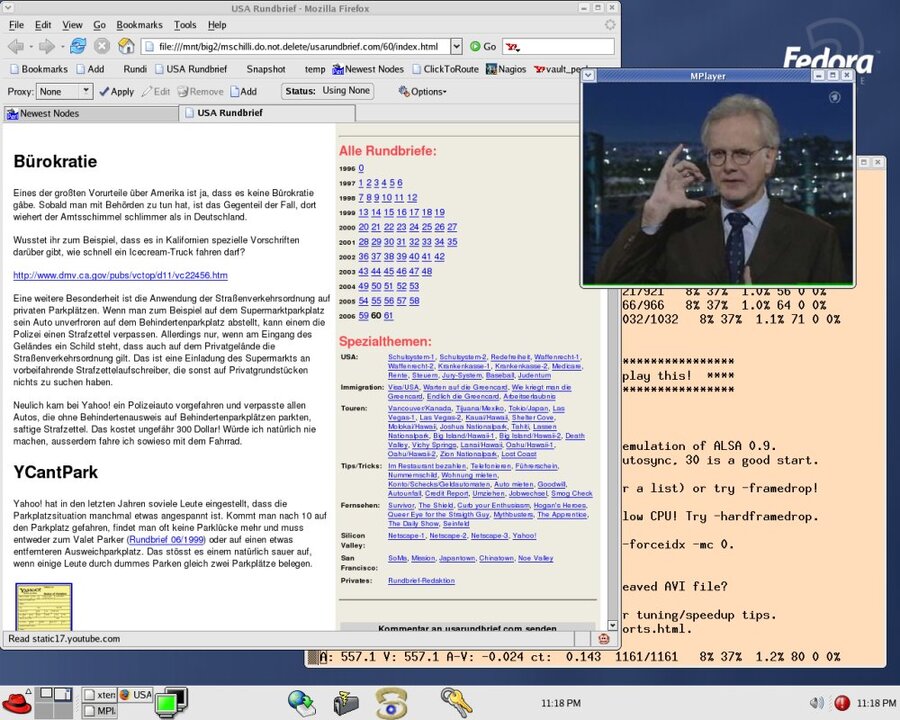
Figure [16]: Thanks to onlinetvrecorder.com, The Harald Schmidt Show is also available in San Francisco.

Michael German humor doesn't have a good reputation internationally. Generally, Germans are considered to lack any ability to be funny. People only enjoy the involuntary comedy of German stiffness. Take a look at the latest Volkswagen ad: A crazy guy in a white coat appears in America, speaks English with a fake German accent, and mimics American behaviors. Americans find that funny.

German humor is not only underestimated within Europe, where the Dutch and English often think all Germans are sullen, but especially in the USA. There, Germans are admired for their diligence, perseverance, and love of technical perfection, but a German comedian would never make it onto television in the USA.

I find that this is not fair. Sure, there are a lot of popular snoring humorists in Germany who ruin the German reputation. Over... onlinetvrecorder.com The translation of the text to English is:

Since recently, you can have German TV shows recorded onlinetvrecorder.com from the U.S. and then download them, and that's how I recently got to enjoy the Harald Schmidt Show. It was so utterly unfunny that one could really believe a humor drought had broken out in Germany. In comparison, Letterman, who is considered slow-paced here, is a laugh bomb.

But when you look at products like the magazine "Titanic" (of course, I still pay for an international subscription at the exorbitant price of 95 euros a year) or the books by Max Goldt or Rattelschneck, you have to say that they can also compete well internationally and often stand out in terms of humor. Although "Titanic" has been steadily declining for decades, columns like the "Humor Critique" by Robert Gernhardt (under the pseudonym Hans Mentz) are still unmatched.

American humor tends to be on the lighter side. I hear this quite often at work. You wouldn't believe how often the episode of The Simpsons is quoted at the lunch table, where a bunch of German backpackers invade the Simpsons' house. One of the most popular quotes: "Number 37 of what's wrong with America: No national health insurance. What is this, the age of Charlemagne?"

Or the topic of David Hasselhoff. That third-rate actor is known from the series "Nightrider" in the eighties, even topping the German charts with "I've been Looking for Freedom" for months, has ruined the reputation of German musical taste in the USA once and for all. David Hasselhoff is a complete laughingstock here in the USA. Recently, in the TV series "The Office," someone who wore their shirt a bit too unbuttoned was referred to as "Hasselhoff," and it was hilariously funny! And even on Yahoo, I often have to endure mockery when I talk about dim-witted American behaviors, and then someone dryly brings up the topic of "Hasselhoff" as a counterbalance. A particularly embarrassing Hasselhoff-Video from German television, which a Yahoo colleague from our lunch group recently sent around, you are welcome to watch. And I have to live with something like this! It's not easy.

Point Reyes

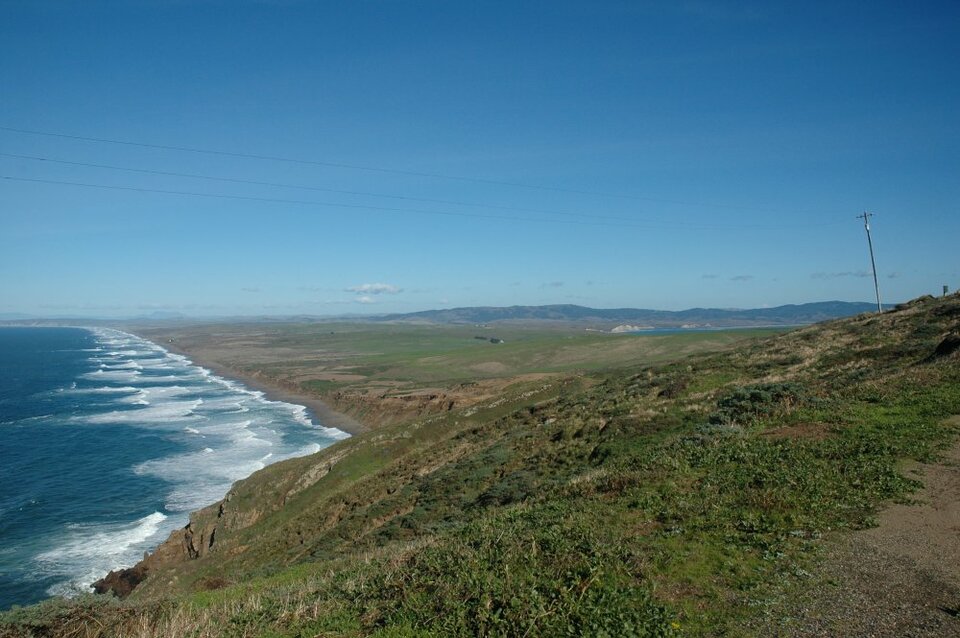
Figure [17]: Point Reyes: The Coast

Angelika One of the unbeatable advantages of San Francisco is its location. While other people go on vacation and spend hours on a plane to get there, we can drive there in just a few hours. California is known for its size and diversity, and many tourists don't have the time to deviate from the classic routes. Most people drive along the "Highway 1," known as America's dream road, from San Francisco heading south along the coast, which is certainly not to be underestimated, but they sadly neglect the north coast. As far as I'm concerned, it can stay that way, as we don't want to be stuck behind lines of cars during our trips. The stretch between San Francisco and Eureka definitely makes my heart beat faster. There's nothing more beautiful than driving the winding road on a cozy sunny day and enjoying the breathtaking views of the sparkling Pacific. The north is rougher, perhaps a bit sleepier, and you encounter more of the type of people I like to call sea dogs. That's where my North German soul feels at home. Sigh!

Figure [18]: Point Reyes: The Lighthouse

If I long for steep cliffs, for deserted beaches where the wind whistles and the waves crash onto the shore with roaring force, for hiking trails that offer breathtaking views of the sea, then we set off for Point Reyes. "Point Reyes National Seashore" is a peninsula-like nature reserve located about 30 miles north of San Francisco, reaching 10 miles into the ocean. We have mentioned Point Reyes in our newsletter before, mostly because we often encounter some wildlife there, such as snakes or whales. To reach the peninsula, you have to leave Highway 1, which is why tourists usually speed past Point Reyes. Additionally, the motto there is: Get out of the car and put on your hiking boots. We owe it to former President John F. Kennedy that this coastal strip was protected in 1962.

The dramatic landscape, as is often the case in California, is closely connected to a fault line. This is the San Andreas Fault, the same fault that runs through San Francisco. The ground here is constantly moving: the peninsula shifts approximately 2 inches further north each year, always along the San Andreas Fault. This is why seven million years ago, Point Reyes was about 80 miles further south and underwater. And since the Pacific and North American plates are rubbing against each other at the San Andreas Fault, there are frequent tremors felt in Point Reyes as well.

Just this week, various celebrations were held in San Francisco to commemorate the devastating earthquake that occurred 100 years ago, on April 18, 1906. The friction along the San Andreas Fault was responsible for that earthquake, as well as for the "Loma Prieta" earthquake in 1989. A short, quite amusing loop trail ("Earthquake Trail") near the visitor center in Point Reyes explains the events at this fault line, with the added thrill that the walker is practically moving along the San Andreas Fault. A split fence demonstrates how far the surface was torn apart by the 1906 earthquake--more than 15 feet, as shown in illustration 19!

Figure [19]: Point Reyes: Replica of a fence that was pulled apart during the 1906 earthquake

For dedicated lighthouse enthusiasts, it is recommended to drive all the way to the tip of the peninsula. The lighthouse sits on the last rock before the open sea and can be reached by descending down stairs with 300 steps. During whale season, the area around the lighthouse is considered the best vantage point for observing the migrating California gray whales, which swim south from Alaska to Baja California (Mexico) in mid-January and make the return journey north in mid-March.

Whale watching is so popular in Point Reyes that visitors must use a bus from the parking lot at "Drakes Beach" to reach the lighthouse on weekends and holidays between the end of December and mid-April. One weekend in January, Michael and I were able to see for ourselves that the system works excellently. Although we didn't see any whales, even though supposedly a handful were spotted that day by others, we did see elephant seals with their young.

And if you've had enough of nature or are hungry, you can drive to the town of "Point Reyes Station" to the "Station House Cafe." The restaurant has a huge outdoor seating area that almost resembles a beer garden. However, in nice weather, it's a real challenge to snag a spot outside. And the servers in the place are the slowest in North America. By the way, you'll find oysters on the menu everywhere around Point Reyes. This is because there are four businesses in the greater Point Reyes area that farm oysters. It doesn't get any fresher than that!

Snakes

Figure [20]: Dangerous snake! The newsletter reporters in danger!

Michael Recently, at REI in San Francisco, I bought new hiking boots. To break them in, we went to the Marin Headlands despite the somewhat unsettling weather. After about 5 miles on the trail, a mountain biker called out to us that he had seen a coyote. We were almost back at the car anyway, and as we marched steadily, I suddenly noticed a frantic movement on the ground. A snake slithered just inches past my boots across the path. Naturally, I performed quite the bear dance!

Angelika laughed naturally, obviously her childlike mind did not grasp the seriousness of the situation! The snake did not even move away afterwards, but continued lurking on the path. That's why I photographed the disgusting reptile with the telephoto lens at the highest zoom setting. Just look at the colorful pattern. Definitely a venomous snake, death occurs within seconds!

Spared to live another day!

Angelika & Michael

RSS Feed
Mailing Liste
Impressum
Mike Schilli Monologues


Get announcements for new editions

New editions of this publication appear in somewhat random intervals. To receive a brief note when they're available in your mailbox (about once every two months on average), you can register your email on the 'usarundbrief' Google Groups list.

Your email address


All Editions:


Send us a comment
We'd like to hear from you, please send us feedback if you want to comment on the content or have suggestions for future topics.

Simply write your your message into the text box below. If you'd like a response from us, please also leave your email. If you want to stay anonymous, simply put 'anonymous' into the email field. This way we'll get the message, but we have no way to respond to you.

Your email address


Message

 
Contact the authors
Latest update: 17-Dec-2025