
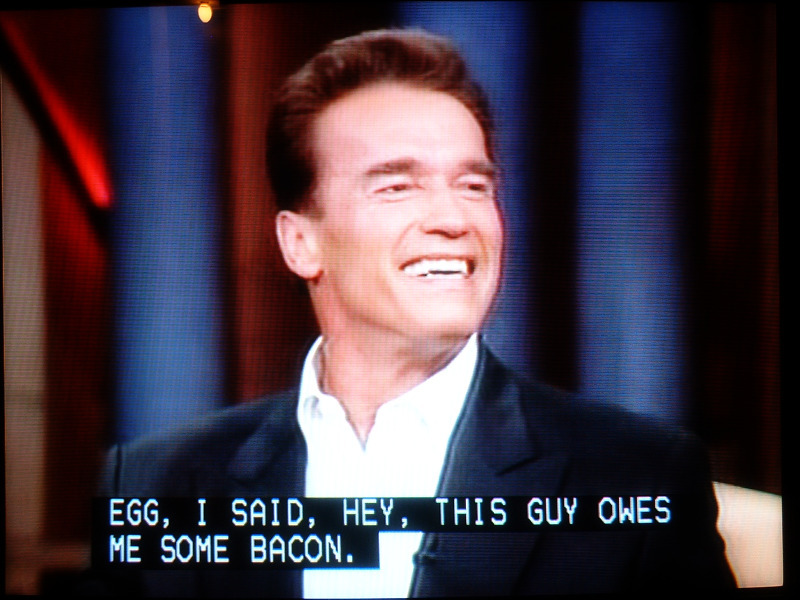
Angelika Why does every random actor in America believe that the Hollywood experience qualifies them to hold political office? This question has been bothering me since muscle man and film star Arnold Schwarzenegger entered the race for the position of Governor of California.
Yesterday, on October 7th, the decision was made that California voters bid farewell to the incumbent Governor Gray Davis in the recall election and instead allowed "Arnie" to take the reins. It is hard to believe: The world's fifth-largest economy and the most populous state in the USA is now being led by a politically inexperienced Hollywood star with an Austrian accent.
Has the abundant sunshine gone to Californians' heads? Much of it has to do with how election campaigns are conducted in America. There is hardly any detailed information about political programs of individual candidates. Instead, short campaign ads from the leading contestants are constantly being aired on television. However, these ads offer little more than platitudes. Arnold's statement was simple: "Politicians have let us down."
Cruz Bustamante, the only Democratic candidate and a Latino, who is therefore more popular among the Spanish-speaking population, sat in front of the camera with a tense smile, accompanied by his family. He also had a hard time getting his campaign slogan across, as he wanted voters to vote against the recall of Gray Davis and, in the second step, for him, to ensure that California would not fall into the hands of a Republican governor. I mentioned the peculiar election procedure in the last newsletter (0). Eligible Voters could pick a candidate, even if they had expressed opposition to Davis's resignation in the first step of the election process.
In the television nation of America, by the way, there are hardly any election posters, like the ones known in Germany. Not a single one could be seen in all of San Francisco. However, there was the obligatory televised debate with the main candidates, where political concepts were actually being discussed. In California, everyone was eagerly awaiting this debate because voters especially wanted to see how Arnold would perform without delivering rehearsed lines. Unfortunately, the debate format was disappointing. The discussion topics were announced in advance, which is unusual, allowing the candidates to prepare, and participants were allowed to interrupt each other. Many were annoyed that the organizers had not invited incumbent Governor Gray Davis. Only candidates who had approval ratings of at least 10 percent in the polls (a total of five) were on the guest list, and Gray Davis was excluded.
In such debates, it is not only important what an individual is saying, but also how they present themselves. You have to give Schwarzenegger credit for that: he has learned how to market himself and he also has the necessary funds to do so. Naturally, it worked to his advantage that, among 135 candidates, he was a familiar face, event to those who are not particularly politically savvy, and the press pounced on him like vultures.
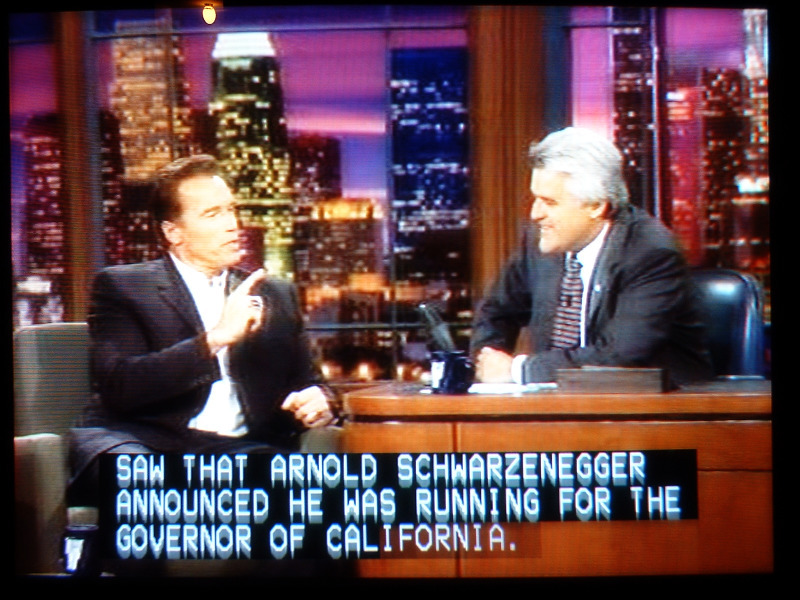
In American election campaigns, it is generally true that those who do not present themselves effectively in the media have no chance of winning. Arnold understands this better than anyone. Initially, he kept a low profile and did not reveal whether he would even run, only to then announce his intention to become the next governor of California with great fanfare on Jay Leno's talk show (a format similar to Harald Schmidt's show in Germany).
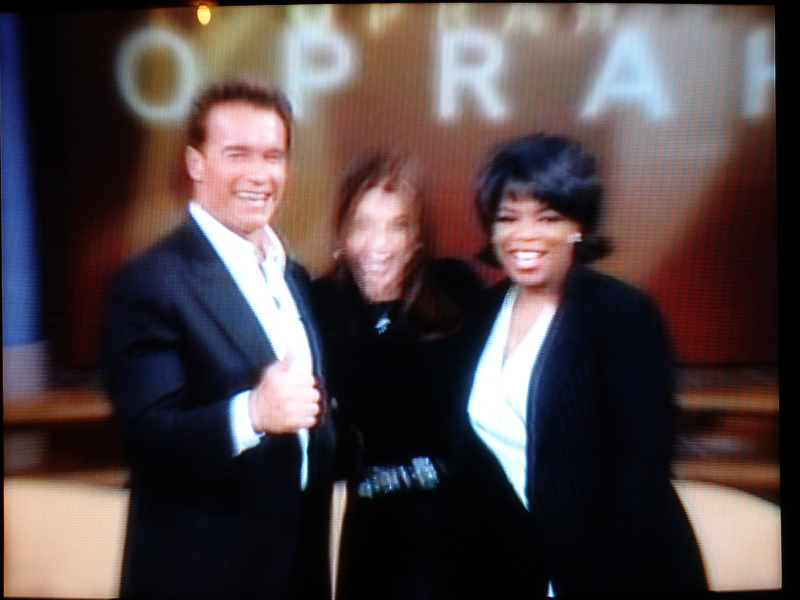
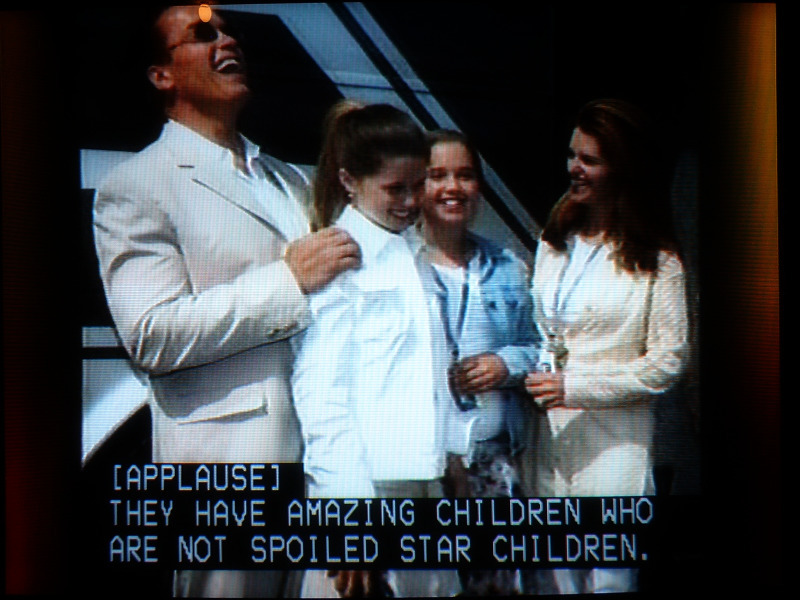
To improve his poor image regarding the treatment of women--after all, he is considered a womanizer and a "breast groper"--he and his wife Maria Shriver moved in with the black talk show host Oprah Winfrey and presented himself as a caring father of four children as well as a loving and attentive husband. This appearance certainly earned him many female votes, as the "Oprah" show not only achieves fantastic ratings but is also regarded by many women as the holy scripture.
This PR stunt was marred by the fact that just a few days before the election, the Los Angeles Times published the stories of six women who confirmed that Schwarzenegger had groped them, after which Arnie apologized contritely for his past boorish behavior on camera.
The New York Times took it a step further and quoted some foolish remarks by Schwarzenegger: In the seventies, he had expressed admiration for Hitler's rise and his oratory skills on several occasions. Being portrayed as a harasser of women and as a Nazi -- that doesn't go over well in America. However, voters here also know that airing dirty laundry is part of every American election campaign.
Additionally, Americans love all kinds of conspiracy theories. So, right after the article was published in the Los Angeles Times, it was suspected that only a political opponent could be behind this story, trying to bring the "Terminator" to his knees just before October 7th, because he was leading in the polls. But let's forget these soap opera dramas for a moment and focus on the political aspect: Arnold Schwarzenegger belongs to the moderate wing of the Republican Party (Please do not confuse with the German Republican Party). He supports existing abortion rights, known in America as "Pro Choice," to distinguish himself from the anti-abortion movement "Pro Life."
He is in favor of gun control and advocates for the rights of homosexuals. These are all issues supported by the vast majority of California's population. With this more liberal mindset, he certainly appeals to Democratic voters. On the other hand, he argues that Californians are being overtaxed and vows not to fill the California budget deficit by raising taxes, which seems almost impossible considering the size of the gap.
Environmentalists and pacifists hate that he drives a so-called "Hummer," a military jeep modified for regular road use (just like the former soccer player Stefan Effenberg).
Immigrants, of whom there are quite a few in California with American citizenship and thus the right to vote, like that Schwarzenegger embodies the American Dream like no other: A nobody from Austria not only made a name for himself as a bodybuilder but also became a famous movie star, despite his terrible accent, raking in millions in the process. And to top it all off, he is married into the Kennedy clan, probably the most well-known family in America.
Unfortunately, our previous governor Gray Davis made the faux pas of joking about Arnold's accent by remarking that no one should become governor who cannot pronounce the word "California" correctly. He seemed to have temporarily forgotten that he is leading a state with a high percentage of residents who do not speak English as their first language. But Schwarzenegger also ruffled some feathers, especially with Mexican immigrants. He criticized a new California law that Gray Davis had just signed, which allows illegal immigrants to obtain a California driver's license.
The entire "recall" process that led to this special election can be characterized as something typically Californian, although this political mechanism is also permitted in other states. California likes to present itself as radically democratic, following the motto: The people decide. And what could be more democratic than voting out a politician who is not doing his job properly?
The whole thing is somewhat short-sighted. If a politician is always acting out of fear that a recall process is looming, all progress eventually comes to a halt. Already, there are threats circulating that the next "recall" is in turn targeting Arnold Schwarzenegger.
Political events in California are also hindered by a provision in the Californian constitution that you in Germany have probably never heard of. Voters can directly pass or repeal laws through a popular initiative (called an "initiative") or a referendum (called a "referendum"). As a result, there are constantly various initiatives here that are poorly thought out and hardly financially viable -- moreover, they often contradict each other.
One of the most famous referendums, the so-called Proposition 13, was passed by voters in 1978 with the aim of keeping the "Property Tax" (comparable to the property tax in Germany) low: Since then, the "Property Tax Rate" has been limited to 1 percent of the assessed property value with very limited yearly increases except if the property's ownership changes. You might say: a dream for every homeowner. However, it must be noted that the rapid deterioration of California's public schools is attributed to Proposition 13, as local schools are largely funded by the property tax. And so the circle closes: Because California's budget has become more dependent on the revenues from California's income tax due to Proposition 13, the general deterioration of the American economic situation and the bursting of the dot-com bubble hit California particularly hard. Company closures, layoffs, and the lack of tax revenue from sold employee stock options caused the budget deficit to grow significantly, which was one of the main arguments for the recall.
But back to Arnold: I'm just glad that the man can't become President, because the American Constitution states that one must be born in America to qualify. However, for some time now, there have been efforts by some politicians to amend the Constitution in this regard. The following proposal by Republican Senator Orrin Hatch from Utah, allegedly a friend of Schwarzenegger's, is currently circulating: An American citizen who has held American citizenship for 20 years should be allowed to run for the presidency. And guess when Arnold Schwarzenegger exchanged his Austrian passport for an American one. 20 years ago! What a coincidence!