
Michael As I might have mentioned before, Americans engage in strange sports. Baseball is one such case. Today, let's go ober the rules.
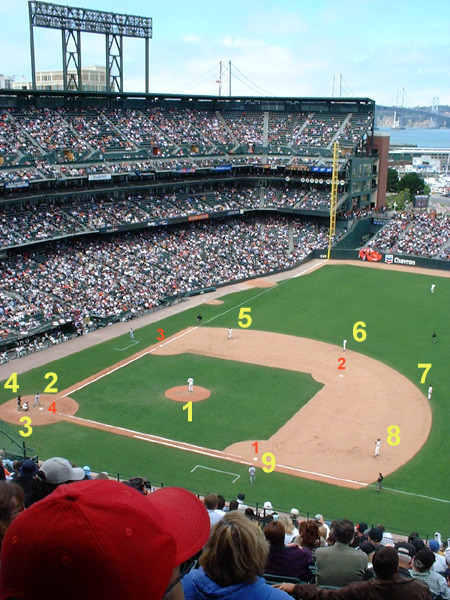
Figure 1 shows a typical game situation, taken at Pacbell Stadium in San Francisco, where the frantic newsletter reporter (live!) sat through an entire game and repeatedly pestered his colleagues with questions until he received logical explanations for the seemingly absurd events on the field.
Just take a look at Figure 1. The yellow numbers indicate the player positions. The pink circle on the left in the image is the so-called home plate. Standing there, from right to left, are the man with the bat ("Batter", 2), the catcher with helmet and glove ("Catcher", 3), and the referee, called "Umpire" (4). Further to the right on the field is a second, smaller pink circle where the pitcher (1) stands. Further to the right follows a wide pink area, the so-called "Infield," where four more figures, the so-called infielders (5 to 8), are positioned. And to the right of the infield is the green "Outfield," which occupies the rest of the stadium area.
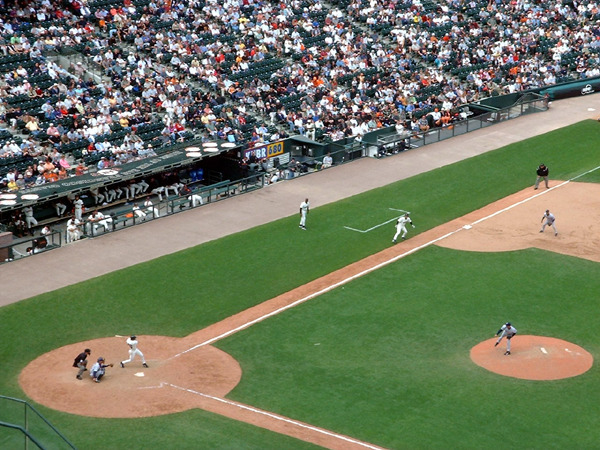
Basically, baseball works like this: The pitcher (1) throws the ball to the catcher (3), and the batter (2) standing in between tries to hit it with his bat. If he succeeds, he throws the bat away and runs as fast as he can along the white line to the so-called "First Base," marked with a red 1 in illustration 1, which is a white cushion fixed on the ground in the corner. From there, he continues to the red number 2 ("Second Base"), then to the marked "Third Base" with a 3, and finally to the goal, the fourth corner, the "Fourth Base." If he reaches there, the team scores a point.
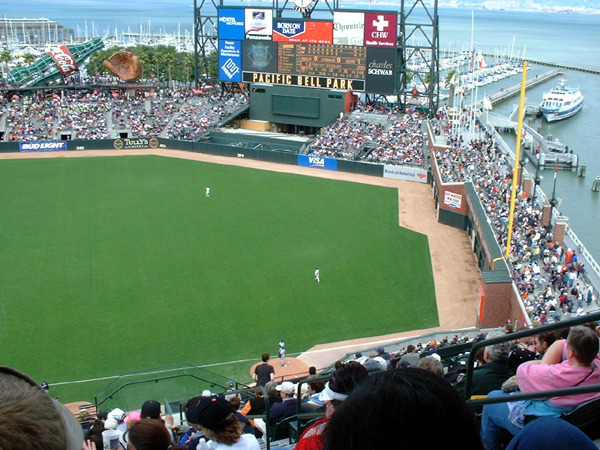
While the batter is running, the infielders and also four outfielders standing further to the right in the green outfield, armed with giantic gloves, try to catch the ball and return it to the infield. And here's the catch: If the batter is running towards a base and an infielder is waiting there, grinning with the ball in hand, the batter is out of luck — he is "out".
Now you might be wondering: Who actually belongs to which team? Those who have been paying attention know: Everyone belongs to the same team -- except for the batter, who plays for the other team.
The pitcher, the catcher, the infielders, and the outfielders all belong to the defensive team, while the batter is the attacker from the other team. The pitcher tries to throw the ball to the catcher in such a way that the batter cannot hit it with the bat. To do this, he often signals to the catcher with secret signs about how the ball will be thrown: depending on whether he touches his ear or picks his nose, the ball will come high or low, more to the left or right, with a spin or super-fast.
After three successful pitches (strikes), it's over and the batter has to leave. However, the pitcher must throw the ball past the batter to the catcher within a prescribed window, otherwise the ball is considered out. If this happens more than three times, the pitcher is out and the batter is allowed to run to the next base without further ado.
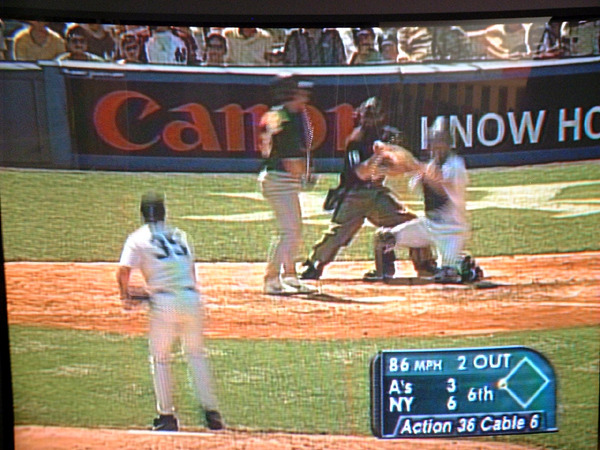
If the batter hits the ball with the bat and the roughly tennis ball-sized sphere rolls into the field (if it goes out of bounds, it doesn't count), panic breaks out, and the fielders immediately do everything they can to catch the ball and return it so that the infielders can cover the bases. This way, one of them can wait, laughing, with the ball in hand for the panting batter to arrive and send him back to the bench.
However, if the batter has one foot on a base bag, no one can put him out. Only when he is running between the bases is he vulnerable, and a catcher positioned on the next base can stop him with the ball. So, for the batter, it's a game of poker. If he sees that he can't make it to the next base, he can simply settle on the current one, and his team can send the next batter into play, like in a pinball game with a multiball feature, in addition to the parked player. This leads to so-called "loaded bases," because each batter is allowed to park on a base. Then it gets exciting, because with each successful hit by the new batter, the parked players can then try to advance to their next base or even all the way to fourth base, for which the attacking team gets one point per player. And this makes the seemingly dull game interesting even during apparent pauses, because even while the catcher is preparing and signaling to the pitcher with secret hand signs how the next ball will come, the parked batters can try to advance to the next base -- if it works out, it's called a "stolen base".
When the batter hits the ball with full force using his bat and it flies into the stands or even out of the stadium, no fielder can catch it. As a result, the batter cannot be stopped and can leisurely run from base to base back to the starting point, scoring a point. This is called a "home run".
But if the batter hits the ball away with the bat and an opposing player catches it without the ball ever touching the ground, the batter is 'out'.
A baseball game consists of 9 rounds, called "innings," each of which has an "upper" and a "lower" half, where one team attacks and the other defends. The points from each inning count, so it might be that the first inning ends 1:2, the second 0:0, the third 4:3, and so on. The team with the most points accumulated from all innings at the end wins. Typically, the games end with scores like 6:8 or 5:6.
The funny thing about baseball is that there are no time limits. The game doesn't last 20 minutes or 1 hour, but rather until the various prescribed plays of the 9 innings are completed. Theoretically, a game could last indefinitely, but typically it ends after 2 to 3 hours.
At the edge of the field (bottom center and left center in illustration 1), you can see boxes drawn on the grass with white lines. These are the designated areas for the First and Third Base Coaches, both assistants to the team manager, who relay secret strategies to the players on the bases. It is apparently considered stylish ("I won't be told what to do!") for the coach not to stand inside the box, but slightly next to it.
Baseball fans are calm and peaceful. Anyone can cheer for their team, no matter where they sit in the stadium; in fact, everyone sits mixed together. My colleague Jeremy even once loudly booed the San Francisco Giants in their own stadium, and the Giants fans sitting around us just laughed. In a German soccer stadium, heads would roll! But just like in hockey or football, Americans strongly identify with their team but would never start fighting or causing trouble. Americans are usually connected to their team since childhood. Since many Americans don't live in the same state their whole lives, it's not uncommon for someone living in San Francisco to cheer for a team from Florida, for example.
The spectators also don't really stay focused. Sometimes someone goes to get a sausage or a beer or chats with their neighbor. Most of the time, you don't miss anything because the game consists of 80% downtime, during which the pitcher prepares or the players return to their positions. The advertising industry takes advantage of this on television by constantly inserting commercials. One of the reasons why soccer will never catch on in the USA is that it cannot be interrupted constantly and predictably.
The TV stations try their best to spice up the sad game with insane statistics. The "hit ratio" of each batter is displayed when their name appears as a subtitle. The value is between 0 and 1, typically 0.638, and indicates the percentage of balls hit by this batter. The given value means that in the current season, he hit 63.8% of all correctly pitched balls (balls outside the strike zone don't count) with the bat and missed or didn't swing at 36.2%.
When the batter steps down, he never takes his bat with him, by the way. Instead, he casually throws the part, which costs several hundred dollars according to the Eastbay catalog, onto the ground, where specially hired bat boys (usually little boys, similar to ball boys in tennis) pick it up and bring it to the team bench.
Due to the inherent boredom of the game, baseball stars used to chew on large wads of chewing tobacco, which they carried around in grotesquely bulging cheeks and regularly spat out streams of brown juice. Since chewing tobacco can cause mouth cancer and baseball players serve as role models for many young people, the stars today ostentatiously chew on huge pieces of gum.
Among the top players, there are noticeably many Mexicans. I was surprised at how many are named "Hernandez" or "Gonzales." The rest are approximately 30% black and 60% white.
Children, students, and women in the USA do not play baseball, but rather softball. The rules are similar; however, the ball is about twice as large and softer. Additionally, it is not thrown from above and from the elbow, as in baseball, but rather from below at hip height.
Since practically everyone grows up with the sport (American football is almost impossible to play at home, even in the foul-free touch football form, due to the high risk of injury), almost everyone knows the incredibly complex baseball rules, of which there are thick volumes beyond those described today. The true fans sit in the stadium with so-called scorecards and record the scores in the individual innings. The whole thing is somehow a mix of chess and handball, with so many strategic moves that it makes your head spin, and a "four-man defense" in soccer seems like child's play in comparison. In all honesty, if I had to pick a sport, I'd probably pick soccer instead.