

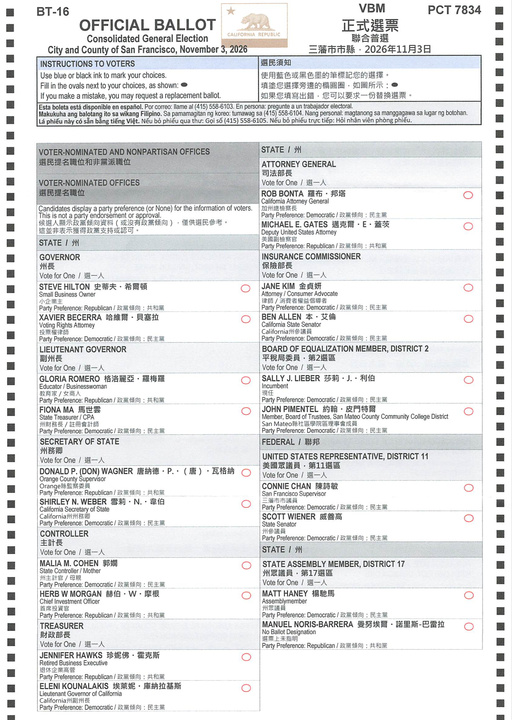
Angelika Unless you live on a deserted island without internet or electricity, you already know that we had an election here on November 3. I mentioned it in the last newsletter. The so-called midterms were coming up. We also elected a new governor in California, an office roughly equivalent to a state premier in the German system. And, as usual, the ballot (Figure 2) also included local elections, such as the city supervisor for our district, several judges, California's attorney general, the city treasurer, the school board, and two dozen ballot measures. Altogether, we had to mark 34 (!) different choices.
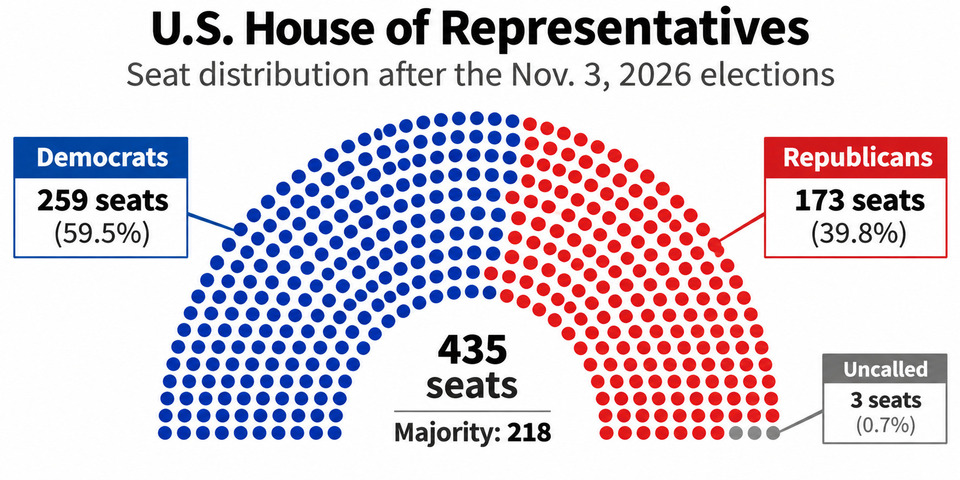
But first, the federal elections: Traditionally, the sitting president's party loses seats in the midterms, especially in the House of Representatives. Forecasts before the election therefore suggested that the Democrats could make substantial gains there and even win a majority in the House.
Over the years, however, pollsters have become somewhat more cautious. You may remember 2016, when Hillary Clinton was already being treated as the sure winner, only for everything to turn out quite differently and Trump to move into the White House. Back then, pollsters were tearing their hair out and had to thoroughly rethink their forecasting models. This time, they therefore considered it possible, but rather unlikely, that the Democrats would also win a majority in the Senate.
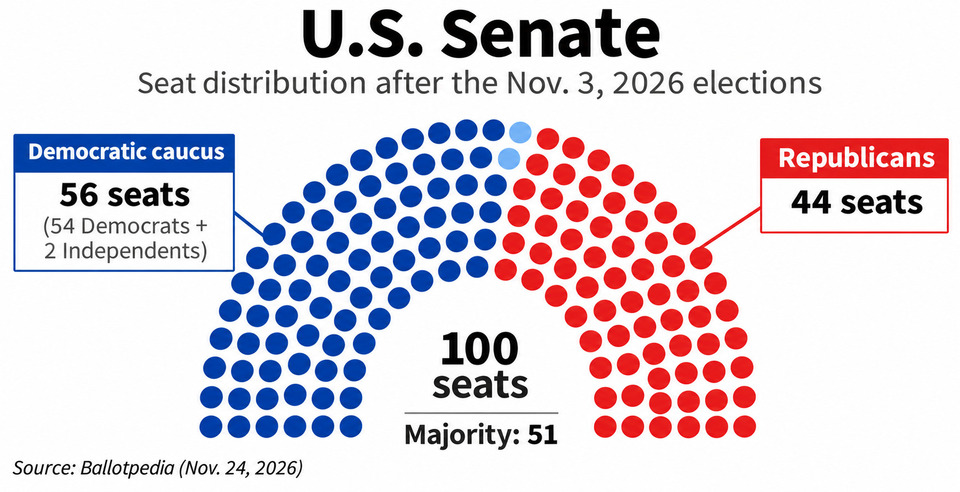
That has mainly to do with the unusual electoral system: Every state, regardless of its size, is represented by two senators. In addition, only about a third of the total of 100 seats come up for election every two years. That makes it quite difficult to wrest a seat from the opposing party and change the balance of power in this chamber.
But as you now know, the blue wave really did sweep through. Some particularly ambitious journalists even called it a blue tsunami. In the United States, blue stands for the Democrats and red for the Republicans. Voters were simply fed up and rebelled at the ballot box. In several traditionally Republican states, the Democrats unexpectedly won important Senate seats, including in Texas, Kansas, Iowa, Ohio, North Carolina, South Carolina, Maine, and Mississippi. Kansas is thus sending a Democratic senator to Washington for the first time since 1932: Adam Hamilton, a Methodist pastor. So the Democrats not only won a majority in the House of Representatives but also took back the Senate. That gives them a majority in both chambers of Congress for the next two years.
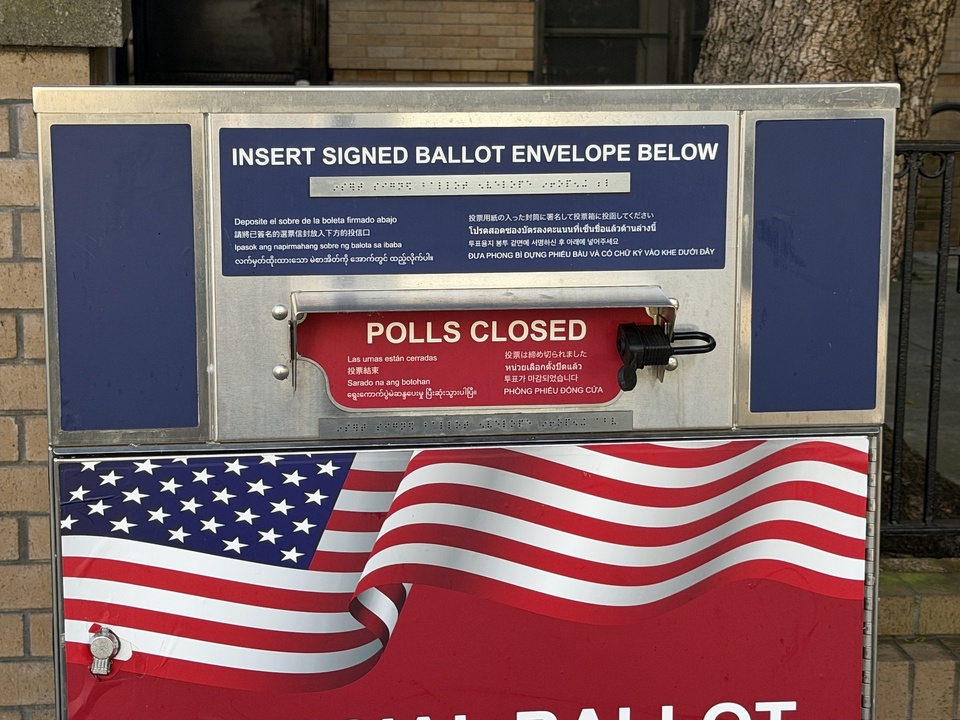
The election was quite clearly a protest vote against Trump's policies and the many promises that, in the eyes of many voters, had gone unfulfilled. Persistently high living costs were repeatedly cited as a source of dissatisfaction. Inflation, tariffs, and, not least, the war with Iran, which has had a particularly noticeable effect on gasoline prices here, have taken a financial toll on many people. Farmers in the country's heartland, usually loyal Republican voters, also voted Democratic because they were suffering particularly badly from tariffs and high diesel prices for their farm machinery. On top of that came growing criticism of the numerous allegations of corruption and conflicts of interest surrounding the man in the White House. That really got voters riled up!
Another important factor was Trump's aggressive immigration policy. Many voters felt that the increasingly harsh deportations and operations by the immigration agency ICE had gone too far. The Republican Party felt the effects particularly among voters with Latino backgrounds. Many of them had voted for Trump in 2024 because they hoped he would improve the economy and bring immigration under control. Now quite a few turned back to the Democrats. In Texas, for example, around 60% of Latino voters chose the Democratic candidate James Talarico. His Republican opponent, Ken Paxton, was also thoroughly mired in scandal, though.
A protest vote is always somewhat problematic, because you are voting against something rather than necessarily making a deliberate choice for something else. According to a recent poll, the Democratic Party is still not particularly popular despite its election victory. Only 39% of respondents expressed a favorable view of the Democrats; for the Republicans, the figure was 40%. Voters now want to see changes. I just hope the newly elected Democrats do not get sidetracked and instead focus their energy on the truly important issues. The new majority does not mean that Trump has now been stripped of his political power, however. The president remains in office and can continue pursuing his own policies, particularly through his extensive veto power. But the Democrats now have considerably more opportunities to scrutinize his administration, block legislation, and establish investigative committees. Things are therefore likely to become more uncomfortable for Trump politically.