![]() |
| Angelika/Mike Schilli |
Angelika Housing in San Francisco is notoriously scarce and absurdly expensive. Since we have been living in this city, nothing has changed in that regard, and there is no improvement in sight. Apartments that fall under the city's rent control are particularly sought after, as they offer tenants special protection. We have been living in such an apartment for over 20 years now.
In general, rental apartments in buildings constructed before June 13, 1979, in San Francisco are subject to rent control. Single-family homes and condominiums are generally excluded. Rent control means that while the landlord can charge whatever they want for new tenants, they can only increase the rent once a year by a percentage set by the city; currently 1.4% (from March 1, 2025, to February 28, 2026). The previous year it was 1.7%. The landlord can increase the rent every 12 months, but is not required to do so. Missed increases can be applied later by adding up the allowed annual increases, but without compound interest.
How does the city arrive at the annually allowed percentages? They are based on the local consumer price index, specifically 60% of it. Every year that a tenant can avoid a rent increase is, of course, advantageous. The landlord must announce increases 30 days in advance. If the increase is over 10%, which can happen if there hasn't been a rent increase for several years, the notice period extends to 90 days. You can probably guess it. This year, we had a rent increase after eight years. Sigh.
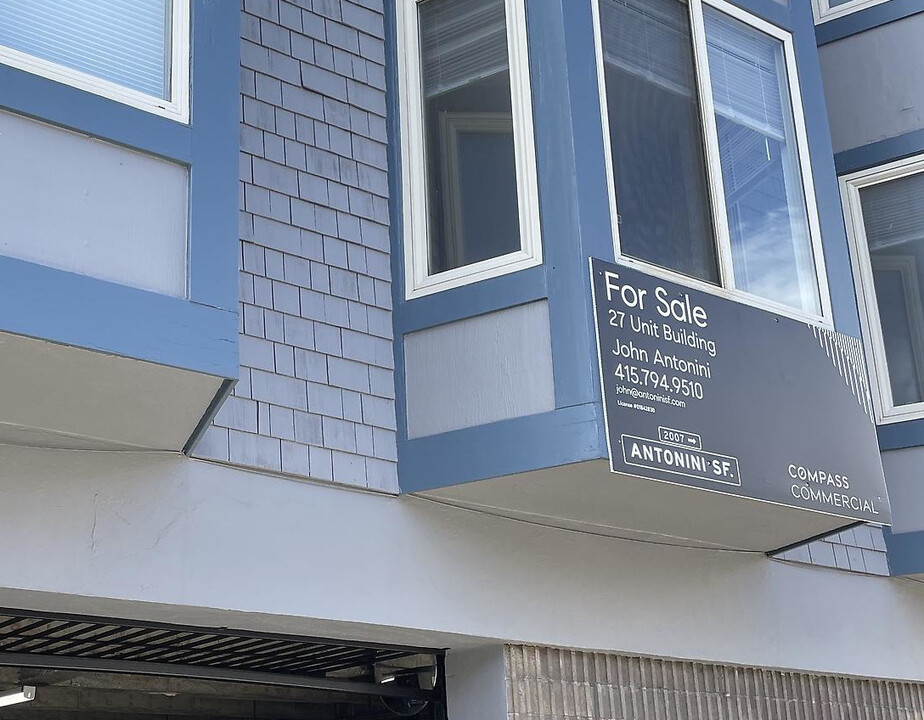
Hardly had we digested that when suddenly, in mid-June, we found a letter taped to our door. A local real estate agent announced that our building was to be sold, and that a viewing of the apartments would be necessary. In San Francisco, it is required that property viewings be announced at least 24 hours in advance. The letter also included a questionnaire and explanations of our tenant rights. More on that shortly. We had feared and anticipated the sale because our landlord Gus, who had built the house himself in the early 70s, had passed away some time ago at well over 90. Gus had been very attached to the house and had always kept an eye on things even in his old age. A very interesting man, our Gus. In his very young years, he moved from Switzerland to San Francisco and actually lived the American dream, as he bought land and built houses, and was very successful at it. Several years ago, he had transferred the management of our house to one of his daughters. And we knew: She would sell the house as soon as Gus would no longer object.
In my opinion, whoever buys our apartment building must be a bit crazy because nothing has been done to the house for years. For example, our elevator regularly breaks down, and the water pipes in the garage keep leaking, creating huge puddles. But Michael always says that in the end, everything is a matter of price.
Now tenants in a building with rent control enjoy extended rights when the building is sold. The buyer cannot simply change existing rental agreements or evict tenants, and the rules regarding rent increases remain in place. Tenants generally cannot be forced to fill out and sign a so-called estoppel certificate. What exactly is behind the term "estoppel"? Generally, "estop" means "to prevent" or "to prohibit." Basically, the form spells out the current rental conditions. When did the tenant move in, what deposit did they pay, is there a parking space and if so, where is it, or has the tenant made any changes or improvements to the apartment and paid for them themselves? Once this form is filled out and signed by the tenants, it is considered binding, and the tenants cannot later claim or sue for something different. However, this also applies if something is not mentioned on the form. Therefore, legal experts debate whether it is advantageous or disadvantageous to fill out this form. If the rental agreement states that it must be filled out, there is no way around it.
Since the estoppel also lists things that were only agreed upon verbally, which the new landlord should be aware of so that they continue to be valid, we felt that the advantages outweighed the disadvantages, and we dutifully filled it out. Another important form that should be completed concerns the question of whether one belongs to a "Protected Class." Tenants who fall under this specially protected category cannot be terminated due to personal use by the owner in the event of a change of ownership. These include: 1) Tenants aged 60 and over who have lived there for at least 10 years. 2) Tenants with disabilities who have also lived there for at least 10 years. 3) Tenants with severe, life-threatening illnesses who have lived in an apartment for at least five years. Approximately half of the tenants in our building fall into these categories.
When a house is for sale in the USA, a process called "staging" takes place, which means the homes are adorned with stylish furniture and impressive, enhanced photos are taken to help sell the house more quickly and at a higher price. In an apartment building where people live, this is naturally a bit more challenging, but the realtor still did their best. Our neighbor's apartment was photographed, and some general beautification attempts were on the agenda. For example, in our entrance lobby downstairs, there had been this wood paneling on the wall that had probably been there since the house was built. It was rigorously torn out, and the lobby was painted in such a bright white that I'm always quite dazzled now when I step through the front door. The building walls were also cleaned with a high-pressure water jet. However, we were not informed about this, so suddenly the dirt sprayed through the cracks of our apartment door because it no longer closed properly. Thankfully, we were home and could immediately cover and clean everything with towels.
But how much should our house cost now? A mere 7.9 million dollars. For San Francisco, that's not even that much, since the smallest "doghouse" here now costs over a million. To let potential buyers know what rental income they can expect, the realtor creates a so-called "Rent Roll" list, which is available online. It not only lists every single apartment with its number but also how much rent each tenant pays, how long they've lived there, and what the rent would be if the apartment became vacant. Because only in the event of a move-out can the landlord raise the rent to the current market price, even for rent-controlled apartments. Privacy is less of a topic in the U.S. than in Europe. In our building, rents range from 679 to 4,500 dollars per month. This depends partly on the size of the apartment and partly on how long the respective tenants have lived here. Some of our neighbors moved in when the building was completed and accordingly pay very little.
In any case, the whole situation is incredibly annoying despite all assurances. Someone constantly wants to come into our apartment. Recently, there was another note on the door saying that repair work would be carried out next week. And who knows who will end up buying the building. For the landlord, it's naturally most lucrative if the long-term tenants move out, as this allows the rent to be adjusted to the market rate. We've already heard horror stories about the methods used to push tenants out. And I definitely don't want to live on a permanent construction site. But moving isn't an option either, as a comparable apartment would easily cost twice as much.
Michael I have often written here about the mega supermarket Costco and the love-hate relationship we have: On one hand, I like the low prices and the generous quantities in which Costco sells goods. On the other hand, the beehive-like overcrowding with customers, the slow checkout process, and the chaos in the parking lot really get on my nerves. All of the three Costco warehouses in our area are packed with customers from morning till night, all parking spaces are occupied, and you can really only shop there comfortably at completely absurd times.
Not only private individuals are now shopping at Costco, but also operators of restaurants and food stalls, because some products are actually cheaper there than at wholesale outlets. In addition to the three mentioned Costco locations near us, there is another one for business people, the "Costco Business Center." It is generally not as well-known, but you can shop at the Business Center with a regular Costco membership card. However, instead of buying a box with 8 avocados, you buy a crate with 40. Or a container with 1,000 plastic plates, or a few miles of aluminum foil.
The best part, however, is the refrigerated section with all the goats (illustration 8), which are fully gutted and hanging on hooks, costing only $3.39 per pound. I have actually seen customers take a goat carcass off the hook and lay it across their shopping cart to push it to the checkout!
The Costco Business Center also offers professional equipment for hospitality businesses and shops. Back in my school days, I worked for a while as an employee of a cleaning crew for machine halls, and the professional mop press for $59.99 (illustration 9) brought back memories for me, making me feel sentimental!
For shopping, the quantities at the Business Center are almost always too large for me, and you should also know that, unlike a regular Costco, they don't sell wine or beer there. However, they do have fun accessories; recently, I saw a freezer display case with a glass lid there (illustration 10), like the ones where popsicles are kept at gas stations. How cool would something like that be in the living room!
Or the professional ham slicer from illustration 11, just like the ones in butcher shops! I could put on a white apron at home and quickly slice a huge whole ham into wafer-thin slices. Endless fun for the whole family!
When I discover something funny during my shopping trips, I like to send a photo via WhatsApp to Angelika to tease her. She often promptly replies with "Absolutely No Way!!" and I crack up laughing.
Michael Who doesn't know those widely visible "Hollywood" letters on that hill down there near Los Angeles? Ah, that reminds me of the old Lindenberg song "Norma Jean" (actually a German adaptation of the American original): "Those Hollywood letters, high above the film city, have already crushed many who were stronger than you, schallalalong ...
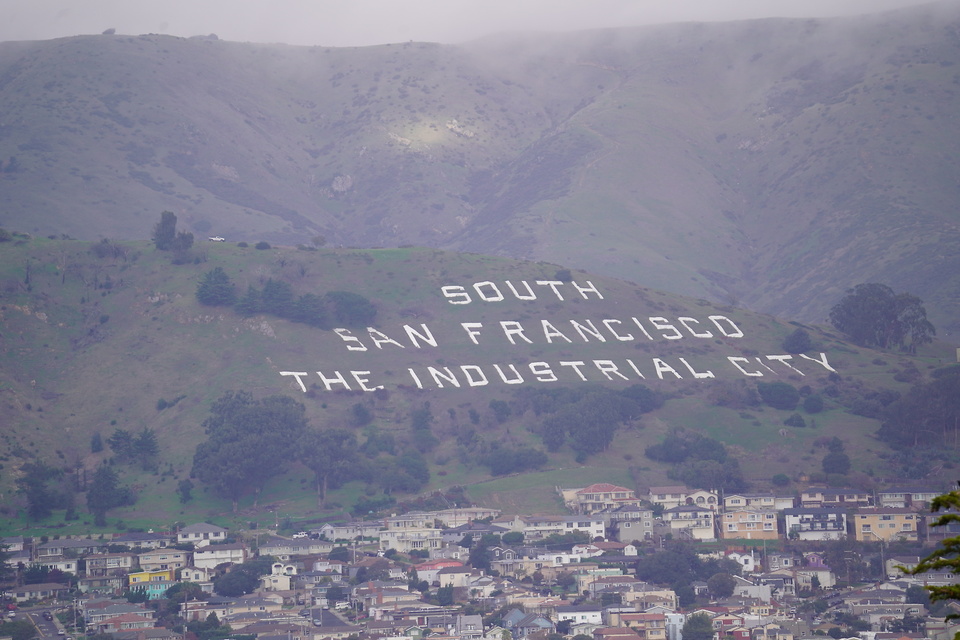
Well, in San Francisco we have (almost) something similar, namely the so called sign hill park with the letters South San Francisco The Industrial City You can see them well when you drive towards San Francisco from the airport on Freeway 101 heading north (Figure 12). I have often wondered what these letters look like up close and if there is a story behind them. And since my guiding principle these days is to simply carry out every silly idea that pops into my head in the morning, I recently drove there as a roving newsletter reporter and explored the situation.
To understand this, one must know that "South San Francisco" and "San Francisco" are two completely different cities, each with its own administration. Yes, the smaller sister city located 10 miles south of the original is not even located in San Francisco County, but belongs to San Mateo County, which extends further down into Silicon Valley.
To the history: The letters were carved into the hill in 1929 (after a temporary installation in 1923) at the urging of the Chamber of Commerce of the then-bustling small city of South San Francisco, which was thriving with steel industry, meat processing plants, and shipyards. The goal was likely to encourage the influx of additional business. Nowadays, the pharmaceutical giant Genentech is the most active employer there. The hill with the letters is part of the San Bruno Mountains, although "Mountains" is relative here, as the tiny hill is only 400 feet high.
The outlines of the letters were carved into the hill in 1929 and filled with white cement. The construction costs amounted to 5,000 dollars at the time. To ensure that the lettering could be easily read from a great distance, despite the slope of the hill, the project's engineer employed all sorts of geometric tricks. The letters are enormous, with the third row alone stretching almost 200 meters in width.
On Wikipedia you can find still more interesting details about the installation, for example, that in 1932 an additional electrically operated luminous beacon was installed, but it was turned off due to fear of air strikes during the then-raging Second World War--and it was never turned on again.
With Google Maps, you can easily find out exactly where the entrance to the "Sign Hill Park" is located. It's off a hidden residential street in South San Francisco. A circular trail about two miles long leads up the steep slope via stairs and to the summit plateau with a weather station, from where you can enjoy an impressive panoramic view in good weather, overlooking the San Francisco Bay and the suburbs of Silicon Valley.
Hikers can get very close to the letters if they deviate slightly from the marked path, but the slope is estimated to be 45 degrees steep and there is little to hold onto. Additionally, coyotes are prowling around. The whole thing is a rewarding excursion, especially for curious people like me.
Angelika In the last newsletter, I had already begun to outline some weaknesses in the American Constitution and the political system of the USA in general, which can lead to abuses of power in various degrees, depending on who is currently in charge. Trump tests the limits every day to see how far he can go. Next year, the so-called midterm elections will take place. During these elections, all 435 seats in the House of Representatives and 35 of the 100 Senate seats will be up for grabs. Traditionally, the sitting president receives a setback in these elections, meaning that the majorities usually shift, which makes governing more difficult if this shift is to his disadvantage. Trump is aware of this and is trying to take precautions, including through the political strategy of "gerrymandering".
But what exactly does gerrymandering mean? We have mentioned this tactic here and there before (Rundbrief 11/2006). Today, however, I would like to delve deeper. Partisan gerrymandering refers to the practice of drawing (or rather manipulating) electoral district boundaries in such a way that a particular party or candidate is clearly favored. The whole concept hinges on the fact that the election results of a district do not contribute proportionally to the overall outcome, but rather only one candidate wins the district: "Winner takes all."
In theory, electoral districts should be designed in such a way that different voter groups are fairly represented. Therefore, in the United States, after each census, which takes place every ten years, the drawing of district boundaries is adjusted to the current population data. Depending on the state, the responsibility for this lies either with independent commissions or with the legislatures. California is one of the states with an independent commission. However, in most states, the respective legislature decides, and you can imagine that the districts are then drawn according to partisan interests, in favor of the ruling party.
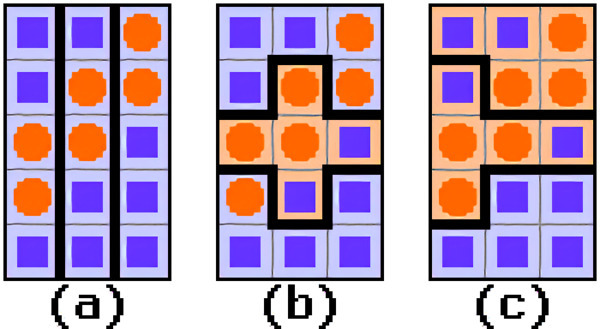
Two methods are particularly popular in gerrymandering: packing and cracking. Packing means "packing" as many voters of the opposing party as possible into a few electoral districts. While the opposition wins these districts with very large majorities, the votes are practically wasted because they are missing in other districts. Cracking is the opposite strategy: the voters of the opposing party are spread as widely as possible across many districts so that they cannot form a majority anywhere.
Here is an example that might make the whole thing clearer: An area with 100 voters is to be divided into 5 districts, each with 20 voters. 60 voters support Republicans, and 40 voters support Democrats. With a fair division, this would result in 3 Republican and 2 Democratic seats, corresponding exactly to the 60/40 ratio. Now, let's imagine the Republican Party controls the districting and wants to reduce the Democratic seats as much as possible by packing their voters into as few districts as possible. Therefore, in District 1, all 20 votes go to the Democratic Party and none to the Republican Party. The packed district thus goes 100% to the opposing party. However, these votes are now missing in the other districts and are thus wasted. In Districts 2, 3, 4, and 5, 12 votes go to the Republican Party, and accordingly, 8 go to the Democratic Party. Republicans win these districts with 60% each, as the "winner takes all" principle applies. This leads to the overall result that the Republican Party now gets 4 seats and the Democratic Party only one. In "cracking," the opposite strategy is applied, as already mentioned. In our example, all 5 districts then go 60% to the Republican Party, which thus receives 5 seats, but this no longer reflects the political landscape of the area.
It is common to redraw the electoral districts after a census (the last one took place in 2020). However, Trump is currently pursuing a strategy to encourage states controlled by Republicans, where the legislature determines the electoral districts, to redraw them in their favor before the midterm elections.
Perhaps you heard that a few weeks ago, Democratic representatives from Texas temporarily left their state to prevent a vote on new electoral districts in the Texas House of Representatives. However, Texas followed Trump's call and redrew some districts to likely secure five additional seats for the Republican Party in the congressional elections in November 2026. This has since been passed.
Our Californian Governor Gavin Newsom is now following suit and wants to also redefine the electoral districts in California. California is firmly in Democratic hands. Until now, the outline of electoral districts in California has been handled by an independent commission, but Newsom wants to temporarily transfer this responsibility back to the California State Assembly. A move that would benefit the Democratic Party. The logic behind this: California could send more Democrats to Congress and thereby counterbalance the approach taken by Texas. Ultimately, this does not solve the real problem, namely that gerrymandering is undemocratic and should be abolished. In deeply polarized times, however, it seems to be all about "an eye for an eye, and a tooth for a tooth."
Now you must know that in our state, the California Constitution actually guarantees the independence of district determination. It was a major concern of then-Governor Arnold Schwarzenegger to end gerrymandering in California. Through his initiative, two amendments were introduced into the California Constitution: Proposition 11 (in 2008) established a 14-member commission to determine the districts for the California legislature, and in 2010, this was extended to congressional districts through Proposition 20. Arnie, although a Republican, is a vehement critic of Trump and has recently spoken out again, as he is now also against Newsom's initiative. However, Newsom has prevailed, and now all California voters must vote in a special election this November on Proposition 50. If the voters agree, the California Constitution will be amended, and for the elections in 2026, 2028, and 2030, the districts will once again be determined by politicians. This week, the first election pamphlets have already arrived at our house.
Michael At the end of 2023, we'd heard rumors that the quintessential German driver's drink "Spezi" would make it to the USA. In reality, Spezi is nothing special, just cola with Fanta and a bit of lemon, but all the sweetness of youth is contained in these memories of bulbous 0.4-liter glasses of the brown drink, with a half slice of lemon floating on top.
Due to the lack of purchasing options, I had already tried mixing Spezi myself in the meantime (Rundbrief 11/2012). But nowadays, to be honest, I prefer drinking Coca-Cola. However, not the corn syrup sludge that's sold under the brand name here in America, but rather re-imported "Mexican Coke" at the exorbitant price of 2 dollars per bottle, which is still sweetened with cane sugar.
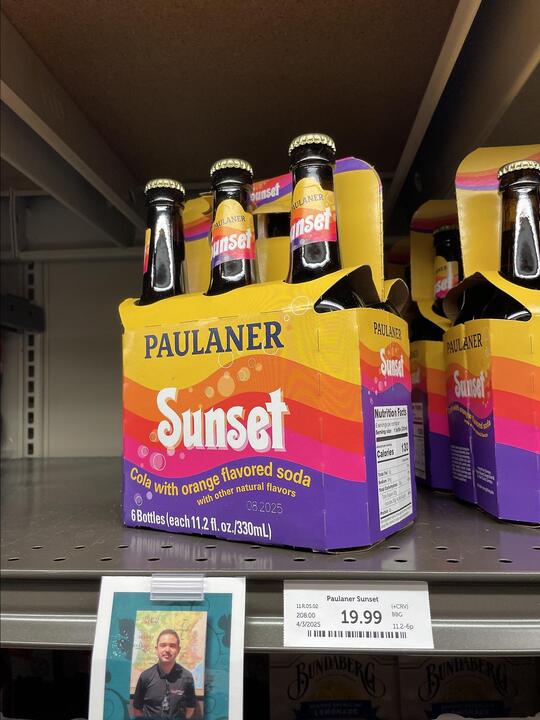
Now we are in the year 2025, and the rumor mentioned above has apparently become reality. Recently, I found a six-pack of 0.33-liter bottles of the Paulaner "Spezi," which has been renamed "Sunset," at the "Total Wine" beverage market for the astronomical price of $19.99. An employee of the beverage market vouched for the quality of the imported drink with a photo (illustration 21), so I, of course, reluctantly bought it.
The first impression was not overwhelming, as the drink is less sweetened than the aforementioned Mexican Coke. However, perhaps my palate has become too accustomed to the generally more heavily sweetened drinks here in the USA after all these years.
The fact that the drink is now called "Sunset" instead of "Spezi" is due to a legal dispute in which the Paulaner brewery, which distributes it, fell out with the Augsburg brewery Riegele. Paulaner, which now belongs to the conglomerates Schörghuber and Heineken, was not allowed to use the brand name registered by Riegele since 1956 and the typical Spezi eye logo on the bottle cap.
As I said, Mexican Coke, which is ultimately identical to the Coca-Cola sold in Germany, tastes better to me. Maybe I should throw a slice of lemon into the glass after all?
Michael Anyone who, like us, frequently stays overnight in foreign cities and books rental properties through Airbnb or Vrbo might know that while many of these apartments are in top condition and prime locations, they all suffer from the same issues.
I'm talking about the fact that in these vacation homes there are never enough coffee tables to put glasses and other things, and that there's nowhere to hang a towel or a piece of clothing.
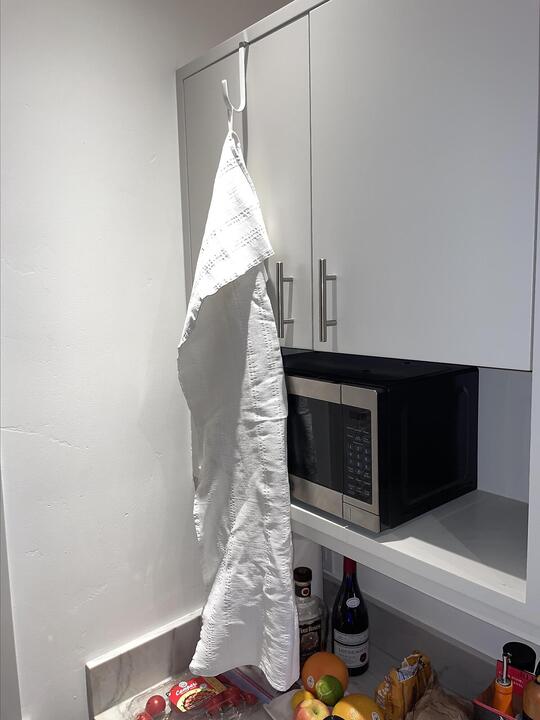
The latter problem is the systematic shortage of hooks. I don't know what your kitchen looks like, but in ours, hooks are drilled into the wall where kitchen towels hang. In the bathroom, hooks are drilled into the wall where bath towels hang. In vacation rentals rented out by amateurs, these things are missing for reasons unknown to me.
For this reason, I bought a set of four portable hooks on Amazon that can be hung over doors or other vertically positioned shapes. These hooks curve upward on the front side, inviting you to hang a piece of clothing or a towel. The set travels with us, and quickly turns any uncomfortable rental apartment into a comfy home.
Why do I now call the useful little helpers "Butzenhaken"? Well, when you have lived abroad for too long without linguistic feedback, like we have, you start to develop the German language uncontrollably, and eventually, a jumble like Texas German emerges, the dialect used by emigrated Germans in Texas. In my personal dialect, I refer to rented places, usually through Airbnb or other platforms, as 'Butze', following another exiled German named Roland. And "Haken" means "Hook", so Butzenhaken! Top product!
Michael The cowboy days, when a tough guy in dusty clothes, like Clint Eastwood, would enter a saloon and quietly say "Whiskey!", prompting a bottle and a glass to slide across the bar, and the tough guy would pour himself the whiskey, gulp it down, and grimace at the throat-burning taste, are definitely over.
Cocktail enthusiasts nowadays prefer palate-pleasing drinks, and to ensure that even affordable hard liquor tastes smooth and doesn't scratch the throat, "bitters" are added to whiskey, as is the case with the classic Old Fashioned cocktail. It is mixed from rye whiskey, sugar (!), water, and bitters, and served garnished with a lemon peel. Bar patrons most fittingly wear a suit from the Mad Men collection with it.
Bitters are tinctures with all sorts of exotic, bittersweet spice notes from plants that no one has ever heard of, like cascarilla (Caribbean), cassia cinnamon (southern China), and cinchona (South America). Gentian and orange peel are also said to play a role. I once bought a set of bitters on special offer at the discount supermarket Grocery Outlet, but since they tasted terrible, I had to give the bottles away. The bitters from Trader Joe's, on the other hand, are amazing. About 10 drops from the bottle, just like measuring homeopathic medicine, are enough to give even a less flavorful bourbon whiskey from the liquor store exotic notes. Top product! Of course, this only applies if you're not already pouring high-quality Scotch whiskies from the Scottish Highlands, where bitters would certainly be out of place.
Angelika I find it continually amazing that even after almost 30 years in San Francisco, we still discover new places. During the pandemic, we started taking daily walks around the city and surrounding areas. Although we no longer walk every day, we still do so regularly.
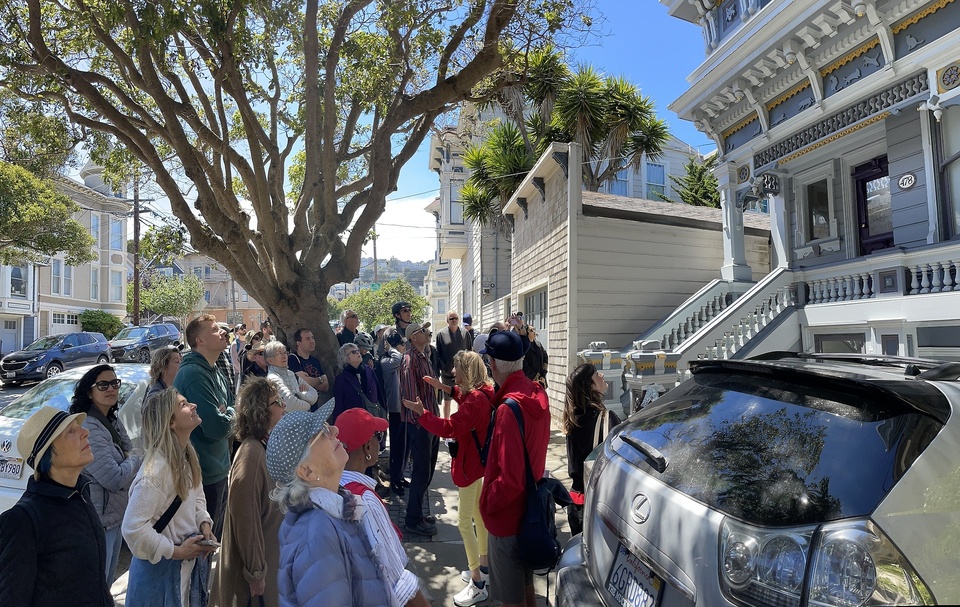
Recently, Michael found out that there is a City Guides tour in our neighborhood, Noe Valley. These Free tours are a great thing! Volunteers are leading tours through various neighborhoods of San Francisco with great enthusiasm. The tours are free, but donations are welcome. The idea goes back to librarian Gladys Hansen, who in 1976 sought volunteers to guide tours of San Francisco's City Hall. Since then, the program has greatly expanded and now includes numerous districts throughout the city. It is still under the patronage of the San Francisco Public Library where you can easily sign up -- and off you go.
The tours are not really aimed at tourists but especially at locals who want to get to know their city better. On a sunny Saturday, we took the tour through Noe Valley. It was well attended. Although we thought we already knew everything about our neighborhood, we learned a lot of new things. What fascinated me the most was that the Victorian houses, which so characterize our neighborhood and cost millions today, were originally built cost-effectively for the working class in the 19th century. They were often arranged like row houses to save space. One of the most significant builders was Fernando Nelson, who had many of these houses constructed in Noe Valley. Now I'm just waiting for Michael to volunteer for the City Guides.
Greetings from our city!
Angelika und Michael