
Angelika In the last newsletter, I had already begun to outline some weaknesses in the American Constitution and the political system of the USA in general, which can lead to abuses of power in various degrees, depending on who is currently in charge. Trump tests the limits every day to see how far he can go. Next year, the so-called midterm elections will take place. During these elections, all 435 seats in the House of Representatives and 35 of the 100 Senate seats will be up for grabs. Traditionally, the sitting president receives a setback in these elections, meaning that the majorities usually shift, which makes governing more difficult if this shift is to his disadvantage. Trump is aware of this and is trying to take precautions, including through the political strategy of "gerrymandering".
But what exactly does gerrymandering mean? We have mentioned this tactic here and there before (Rundbrief 11/2006). Today, however, I would like to delve deeper. Partisan gerrymandering refers to the practice of drawing (or rather manipulating) electoral district boundaries in such a way that a particular party or candidate is clearly favored. The whole concept hinges on the fact that the election results of a district do not contribute proportionally to the overall outcome, but rather only one candidate wins the district: "Winner takes all."
In theory, electoral districts should be designed in such a way that different voter groups are fairly represented. Therefore, in the United States, after each census, which takes place every ten years, the drawing of district boundaries is adjusted to the current population data. Depending on the state, the responsibility for this lies either with independent commissions or with the legislatures. California is one of the states with an independent commission. However, in most states, the respective legislature decides, and you can imagine that the districts are then drawn according to partisan interests, in favor of the ruling party.
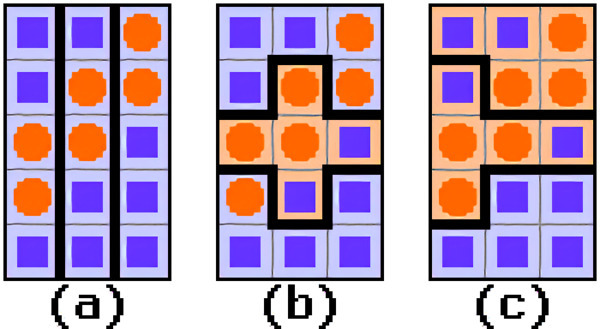
Two methods are particularly popular in gerrymandering: packing and cracking. Packing means "packing" as many voters of the opposing party as possible into a few electoral districts. While the opposition wins these districts with very large majorities, the votes are practically wasted because they are missing in other districts. Cracking is the opposite strategy: the voters of the opposing party are spread as widely as possible across many districts so that they cannot form a majority anywhere.
Here is an example that might make the whole thing clearer: An area with 100 voters is to be divided into 5 districts, each with 20 voters. 60 voters support Republicans, and 40 voters support Democrats. With a fair division, this would result in 3 Republican and 2 Democratic seats, corresponding exactly to the 60/40 ratio. Now, let's imagine the Republican Party controls the districting and wants to reduce the Democratic seats as much as possible by packing their voters into as few districts as possible. Therefore, in District 1, all 20 votes go to the Democratic Party and none to the Republican Party. The packed district thus goes 100% to the opposing party. However, these votes are now missing in the other districts and are thus wasted. In Districts 2, 3, 4, and 5, 12 votes go to the Republican Party, and accordingly, 8 go to the Democratic Party. Republicans win these districts with 60% each, as the "winner takes all" principle applies. This leads to the overall result that the Republican Party now gets 4 seats and the Democratic Party only one. In "cracking," the opposite strategy is applied, as already mentioned. In our example, all 5 districts then go 60% to the Republican Party, which thus receives 5 seats, but this no longer reflects the political landscape of the area.
It is common to redraw the electoral districts after a census (the last one took place in 2020). However, Trump is currently pursuing a strategy to encourage states controlled by Republicans, where the legislature determines the electoral districts, to redraw them in their favor before the midterm elections.
Perhaps you heard that a few weeks ago, Democratic representatives from Texas temporarily left their state to prevent a vote on new electoral districts in the Texas House of Representatives. However, Texas followed Trump's call and redrew some districts to likely secure five additional seats for the Republican Party in the congressional elections in November 2026. This has since been passed.
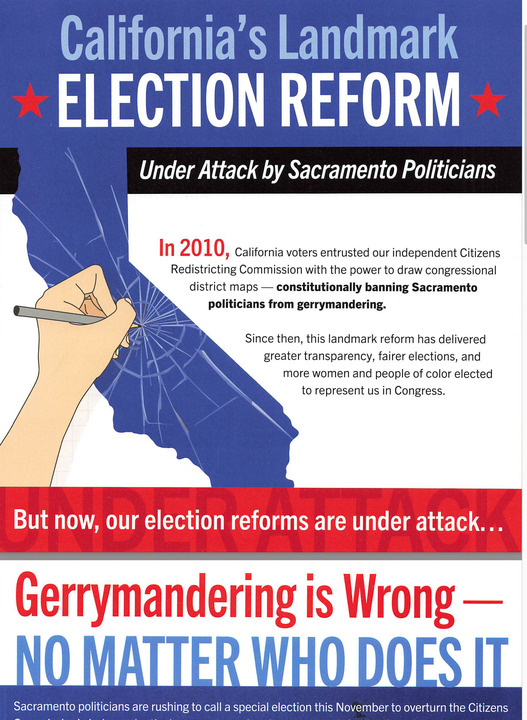
Our Californian Governor Gavin Newsom is now following suit and wants to also redefine the electoral districts in California. California is firmly in Democratic hands. Until now, the outline of electoral districts in California has been handled by an independent commission, but Newsom wants to temporarily transfer this responsibility back to the California State Assembly. A move that would benefit the Democratic Party. The logic behind this: California could send more Democrats to Congress and thereby counterbalance the approach taken by Texas. Ultimately, this does not solve the real problem, namely that gerrymandering is undemocratic and should be abolished. In deeply polarized times, however, it seems to be all about "an eye for an eye, and a tooth for a tooth."
Now you must know that in our state, the California Constitution actually guarantees the independence of district determination. It was a major concern of then-Governor Arnold Schwarzenegger to end gerrymandering in California. Through his initiative, two amendments were introduced into the California Constitution: Proposition 11 (in 2008) established a 14-member commission to determine the districts for the California legislature, and in 2010, this was extended to congressional districts through Proposition 20. Arnie, although a Republican, is a vehement critic of Trump and has recently spoken out again, as he is now also against Newsom's initiative. However, Newsom has prevailed, and now all California voters must vote in a special election this November on Proposition 50. If the voters agree, the California Constitution will be amended, and for the elections in 2026, 2028, and 2030, the districts will once again be determined by politicians. This week, the first election pamphlets have already arrived at our house.