![]() |
| Angelika/Mike Schilli |
Michael Even after ten years in the country, our map of America still has sporadic white spots: Los Angeles was one such location. L.A. is the quintessential American monster city: 3.8 million people live there, and 13 million people in the surrounding suburbs. Traffic is complete chaos, public transportation is practically non-existent, and without a car, you're stranded.
TODO
And in typical American fashion, we went there for a long holiday weekend: flew in on Friday evening, rented a car, drove to our accommodation, a fancy Bed & Breakfast. On Saturday morning, we grabbed bikes that were available there and rode along the beach to Venice Beach and further up, almost to Malibu.
It was noticeable that an unusually large number of cyclists were out and about on this beautiful weekend; who would have thought that of the American monster city! The beach was dominated by well-trained volleyball players, but completely ordinary people also enjoyed the day there, and on the basketball courts, a few daring-looking gangster rappers were hanging around!
The next day, in the morning, we went to the Getty Center, a museum complex of gigantic proportions built by the foundation of the industrialist J. Paul Getty. The site is located on a hill, and you take a dedicated train to get up there. Everything is architecturally styled down to the smallest detail. And the best part: there is no admission fee. However, if you park your car there (it's hard to get there without one), you pay 8 dollars.
We had gotten up early (on weekends before 11 a.m., the world belongs to you in America), but shortly after the highway exit, right in front of the museum, we got caught in a traffic jam reminiscent of Ikea. It took about 15 minutes, during which we moved forward about 500 meters, when suddenly, just before the museum, a brazen driver tried to cut in line in front of our Chevy Malibu! In such cases, I am steadfast and keep no more than a 3cm distance from the car in front. I also honked the horn for several seconds and signaled to the clown with "Shoo! Shoo!" gestures to get lost, which he did. It's unbelievable what some people dare to do, but not with me! The museum was quite nice, with a pretty good photo exhibition on the theme "Where we live" and the painting "Cross in the Mountains" by Caspar David Friedrich with the most ridiculous frame I have ever seen.
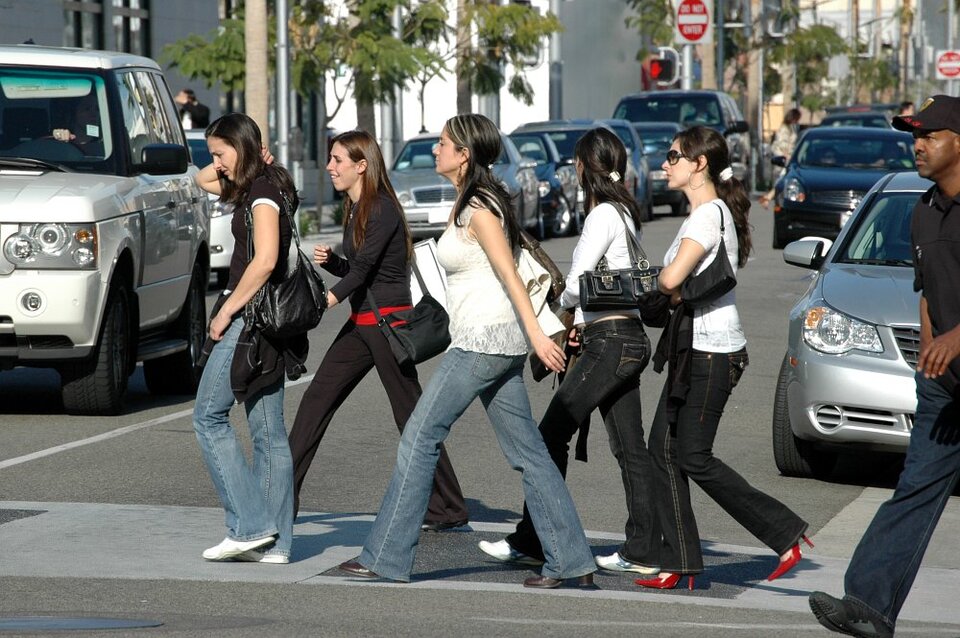
Right next to the hilly villa district in Beverly Hills is Rodeo Drive, a well-known shopping street for the super-rich. And indeed, money was flaunted there in a way you can't imagine, one Ferrari after another, Gucci, Dolce & Gabbana, Hermès, and endless bling.
We spent half an hour just watching people, it was quite a spectacle.
And what a cost it is! When you arrive by car, a guy at the entrance asks if you want to park directly in front of the park or if you'd prefer to walk 15 minutes through a commercial hell of fast-food restaurants and souvenir shops. The first option costs $20, the second $10. We chose the second option because we like commercial hells for research purposes. Once you've made it through the hell, the next shock comes: At the park entrance, the admission costs a whopping $61 per person!
Through gritted teeth, amidst screaming children and overwhelmed adults, you hand over the amount, and the guy in the ticket booth calmly asks if you'd like to buy an annual pass (No!), if you're sure (Yes!!), if you want a Front-of-The-Line pass ($99) so you don't have to queue anywhere (No!!!), and if an All-You-Can-Eat coupon might be worth it? (No!!!!).
Inside the park, you can either buy more souvenirs, eat fast food, attend one of the Disney-like shows, or ride themed roller coasters. We only wanted to do the studio tour, where you drive past various buildings labeled "Stage 23" with a tour vehicle and an entertainer, then later comes "Stage 24," and further back there's a gray concrete block labeled "Stage 25.
You drive through a Western setting, then the tour vehicle goes into a building, flames shoot up, the vehicle rocks back and forth, etc., quite well done. Then there's the replica of the great white shark to see, flames shoot up again as a gas station in the water (?) catches fire.
The television series "Desperate Housewives," which is quite popular in the USA, is also filmed on the premises. We drove through this street with the tour bus, and it looks just like a typical suburban street somewhere in America.
All in all: Quite nice if you need to kill some time before your flight home takes off, but I wouldn't go out of my way for it. However, it's something you should do, otherwise you might feel like you've missed out on something.
And according to experts, L.A. has better sushi restaurants than San Francisco. This is, of course, a bold claim, because in San Francisco there are not only a thousand sushi restaurants, but also some that serve at a very high level.
We were recommended "The Hump," a small sushi bar located right by the private jet area of the small Santa Monica Airport. According to the travel guide, celebrities like Dustin Hoffman are said to frequent this place, but during our visit, the only celebrities spotted were the two newsletter reporters.
In such establishments, there are dishes that even a good sushi connoisseur may not have seen before, so you simply sit at the bar and order "Omakase." The sushi chef then looks you in the eye, gauges how much money you might have, and begins to serve his specialties until you say stop. The menu does mention that the dishes served via Omakase can be quite expensive, but hey, that's what credit cards are for!
The dishes were also quite extraordinary, including a hairy giant crab (from the cold waters around Japan's northernmost island, Hokkaido) and foie gras with sake-marinated snapper. And the toro, a standard dish, was probably the best we've ever eaten.
But the bill, my goodness! It was immediately locked away in the editorial safe after the trip and will never be made public. Imagine an absurdly high restaurant bill, and then double the amount. Only once in a lifetime!
Angelika It's hard to believe, but one of its largest green oases, the... Presidio, San Francisco owes its existence to the military. Here's how it happened: When the Spanish settled the West Coast of the USA with missions in the 18th century to convert the Native Americans, they established not only churches but also military bases. Rundbrief 05/2000 In 1776, the Spanish soldiers founded the garrison "Presidio" (fortress) in what is now San Francisco. After Mexico's declaration of independence from Spain, it was under the Mexican flag until 1846, when the Americans took control.
With the end of the Cold War, the American Congress decided in 1989 to reduce military bases, and in 1994 the military finally withdrew from the Presidio. It left behind over 800 often historic buildings, a military cemetery, a cemetery for the soldiers' four-legged companions, as well as extensive green spaces and groves.
And since 1994, this entire northwestern tip of the city, which leads to the Golden Gate Bridge, has been under nature protection. As part of the Golden Gate National Recreational Area, it is managed by the National Park Service. Because the army occupied the area for so long, hungry real estate sharks had to stay out, and the billion-dollar land could not be sold. After all, the location is prime. Where else can you find such fantastic views of the Golden Gate Bridge and the Bay? The "Presidio" is a national park of a very special kind, because by the year 2013, it must sustain itself to avoid the risk of being sold. Therefore, in 1996, the so-called "Presidio Trust" was established to ensure that the park achieves financial independence from government funds. At the same time, the charming area is, of course, meant to retain its character.
Money is currently coming into the cash register primarily by renting out the buildings to private individuals for residential purposes and for commercial use. So if you plan to set up camp in San Francisco soon, you can rent an apartment or house on the Presidio grounds. However, some people claim that there are long waiting lists. Incidentally, George Lucas ("Star Wars") has also located his film studio on the premises.
If you ask me, the so-called "Crissy Field" is the highlight of the Presidio. Michael and I take walks here on many weekends. Behind "Crissy Field" are the former runways for military aircraft, which were located right by the bay.
The entire area was thus concreted over until 1998, when an extensive restoration project began to return the saltwater-fed marshland to its original state. Volunteers planted over 100,000 native plants, and the runways were transformed into a lagoon.
And since many travel guides are already writing about Crissy Field, I can confidently share my insider tip for San Francisco tourists: Hop on the Cable Car at Powell Street, which will take you to Fisherman's Wharf. Skip Fisherman's Wharf, it's a total tourist trap. Instead, turn left and walk along Aquatic Park, through Fort Mason and the Marina, to Crissy Field.
You always hike there along the water with a view of the Golden Gate Bridge. Pause at the "Warming Hut" cafe when it reopens in a few months. Unfortunately, there was a fire there a few weeks ago, which severely damaged the building. Then take the small trail that leads up to the Golden Gate Bridge when you reach the road to Fort Point. The truly ambitious can, of course, also make a detour to Fort Point. Wind your way up to the Golden Gate Bridge, walk across and back, and hop on a Muni bus at the southern viewpoint parking lot if you're tired and don't want to walk the same way back.
Angelika Michael had been nagging me for years to find a new job. He was probably tired of my complaining about one thing or another at work. Tenderloin ChildcareCenter The text appears to be in German, but there are some encoding issues with the characters. Here's a translation of the corrected text:
"Overwhelmed. It took a while for me to get going. But when almost half of the familiar staff in the Tenderloin left in August, I gave myself a push last September and started looking at job advertisements on..."
If you have more text or need further assistance, feel free to provide additional context! craigslist.org The German phrase "zu durchforsten" translates to "to comb through" or "to sift through" in English.
We have already mentioned that craigslist.org has become the first point of contact for looking for a new job, unless headhunters are beating down your door. Rundbrief 08/2004 My challenge was to find a somewhat interesting part-time job in the educational field, because they are even worse paid here than full-time jobs and you are often downgraded to menial tasks.
Michael, of course, didn't hold back with good advice and said that the first job applications and interviews were just for warming up anyway. No sooner said than done. The first application went to an organization that provides early intervention for autistic children of preschool age, and the second to a small private kindergarten (referred to here as "preschool").
The translation of "Bewerben auf amerikanische Art" to English is
"Applying the American way.
Applications in the USA do look somewhat different than in Germany. Michael always likes to emphasize that, under no circumstances, should the date of birth or a photo be included in an American application, in order to prevent discrimination based on skin color or age. Rundbrief 11/2004 ). In this country, marital status, place of birth, or religious affiliation have no place in a job application. However, we always state that we possess a Green Card and are therefore allowed to work in the USA without restrictions, as many employers emphasize in the job advertisement that having a U.S. work permit is an absolute requirement to apply for the position.
The potential candidate also does not send copies of diplomas or work certificates as attachments. Work certificates are a foreign concept here anyway. Michael had to fight at AOL just to get confirmation that he worked there from a certain time to another.
Everything in the USA operates through so-called references (recommendations), which are almost always obtained by phone. You already mention in the application that references are available if needed. In practice, it usually looks like this: the offer has already been made verbally, and then the employer picks up the phone. You yourself decide who should be called.
It makes sense to name colleagues or supervisors with whom you had a good working relationship. Three references are now common. For me, at least one of them had to be of a professional nature, and the personal ones could not be relatives. All listed individuals should have known me for three or more years. Additionally, the employer is allowed to gather information to verify what is stated in the application. For example, they may call the HR department of the previous company to ask if you actually worked there. The applicant usually permits this by filling out a form and signing it. This all sounds terribly complicated, but funnily enough, my new employer didn't call anyone. It was probably enough for them that I had diligently filled out a form with all the addresses, names, and phone numbers.
How does the employer know what responsibilities the job applicant had in their previous positions if no references are provided? The solution lies in the resume (called a "resume" in the USA). Under each job position, one lists the areas of responsibility in bullet points.
In my resume, you will also find information about the group size and the age of the children I have cared for. And what stands out when you study the resume? Correct! The last employer is listed first in the USA. Similarly, in an American resume, the highest and most recently obtained degree is listed first.
The primary or secondary school attended is not typically included. By the way, it's a matter of personal preference whether the resume lists education or work experience first. Many people start with the latter, especially if their university years or training were a long time ago.
In America, you also tailor your resume to the position. I usually never list the numerous internships I've done, but for the autism position, I naturally mentioned my time in the clinic for autistic children in Bremen. A cover letter is also part of a standard application in America. In it, the applicant should explain why they are particularly suited for the position and what attracts them to it.
By the way, there are exceptions to phone references. When applying for a degree program, three written letters of recommendation are usually required. Some time ago, I applied for an internship at the Museum of Modern Art in San Francisco. They also wanted the references in writing. I had one written by one of my former photography teachers, who actually wrote that I am a very intelligent person. I laughed so much, as such a sentence would be unthinkable in a German reference. But I digress. While phone interviews are common in the first step in Michael's industry, in my field, it involves an observation period to see the facility, plus an interview. In the private kindergarten, I was then supposed to do a paid trial work period and independently conduct a morning circle and an activity offer. However, it didn't come to that because I had already accepted a position at the facility for autistic children. There, I also observed a home-based intervention and was given some responsibility with the child.
In the "Live Scan," a method that has been common for a long time, fingerprints are no longer produced using ink. The individual fingertips are placed on a scanner, the fingerprints appear on the screen, and then they are swiftly sent electronically to the FBI.
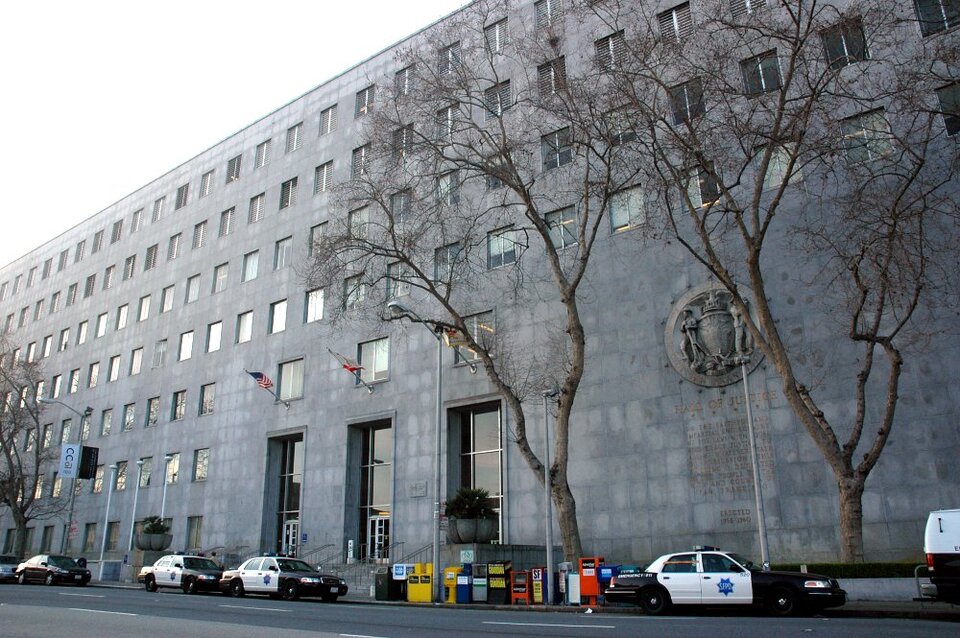
Since we had already had to provide our fingerprints for our Green Card, I didn't think anything of it when I was asked to go to the police station in the courthouse on Bryant Street this time. After all, I had called the 1-800 number for the company "Identix Identification Services" and made an appointment, as my new employer instructed me. So, in a good mood, I went through the security check at the courthouse one fine morning and made my way to the police station.
Upon arriving there, I looked a bit bewildered because I not only encountered a jungle of hanging signs but also a long counter behind which a somewhat grim-looking young man with many tattoos was collecting fines from those standing in line in front of the counter. To the right, people were sitting on various chairs in front of a door labeled "Fingerprinting." I was a bit shocked to see a homeless person curled up asleep next to the chairs, especially since I was in a police station. I really thought I had stumbled into a Hollywood production. Bravely, I asked one of the people waiting in line for fingerprinting if they knew where I should report if I had an appointment or if I should take a number from the well-known number dispenser, to which they replied that they didn't work there. Thanks, very helpful. So, I tried my luck with a uniformed police officer who emerged from one of the various doors. He explained that I needed to inform the man behind the counter with the fines. I found this a bit strange, but I did as instructed, and indeed, the aforementioned man came out from behind his counter, led me past the line of waiting people who gave me a few dirty looks, and opened the door by entering a code.
In a flash, I found myself in the hallowed halls of the police station. A vast room with filing cabinets, office plants, and the occasional clatter of typewriters (no joke!) spread out before me. I felt like I was in the crime series "Cagney & Lacey." A friendly Black woman greeted me and asked me to take a seat. She immediately informed me that it might take a while because the computer responsible for FBI matters had just crashed. So, she first attended to the nice-looking young man before me, who had to stand in front of a large gray wall for a photo and whom she kindly asked about his probation officer. Did I mention that above the employee's desk hung a sign with the words "Sex Crime Unit"? It certainly got me thinking.
In the meantime, the guy I had spoken to about the fingerprint procedures was banging like crazy on the window next to the door and shouting that he had been waiting forever. He was actually next in line and had to stand in front of the ominous wall for the photo. When the employee asked him for his place of birth and residence, it turned out that the man was homeless and had been living on the streets for over a decade. She then immediately followed up with the question: "What's your location?" (meaning his usual place of stay). He replied: "24th and Mission!" Ah yes, the subway station near our apartment. I would have loved to watch this spectacle for hours, but unfortunately, it was my turn, and everything went smoothly.
Angelika As I already mentioned, the institution I currently work for supports preschool-aged autistic children. Smart minds have found that the earlier and more intensive a support program is implemented, the better the chances for the autistic child. For those of you who are not educators, here is a quick summary of what autism is. The professional community understands autism as a severe early childhood developmental disorder that occurs before the age of three. Autistic children have difficulties with social interaction and both verbal and non-verbal communication.
Some autistic children do not speak at all or have a very limited vocabulary. Often, these children do not know how to use language to communicate. Additionally, autistic children show little interest in other people, avoid eye contact, and have difficulty accurately assessing the feelings of others and social situations. They often use toys in unconventional ways or in the same manner repeatedly. For example, the little boy I care for loves to spin objects, from wheels to plates. Many autistic children find it difficult to cope with changes. They often struggle with sensory disorders and therefore either self-stimulate or react particularly sensitively to certain stimuli.
Despite intensive research, the cause of autism has not been found to this day. There is consensus that it involves early developmental issues in the brain. Other scientists emphasize a genetic component, as autism occurs more frequently in some families (but not in all). Autism is found in all cultures and social classes. Boys are four times more likely to be affected than girls. Autism is one of the fastest-growing developmental disorders, and scholars naturally debate the reasons for this. One reason is certainly the strong media presence and improved diagnostic possibilities, but also the expansion of the diagnosis to milder cases. In America, experts now refer to "Autism Spectrum Disorder" because autism occurs in very different manifestations.
My employer has now set the goal of helping these children. There are two main focuses: intensive support in the home environment and assistance in group situations. I work with the child at home, from Monday to Friday, for three hours each day. I initially had some concerns that three hours might be too much and too long for a child not even three years old, as I was only familiar with early intervention conducted once a day for an hour, but the program is well thought out and works. Other children who are already in kindergarten-like facilities receive 1:1 support from our organization, meaning someone accompanies the child and helps them navigate group life. Home support often takes place additionally in the afternoon. We serve children aged between 2 and 4 1/2 years not only in San Francisco but throughout the Bay Area. The therapeutic approach is primarily behavioral but is supplemented by other methods. For example, we place great emphasis on a structured environment and visual aids like photos.
Now you might be wondering who pays for all of this. Surprisingly, in the social desert of America, these measures are actually funded by government resources. A law promoting children with disabilities makes this possible ("Individuals with Disabilities Education Act"), which I briefly explained in another newsletter. Rundbrief 05/1998 However, two different agencies are responsible depending on the age of the child. From 0-3 years, it is the so-called "Department of Developmental Services," and from three years onwards, the school authority takes over, which may work better or worse depending on where you live.Autismus
Michael It seems like your input is incomplete. Could you please provide the full text you would like translated into English? Rundbrief 12/2005 We have already reported that in some states in the USA, sex offenders are required by law to have their addresses listed on the internet. But even regular court records are publicly available, and "publicly" here in the USA truly means: accessible to anyone on the internet.
Let's take, for example, the courthouse of Santa Clara, a county in Silicon Valley. Under http://www.sccaseinfo.org The translation to English is: "You can see which cases have been tried there in the last few years. It's exciting to enter the names of colleagues and come across unexpected results!
Clicking on "Search By: Party & Casetype" allows you to simply enter a last name, and the cases being handled will appear. As already mentioned in... Rundbrief 05/2000 The text translates to:
"mentioned, Americans like to abbreviate their first names, so don't search for the Oracle mogul Larry Ellison, but for 'Lawrence J. Ellison' and not for the Apple bigwig Steve Jobs, but for 'Steven P. Jobs' and you will find that these not long ago a"
(Note: The sentence seems to be incomplete, so the translation reflects that.) Court proceedings with Plumbers & Pipefitters Local No. 572Pension Fund have delivered
By the way, it's no big deal; it's completely normal in the USA for attempts to be made to extract money from wealthy people or companies through lawsuits. That doesn't necessarily mean the claims are justified. But it's somewhat nice that the formula "All are equal before the law" is actually true, at least regarding the dissemination of information about the legal proceedings on the internet.
Netflix has a website where you can select DVDs like in a video rental store. Of course, Netflix has a few more DVDs, just like Amazon has more books. And just like Amazon, Netflix has a "recommendation engine," a computer program that suggests what you might want based on data from other people with similar ordering behavior. This way, you can create a long wish list that you then work through step by step. By the way, the selection is very good; practically all new movies are available. Only for very obscure art films are some video stores in San Francisco better stocked.
The selected DVD almost always arrives the next day, as a regular letter that the mail carrier drops into the mailbox along with the other mail. That's cleverly done, because the Netflix team has distribution centers spread across the entire country to prevent long waiting times.
The DVD can be kept for as long as you want. However, it would be foolish to dawdle, because if you send the DVD back in the same red envelope it arrived in, Netflix will send the next DVD on your wishlist the very next day!
Netflix offers different subscription plans, and I chose the following one: I pay Netflix $9.95 per month. For that, I receive one DVD at a time, but I can exchange it as often as I like.
I once calculated that you could get up to three DVDs per week this way: Tuesday, 1:00 PM: take the DVD out of the mailbox, watch it, send it back, run to the mailbox, it gets emptied at 5:00 PM. Netflix receives the DVD on Wednesday, sends the next one, which arrives on Thursday. Thursday, 1:00 PM: take the DVD out of the mailbox, watch it, send it back, run to the mailbox, it gets emptied at 5:00 PM. Netflix receives the DVD on Friday, sends the new one, which arrives on Saturday. Watch it, the mail is also picked up at 5:00 PM on Saturday, Netflix receives the DVD on Monday, sends the new one, which arrives on Tuesday. And the cycle begins again.
Sometimes, however, Netflix throws a wrench in the works. A DVD might be "unavailable" at a shipping center and then promptly sent across half the continent, which takes three days. I call this: "Shipped from Romania." This brings the whole well-oiled machine to a standstill. But they can't do this too often, because otherwise they'll get hit with a "Class Action Lawsuit," as happened some time ago. But all in all: Definitely recommendable.
As previously reported ( Rundbrief 09/2005 We once rented a little house in the countryside, and the owners there had a hummingbird feeder. It's a glass container that you fill with red sugar water, and the hummingbirds zoom over to it and sip the liquid from the openings.
I thought to myself that I could buy something like that for our balcony, so I went to "Target," a large supermarket chain. At first, I wandered aimlessly through the endless aisles, only to unexpectedly come across an entire shelf (!) of hummingbird supplies. I purchased a feeder and a large pack of the red sugary stuff, filled the glass container at home, and hung the whole thing on the balcony.
For weeks, nothing happened, but all of a sudden, we started receiving regular visits. I can hardly keep up with refilling, as the little devils eagerly devour my treats. Top product!
Michael Angelika gave me a small digital video camera for Christmas, and naturally, I immediately started experimenting with it. A small sample for those who have never seen me live is shown in the video below.
The text translates to: "ZinboomMncU|Michael reads from the Linux Magazine.
And my craft activities are now being recorded on video as well. Recently, I ordered a sewing machine from Amazon to finally trim and hang the curtain that we bought at Ikea more than a year ago (!). Video The translation to English is: "You can admire me as a brave little tailor.
And there is also an in-house production in documentary style to admire: A short report about surfers under the Golden Gate Bridge, my very first video piece with Angelika as the documentary aunt.
The Surfers under the Golden Gate Bridge
In the next episode: How I prepare a Wiener Schnitzel according to Alfons Schubeck's recipe and then fry it in the pan.
Bis denn!" translates to "See you then!" in English.
The translation of "Michael & Angelika" to English is "Michael & Angelika," as these are proper names and typically remain the same across languages.
Video-Wahn