
Processing Fee and Passport Stamp
Angelika Anyone who thinks that the immigration office immediately sent us the actual Green Card is greatly mistaken. That would be far too easy. First, a letter arrived at our home, stating that the application had been approved. In April 2002, our mail carrier delighted us with the aforementioned notice. Along with the joyful news, the letter instructed us to appear at the immigration office in San Francisco with two brand-new passport photos, our current passports, etc. The intent was to receive a stamp into our passports, which served as a temporary Green Card, and entitled us to work and travel.
On a Tuesday in April, we set out early in the morning, armed with thick jackets, all necessary documents, and reading material, to join the line at the immigration office in San Francisco. We had already heard that there are two lines in San Francisco: one for people with an appointment (e.g., for an interview) and the other for the unfortunate souls without one (which is notoriously long). Unfortunately, there was some confusion about which line we should join. The immigration office is located in San Francisco's "Financial District," specifically at the corner of Sansome and Washington Street--a huge building. To be seen early, we arrive at the INS building at 6:10 AM. The line for those without an appointment already winds around the block. No one is standing at the other entrance, where people with appointments are processed. Dutifully, we join the line behind about 80 people, grateful for our warm jackets as the wind is blowing quite briskly around the corner. Naturally, we immediately start asking the people standing in front of and behind us in line. In front of us is a married couple. He is American, and she is a foreigner in the process of obtaining a green card through marriage. They seem like pros to us, as this is not their first time in line. They assure us that we are in the right line. Behind us is a software engineer from India, who, like Michael, received the green card through an American employer, so he is in the same boat as we are. He is just as uncertain as we are about the line issue.
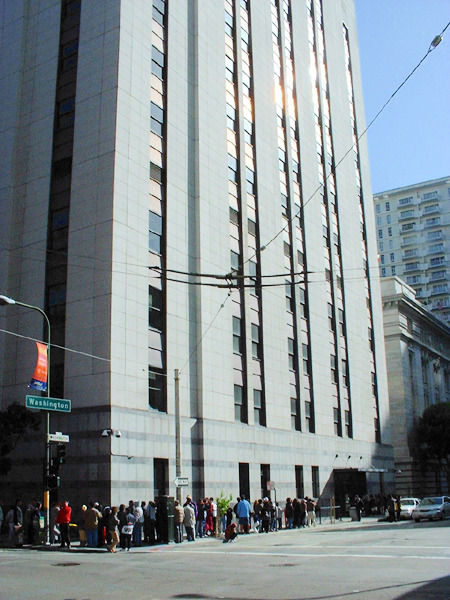
After 10 minutes, I decide to wander over to the other entrance, hoping to find someone competent who can solve the line puzzle for us, even though the doors for the general public are still closed (Did I mention that there are no signs anywhere providing guidance?). I encounter security personnel standing at the entrance. Patiently, I explain that the immigration office has approved our I-485 (people always throw around form abbreviations; it makes it seem like you know what you're talking about) and that we are here to get our stamp in our passport. Prompt response: "Do you have an appointment?" Somewhat desperate reply: "No, not really," because the letter we are holding does not specify a concrete date or time for our appearance. Expected response: "Then you have to line up with everyone else!" And just like that, I'm back in line next to Michael, which is steadily growing. While we wait patiently, I wonder why no one has thought of selling coffee and bagels (something like a roll with a hole) to those waiting. A real market gap. Behind our Indian fellow stands another Indian compatriot with his family and child--everyone must appear in person at the INS. Once again, the line problem arises, someone else wanders to the other entrance, asks the questions I had already asked, and returns with the same answer. Slowly, our skepticism fades, and we begin to believe that we are indeed in the right line.
At 6:45 AM, the crowd of people starts to stir. The doors open. About 10 people are allowed into the building at a time. Everyone must show identification, bags are scanned, and you go through the metal detector. The line moves at a snail's pace because there is only one metal detector and one scanning machine. Hooray, at 7:30 AM, we enter the hallowed halls. The security personnel confiscate Michael's digital camera (don't worry, he got it back when we left the building), and we navigate through a maze of barriers, eventually reaching three counters. We hand our papers to the man behind the counter. He initially looks a bit confused but then wants to direct us to the next counter, where there apparently are waiting numbers. Suddenly, another INS officer (apparently a supervisor) next to him intervenes and informs him that we could go directly to office 200-B, as our positive notice is equivalent to an appointment. You can guess what that means: we had been standing in the wrong line. After a few quiet sighs, we make our way through the maze of corridors and stand in front of office door 200-B. It is now 7:50 AM. A sign on the office door instructs us to drop the letter indicating our appointment through the designated slot in the door. The only problem: we don't have a set appointment. By now, many people are sitting in the waiting area--some with appointments, some without--and the discussion begins about what those without a fixed appointment should drop in the slot, because how else will the responsible officers know that we are waiting outside the door? The only option is to drop the original (!) of the positive notice we are holding. However, many are distressed about this because the notice is the only proof that the immigration office approved the Green Card application. Naturally, Michael makes silly jokes about a shredder being behind the slot, destroying all the papers.
Shortly before 8 o'clock, a female officer slips out of one of the back doors, and although there are signs everywhere with the inscription "NO QUESTIONS, NO INFORMATION," I bravely approach her to find out what we are supposed to drop into the slot. At first, she remains silent, but after I look at her desperately, she shows her generous side -- the official notice is to be dropped in. At 8 o'clock, the office door opens, and INS officers call the first people in for interviews, just like in the movie "Green Card." Those waiting not only have family photo albums ready to prove, for example, that the marriage to an American citizen truly exists, but they also usually have a lawyer in tow. If you apply for a Green Card with the help of an employer, the interview is generally waived, as was the case with us.
At 8:05, another officer directs all individuals who already have a positive Green Card notice (including us) to the waiting area of another counter and begins his work. At 8:30, he calls us up. We hand over our passports and photos, a fingerprint from a single finger is taken twice (this time with ink), and we sign a designated form twice. The fingerprint, signature, and photo will later appear on the actual Green Card. The officer also confirms our address, to which the Green Card should be sent, and then we take a seat in the waiting area again. By the way, it's better not to move between residences until the Green Card arrives in the mailbox, as the postal service is not allowed to forward Green Cards to a different address. Although there is an option to notify the immigration authorities of an address change, based on our experiences, we wouldn't dream of taking that risk--who knows where the notifications might end up at.
At 9:30 AM, another officer calls us. She holds our passports in her hands, shows us the stamp that serves as a temporary Green Card and is valid for one year (with the possibility of extension after the year expires). She also informs us that the actual Green Card will arrive in six to twelve months. Michael later claims that the red stamp looks like a potato print, which is true. Our names are handwritten under the stamp, which is a bit disappointing after all the waiting. At 9:40 AM, we leave the building beaming with joy and go for a royal breakfast to celebrate the day before Michael heads to the office.