
San Francisco, September 18, 2001
Even a week after the terrorist attacks, America remains in a state of shock. Unfortunately, the voices calling for revenge, retribution, and the harshest military action as an appropriate response to terrorist violence are growing louder. San Francisco is trying to return to normalcy. As early as last Wednesday, all city and state buildings reopened their doors. Schools and universities were only closed for one day. Baseball games are being played again, concerts are taking place, and people are going to work. The highways are as congested as ever during rush hour. However, a closer look reveals that the impact of the catastrophe runs deep. Although New York and Washington are miles away, the tragedy affects many in San Francisco and the surrounding area quite directly. A participant in one of my photography courses lost two of his friends who worked in the World Trade Center. Some of Michael's colleagues are still stuck in Dulles, the AOL headquarters. They were on a business trip to the East Coast last Tuesday and are now patiently waiting for American air traffic to return to normal.
Even in the liberal stronghold of San Francisco, you can see American flags waving everywhere. They meet us at every turn: in store windows, on residential buildings, and on car antennas.
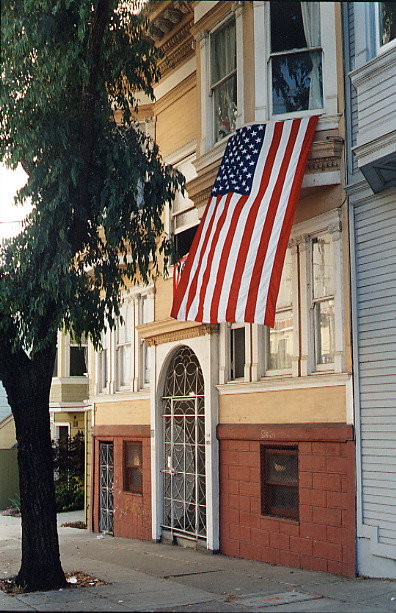
Many people attach red, white, and blue ribbons to their sweaters or jackets. Americans generally approach their national flag with a sense of ease and lack of criticism. Even in normal times, public buildings are often draped in the Stars and Stripes, and the flag can be found in many front yards, not just on holidays. However, this defiantly displayed nationalism is not comfortable for everyone. For example, I am strongly reminded of the dark times in Germany when flags were waved aggressively. America now wants to present a united front, and being a patriot is the order of the day. A real estate agent in our neighborhood, who leans Republican (referring to the American party) and is not shy about publicly sharing his beliefs, is urging residents to display the flag with signs in his shop window.

Even in San Francisco, which is considered tolerant, there is an increase in verbal and physical assaults on Muslim, Palestinian, or Arab fellow citizens (often referred to here as "Arab American"). In the Mission District (a neighborhood in San Francisco), for example, an unknown person threw a blood-filled bag at the entrance of an Islamic facility. Just as frequently as we see the American flag, we now encounter yellow posters in our neighborhood, hanging in shop windows and private residences, declaring the neighborhood a "hate-free zone."

Although it is true that, according to surveys, about 90% of the American population considers military retaliation for the terrorist attacks to be justified, we know many Americans here who do not belong to these 90% and are extremely concerned about how the USA will respond. Congresswoman Barbara Lee (Democratic Party) is, for me, also part of this other America that is focused on prudence. She was the only representative to vote against military retaliation (420 to 1 vote). She expressed concern that a hasty military response could have unforeseeable consequences and easily spiral out of control. Incidentally, Barbara Lee represents the cities of Berkeley and Oakland; both are located on the opposite side of the bay from San Francisco.
Unfortunately, President Bush often lacks this prudence. This can be seen, above all, in his choice of words in recent days. For example, he spoke of "smoking out the terrorists from their holes" or "wanting Osama bin Laden dead or alive." While these statements resonate with a large part of the American population, they cause significant damage on a diplomatic level.
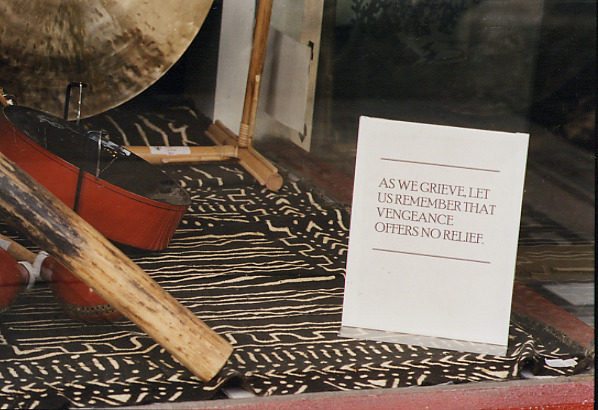
Nervousness is spreading alongside grief in San Francisco, as no one knows what else is to come. The absence of tourists and empty restaurants also speak volumes. We are still far from a normal everyday life.